Listen on Apple Podcasts | Listen on Spotify | Watch on YouTube
Host: Michelle Rowan, President and COO of Franchise Business Review
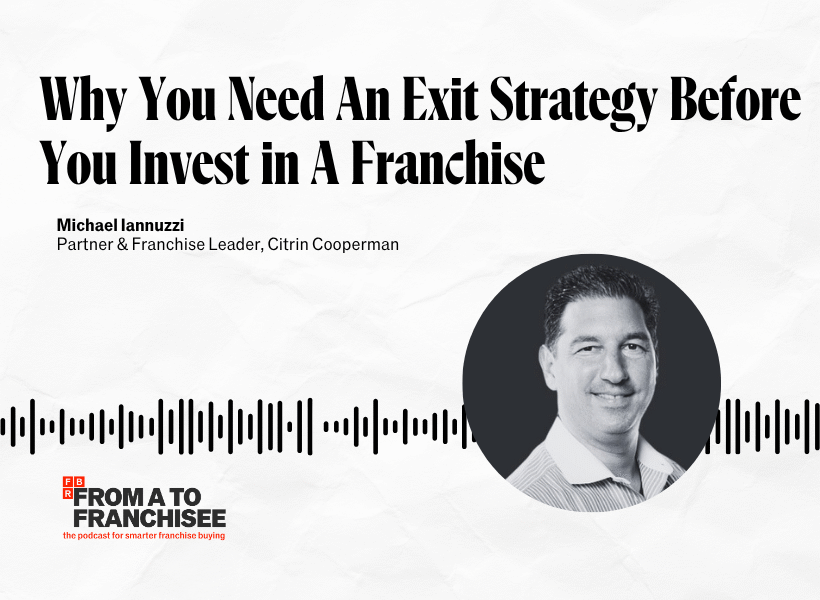
Guest: Michael Iannuzzi, Partner – Franchise Practice Leader at Citrin Cooperman
Episode Summary for Consider a Franchise Exit Strategy Before Investing
In this podcast episode, Michelle Rowan discusses the importance of having an exit strategy in franchising with guest Michael Iannuzzi, a partner at Citrin Cooperman. They emphasize that it’s never too early to plan your exit strategy, as it helps avoid future surprises and aligns with personal and business goals. Michael explains key concepts like the franchisor’s right of first refusal and the importance of having a well-organized data room for potential buyers. They also explore common exit strategies, such as selling to private equity, internal resales, and transitioning to family members or key employees. The conversation highlights the need for franchisees to engage with their franchisors early and often about exit plans, and to understand the realistic value of their business. Michael advises potential franchisees to thoroughly research and engage with the franchise community to make informed decisions.
Resources
- Understanding the Franchise Disclosure Document – Episode 9
- How Much Money Can You Make Owning A Franchise – Episode 14
- Top Considerations for Transferring a Franchise Business
- Do You Need a Franchise Lawyer?
Transcript
Michelle Rowan (00:03)
Welcome back to our podcast from A to franchisee. And today we’re talking about the importance of an exit strategy in franchising. And we are intentionally talking about this before you even get into business. Today, I welcome Michael Iannuzzi to the podcast. Michael’s a partner and leader of Citroen-Couperman’s franchise accounting and consulting practice. The firm provides audit and accounting.
business consulting and advisory, and tax planning services to a wide spectrum of clients within the franchise community. Michael works with franchisors and multi-unit franchisees in a variety of industries, including fitness and athletic centers, children entertainment services, such as recreational youth programs and party providers, junk removal companies, mobile concepts, pet hotels, quick service restaurants, and grocery stores.
And we’re here to talk about something that probably surprises you if you haven’t started your business yet, but it is important that we start talking about how you get out. So my first question, Michael, thank you so much for being here.
Michael (01:04)
Well, no,
thank you for having me. I’m glad we got this all worked out.
Michelle Rowan (01:10)
Yeah, yeah.
And so I think we’ve already kind of alluded to this. But my first question is, is it ever too early to think about your exit strategy? Yeah.
Michael (01:17)
Well, you pretty much teed it up.
The question is no, it is never too early to think about your exit strategy. And the reason is you just never know what’s going to happen in the future. So franchisees that are getting ready to get into this, you don’t know what their life goal is until they start talking about it. So do they want their kids involved? Do they want their other family members involved? Are they buying this specifically because they want to exit?
in the future? they buying this specifically because they want their kids to have something to do? So these are all considerations that people need to think about and there’s no reason not to think about this from the beginning. And plus in the franchise business, gotta remember the franchisor has right of first refusal on a lot of things in the future. So the more you plan, the more you avoid surprises, you know, later on in the future. And so, you know, plan from the beginning and then every
year to years, you should reevaluate that plan as to what’s happening in the business and what’s happening in your own personal life.
Michelle Rowan (02:21)
Okay, so you have brought up good things there because I was gonna say you can always change your exit strategy plan, but having a roadmap I think is good. But I do wanna stop you because you said right of first refusal. And some people are tuning into the podcast for the first time and might not understand that term. Can you explain just very briefly how you would explain that term to a franchisee that hasn’t read an FDD or understood that agreement yet?
Michael (02:29)
Correct.
Mm-hmm.
Sure, yeah, so one of the things I would advise immediately is that for any new franchisees coming into this business, they definitely should link up with a highly qualified franchise attorney to go through the FDD and the franchise agreement. In the franchise agreement, there’ll be certain clauses about how you can transfer your unit in the future. Certain fees have to be paid, like transfer fees. There are also clauses in there about right of first refusal, where the franchisor may not
approve of the person that you want to transfer the franchise to in the future and that could be your family. You know, it could be a brother or a sister or your kids and so you may want to go do that two or three years down the road and the franchise or may say, ⁓ we don’t want that person as a franchisee and we’re going to make you look for another buyer. So this is all part of the plan, all things to think about and consider before you start signing legally binding documents.
Michelle Rowan (03:43)
Perfect. Yeah. So, and the reason that that clause is there is because the franchisor’s rule is to protect the brand standard. So, if they are talking to your potential successor and they don’t feel that it’s someone that ⁓ fits the culture of the brand or ⁓ has the business acumen to run the business, they could say no. So, that’s right. Okay. So, I also want to tackle the idea that…
Michael (04:04)
they could deny you, yep.
Michelle Rowan (04:11)
I feel like we, you know, we talk to franchisors more now. I’m assuming you do as well that it’s important for them to have conversations with their franchisees to understand these exit plans well in advance. Typically we’re looking at franchise agreements that are 10 years. Year nine is not the time to start talking about this with your franchisor. And I also want franchisees and people thinking about franchising to understand.
Michael (04:25)
Yeah. Right. Right.
Michelle Rowan (04:33)
Your franchisor is not gonna think that you’re ready to bolt if you start having these conversations early and talking to them about what your plans are. And they might be even able to help you find a buyer. So actually, let’s stop, Michael. What are some common ways that franchisors exit their business? Why don’t we start there? You mentioned family members, that’s one way.
Michael (04:54)
So yeah, mean, private equity is the hot topic. It’s been the hot topic for the last probably, I would say, five or so years. And this is on all three stools of the franchise community, franchisors, franchisees, and suppliers, which is like you and I, we’re in the supplier side. So that’s a very common type of transaction and exit plan that’s been going on these last number of years. And that could be, again, franchisor, franchisee. But you have to be ready for that.
They want certain sizes when they’re looking for, when private equity is looking to enter into a transaction. So I would say that’s one typical, know, typical thing to think about. Other things are rolling up in the system. So if this is a large system, you know, you may look to exit to a larger multi-unit franchisee that’s looking to, you’re looking to exit, they’re looking to expand. And so sometimes internal resales are a very strong way to go because most likely that
Michelle Rowan (05:36)
Yes.
Michael (05:51)
large multi-unit franchisees already pre-approved by the franchisor to continue acquiring. It stays within the brand, within the system, and it’s an easier kind of transaction, because you’re just moving from franchisee to franchisee. So that’s common too, and the good systems do that a lot internally. Those units don’t even come to market. Other franchisees are buying them before they come to market.
Michelle Rowan (06:16)
Yep, okay. Some other ones I think that you didn’t say. So a lot of franchise brands now are part of platform brands. So they have sister brands. So there could be a franchisee and another brand within your network or without that might be interested in adding your business, your service, your product that you offer to their portfolio. That’s one. Another one would be…
Michael (06:23)
platform.
Absolutely.
Michelle Rowan (06:38)
a key employee that they have on staff that they’re helping create an exit strategy that allows their their employee to become the new business owner. ⁓ So I think that those are probably the main ones. But the idea is, yeah, it can change, but have an eye on that target of why you’re doing this and how you want to get out and ⁓ talk about it with your your franchise or the corporate team, your field coach, like just constantly talk about it because it will help you build awareness that
Michael (06:50)
Those are the big ones.
Alright.
Michelle Rowan (07:07)
your timing and that you’re ready to exit and you can kind of raise that signal and make that finding that buyer easier. ⁓ Okay, so Michael, let’s talk about some ways that a franchisee can really prepare for that exit. So this is now like not, I’m just signing and I’m 10 years out, but as you start thinking about your exit strategy, how do they get ready for sale to get the best possible sales price or transition that they could hope for?
Michael (07:33)
Sure, yeah, lots of different things here and this could be a whole different session that could last an hour just talking about this, but some very general things are when franchisees are getting ready just to do their basic accounting and their books and records, there’s so many different ways to do accounting. There’s cash basis, accrual basis, tax basis, hybrid methods. So getting the books and records in order from day one is crucial. Putting your data room,
together where you have all your signed leases, you have your any addendums that you may have signed to the franchise agreement, all your ⁓ corporate filings, banking information, having that data room put together and constantly updated as you’re growing is very important because that’s one of the first things they’re going to ask you when you get started. Okay, show me your financials, show me your data room, show me your franchise agreements. And if you’re kind of running around scrambling to put that together.
The buyer’s already lost some faith that either you’re not running the business the right way or you just don’t have a handle on what’s going on. Yeah.
Michelle Rowan (08:39)
Yeah, or you’re not ready. Yeah, yeah, those are
good tips. Okay, so we talked about the franchisor has right of refusal. What other ways do franchisor or the corporate team get involved in helping that transition to ⁓ to the next owner?
Michael (08:54)
Yeah, so some of the more mature systems, and you mentioned this earlier, Michelle, they’ll be either field consultants or business coaches. So the good ones that have these in place, when they’re meeting with the franchisees on a semi-annual basis at a minimum, they’re having these types of discussions with them, asking them what their plans are, how they think they’re gonna grow, what they’re looking to do. And so as you’re going through your franchise agreement, especially if you’re brick and mortar, there’s leases.
that are involved here. once you’re getting to six, seven years into your franchise agreement, you have leases coming up, your franchise agreement needs to be, you know, start to be renewed. So you need to have these conversations a couple of years out. And so the field consultants and the franchisor, they’re starting to coach you on these types of things. Like, you looking to renew? Do you want more units? Your lease is going to expire before the franchise agreement expires. You know, how are you planning for that? So…
The earlier you start, the more communication you have, the better off you’re going to be in the end.
Michelle Rowan (09:56)
So do you think if the lease agreement doesn’t line up with ⁓ the date that you want to transition, is it better to be locked into a lease or to have that coming up soon? Do you think that there’s a benefit either way to a business owner? Yeah.
Michael (10:10)
I think that’s a tough tough question to answer
because it’s market market conditions. It’s do you love do you really love the location? If that’s happening, you know that’s happening. So that’s not a surprise, right? It’s not like all of a sudden your your lease term change and you know, it’s expiring. So if you know you’ve set yourself up that way from the beginning, you know, a year or two years out minimum is when you need to start addressing that situation. It can’t be three, four months before the lease expires or the franchise agreement expires.
you have to start addressing that a couple of years out to plan in case the landlord doesn’t want to approve you for whatever reason. You have to start thinking about moving. So you need a year or two out minimum to plan for that type of scenario.
Michelle Rowan (10:47)
Yeah.
Yeah, I agree with that. I have another question for you and we didn’t talk about this before, so I’m gonna throw this at you on the fly. I feel like I hear a lot of times from franchisors that franchisees don’t have a realistic number of what their business is worth. Do you feel like there’s any recommendations we can give to people to have a really realistic sense of what they have for value in their business and what they should be selling it?
Michael (11:00)
Okay.
Yeah, so there’s a couple of things to do to kind of figure out that value, but just from an overall perspective, know, when buyers are looking to buy the business, they want to pay for kind of what’s going on now and maybe build in some sort of future, you know, run rate projection. So where the disconnect comes in is, well, I’m projecting my business in three years from now to do X. OK, but nobody’s really going to pay for three years later. They’re looking to see
Michelle Rowan (11:50)
Yeah.
Michael (11:51)
what they can pay for now and then what their money will do to get you to that three-year plan. So that’s where the big disconnect comes in a lot. But if you’re preparing and doing things like calculation of value, those are reports that you can prepare that are not that expensive and it gives you the down and dirty comparable value of what your unit is worth to other units that are in the system. And that starts to give you some ammunition for when you get ready to go to market. Because again, you don’t want to go to market
not knowing anything about the business and the value. You need some, you need like ace up in your sleeve to kinda get ready to do this. This way, nobody’s pushing back on you and you have no basis to push back on the buyer.
Michelle Rowan (12:34)
Yeah. Well, and I was going to ask, I don’t think they are, but I’m going to ask you if you’ve seen this, I don’t think franchisors are very transparent with what other franchisees have sold their business for. Some franchisors are better about sharing what we’ll call a report card or scorecard across their system. So you can see, ⁓ sometimes it’s top line revenue, sometimes it’s different metrics of how transparent franchisors will get, but
Michael (12:52)
Okay.
Michelle Rowan (13:02)
The idea is the more information you have into other franchisees business, you kind of know where you fall in line in a rank order of sales or profitability. I think that can help give people an idea of where am I in that system rank as far as success. And the other thing I was gonna say is your FDD, if you don’t have a really involved community with franchisees, you should always kind of know what’s happening with your franchisee community and if people are selling.
or have sold recently, reach out to them and ask them what questions. Yeah, they might not always share a lot of detail, but I think it’s a good place to start. If you’re in a franchise system that doesn’t give you really good access to the franchise community, the people that have exited the system are listed in the FDD. So your franchisor is updating that FDD every year and you can see who’s exited. So you could reach out to them that way and try and get a sense of even just, you get what you were hoping for? Did you get what you’re asking for? If they’re not willing to share numbers, but I think those are some
Michael (13:29)
Yeah.
Absolutely. Yeah.
All right. All right.
Absolutely.
Yeah, and the broker networks are out there, you sometimes they publish information like that or you can see what recently, you know, recently traded do some simple Google searches, Chad GBT type searches to see, what public information is out there on certain transactions.
Michelle Rowan (13:59)
Yeah.
That’s what I was gonna ask if you had other ideas.
So that’s perfect. So yeah, so trying to get a sense of what other businesses like yours have sold for. And even it doesn’t even have to be in your network. You could try and find that out from businesses similar to yours in your region would be another way just to make sure you’re not thinking you’re gonna get 10 million from this transaction. And it’s really gonna be like 3 million. That’s a big letdown. ⁓ Okay.
Michael (14:27)
Sure. Sure.
Right, right, right.
Michelle Rowan (14:38)
What other thoughts do you have, Michael? What advice would you give to candidates or people that are interested in franchising? And it can be specific to succession planning or just in general, what advice do you have to this audience on how to find out if a franchise is a good fit for them or what advice would you give them as they’re researching franchises before they pull trigger and sign that very big document?
Michael (15:00)
Yeah, mean, you know, there’s so much there’s almost information overload, but there is so much information that is that is out there these days that if you’re not reading through all the different websites that are out there, if you’re not pulling competitor, FDDs, if you’re not, you know, listening to things like this, or doing your own talking to every single franchisee that you can talk to that’s listed in the FDD, I think you’re really doing yourself a disservice not to
Not to do that, the information is there. ⁓ Included in the FDD are the financial statements. A lot of people kind of glaze over that as well. So you should be looking at the financial statements that the franchisor is putting out, asking them certain questions about it. How are you gonna support me in the future? ⁓ Sold but not open is a big one. So if you’re going through the item 20 and you see a big backlog, could be okay. But it’s a good question for you to ask, why is this the
big backlog, how long does it take to get these people open, where do I fall in that category if I sign this agreement. So those are the types of things that come to mind. But between all the educational content out there, the conferences, the webinars, the franchise community, as you know, Michelle is very kind of tight and we put a lot of content out. So I think there’s a lot of information out there that you can get your hands on and educate yourself on.
Michelle Rowan (16:24)
Yeah, think so you brought up the first one. I think no one else has talked about this is the idea of getting your hands on competitor FDDs. It’s a that’s a great piece of advice. If they are franchising and one of the registration states, which we’ve discussed in past episodes, you can get that on the Internet. And that’s that’s a great point, which I don’t think we’ve talked about that before. ⁓ How about.
Michael (16:32)
Sure. Sure.
Yep.
Michelle Rowan (16:47)
What kinds of content do you guys have on the Citrin Cooperman? Obviously they can work with your team to do more of this and get more, but what kind of content do you have on your site that people not working with you yet could get their hands on to get a sense of the kinds of things that you’re doing or things that would help them in their business planning?
Michael (17:04)
Yeah, we have a lot of things like taxes, because that’s always a popular topic. was the new tax bill that was passed a couple of months ago. So all that education content around the one big, beautiful tax bill is up on our website. ⁓ Podcasts that were done, webinars that we’ve done, that’s all linked on our website. Other things that maybe could be value-add as you grow your system.
Michelle Rowan (17:08)
Yeah.
Michael (17:29)
different types of software you may want to look at, different technology platforms. So our website has a lot of that information curated on our franchise page and then on our main company website that does lot more than just franchising. Yeah.
Michelle Rowan (17:42)
That’s awesome. And
I actually was on the webinar that you did around the one big, beautiful tax bill. So that was really, really great education for just a business owner. I own a business with my husband. To understand it was a very big tax bill. So I think that that was a great kind of breakdown of it. Yeah.
Michael (17:46)
Have a good one.
Yeah, and it’s very unique. It’s like
individualized type of stuff. So, you you and I may own the same type of business, Michelle, but you may have it in one entity. I may have it in another and our answers could be different because of the entity type.
Michelle Rowan (18:08)
Yes, yes. Yep, yep. That’s great. Yeah.
So I’m glad I asked about that. ⁓ And then I have one other question. If you could buy or if you had to buy a franchise, what industry would you consider? I’m not saying you would buy. I don’t want you to offend any customers, but what intrigues you?
Michael (18:18)
Stop.
I do get asked this question a lot. I like things with subscription revenue and reoccurring revenue because at least you have some sort of idea going into the next year what you think you can do. That’s something that’s because that’s kind of like the accounting business as well. If we do a good job and we take care of our clients, the hope is that they’ll return.
Michelle Rowan (18:33)
Yes!
Michael (18:54)
next year because they need annual audits, annual tax compliance, so we can kind of project a little bit we’re looking at. So things like that I like, you know, health and wellness, ⁓ mobile type concepts, you know, there’s a lot out there that I kind of I’m intrigued about to see what like, yeah.
Michelle Rowan (19:09)
Yeah, well, and the subscription model too, when you
go to sell your business, that is something that buyers really, really like. So that’s another reason to look at it. Awesome.
Michael (19:14)
Yes. Yes. And
what I would say for the non-subscription ones, you have a lot of data in-house, based on your customer feedback, customers that you’ve taken care of. There may be other things that you can offer those customers that maybe are kind of outside the daily routine. It could be some type of product or supplement or even just merchandise that you can offer that customer base that maybe is a one-time type customer, but they like you.
that happy with your service and maybe there’s something else that you can do for them or you can link up with other types of businesses that you can share that client. Maybe you get a referral fee in return. So lots of things to do even with the one time customers.
Michelle Rowan (19:57)
Yeah, that’s great. Yeah,
and I think we have talked about this in other episodes and just that I think one of the underutilized parts of franchising is that franchisees don’t connect with other franchisees in their local market to do a lot of that kind of cross promotion or my customer might be a good customer for you. So that’s a great thing to point out to. Awesome.
Michael (20:09)
Absolutely, yes Yes
Yep, for sure, for sure.
And then not out in the market enough. So get into your community, go to your local chamber events, any networking groups that you can join, be known in your community.
Michelle Rowan (20:20)
Yeah, always.
Absolutely. Yeah. Don’t, don’t rely on the franchisor to bring you your business and, and you have to keep those people coming back to your business. So yeah, get out there. Awesome. Well, Michael, I’m so glad you were able to join us. Thank you for getting people to think about the importance of this from day one, to have some kind of plan on how they’re going to exit. It’s great.
Michael (20:32)
Yeah.
Correct. Correct. All right. Yes, yes.
Michelle, thank you as always. It’s much appreciated. Thanks, you too.
Michelle Rowan (20:49)
Yeah, have a great rest of your day.