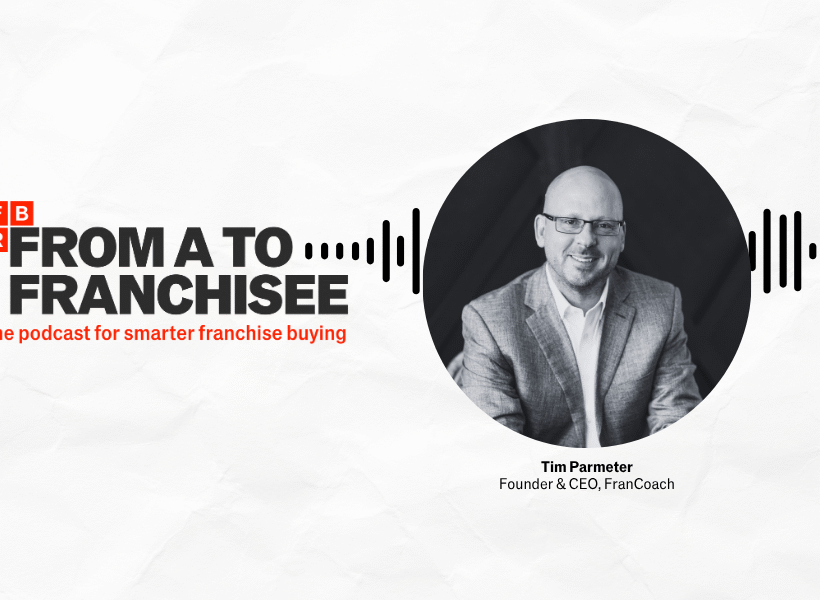
Michelle talks to FranCoach CEO and Founder, Tim Parmeter, a franchise broker, to get to the bottom of what role they play.
Listen on Apple Podcasts | Listen on Spotify | Watch on YouTube
Host: Michelle Rowan, President of Franchise Business Review
Guest: Tim Parmeter, Founder and CEO of FranCoach
Summary
Unlock the secrets to successful franchise ownership with insights from Tim Parmeter, a seasoned franchise broker at FranCoach. This episode reveals how working with a franchise consultant can be your shortcut to finding the right franchise fit. Tim demystifies the role of brokers, explaining how they’re compensated and how they vet both brands and candidates.
Learn to spot red flags like pushy sales tactics and misleading earnings claims. Tim shares how to decode franchise disclosures and ask the right questions to avoid common pitfalls such as rushing into the wrong opportunity. He outlines the process from initial conversations to deep-dive vetting and financial profiling, ensuring candidates align with brands that match their passions and financial goals.
Ideal for anyone considering franchise ownership, this episode offers practical advice to make confident decisions. Tim’s 12 years of experience and nearly 1,000 placements provide a foundation of real success stories, emphasizing integrity and relationship-building.
If you’re overwhelmed by options or wary of shiny object syndrome, Tim’s insights could be your game-changer. Start making informed choices today and find your best franchise fit faster.
Resources
- Read: The Most Important Aspects of an FDD
- Listen: Understanding the Franchise Disclosure Document
- The Franchising 101 Podcast
- Read: The Pros and Cons of Working With A Franchise Broker
- Read: Do You Need A Franchise Lawyer?
- Read: What Do You Need To Start A Franchise? Your Due Diligence Checklist
Transcript
Michelle Rowan (00:05)
All right, we are back on our podcast from A to franchisee. And today we are going to talk about franchise brokers. We’re going to pull back the curtain on this part of the franchise industry that a lot of people might hear about, but don’t fully understand. So they’re sometimes called franchise consultants, sometimes called brokers. And so if you have ever wondered what the heck does a franchise broker do? Are they salespeople? Does it cost you money to work with them?
What’s the process like? This is the right episode for you. Today we are joined by Tim Parmeter, a franchise broker with FranCoach, who works directly with candidates that are exploring franchise ownership. Tim, thank you so much for being here.
Tim Parmeter (00:50)
Michelle, it’s my pleasure. Good to see you.
Michelle Rowan (00:51)
Well, and I should say too, I’ve been a guest on your podcast. So why don’t you share your podcast with our listeners as well so they can find you.
Tim Parmeter (01:00)
Well, if you’re gonna force me to, will do so. Yeah, so Franchising 101 is the podcast which you can find only on like 12 different podcast platforms and our YouTube channel. So we’re a little bit of everywhere.
Michelle Rowan (01:02)
Yes.
Awesome, good. So let’s start at the very beginning. Let’s assume somebody just happened to find this podcast, they’re new to franchising. What is a franchise broker? How would you describe the role of a franchise broker as simply as you can?
Tim Parmeter (01:28)
Yeah, no, and you said the term you’ll hear.
broker, consultant, coach, advisor, whatever, we are the dudes and dudettes that are going to help educate you on franchise ownership to first, like, is it even for you? Because as you know, Michelle, most people, they don’t have the foggiest idea what franchising is really all about with that. So it’s kind of the education piece first, but then it’s really kind of that matchmaker of what’s the absolute best franchise for each person to own? ⁓ And then that’s the simple
simple
version and then it’s a very long process but our services are 100 % free. So we are, which always throws people off like, whoa, whoa, whoa. Yes, yes, we’re awesome human beings. We love doing things but we don’t actually work for free. We’re kind of like a recruiter in the corporate world. We get compensated on the backend by the franchise ours.
Michelle Rowan (02:20)
Awesome, and so that is one of the things that I love to talk about is that ⁓ franchisors, do they have to disclose when they’re working with brokers?
Tim Parmeter (02:31)
Do the franchisors, ⁓ no, I don’t think so.
Michelle Rowan (02:34)
Okay, so that’s always what I like to just put out there is you can’t tell which brands are or are not working with brokers, but they basically say, hey, Tim, if you find candidates that are right for us and they sign with us, we’re going to pay you for the work you do. That’s the arrangement that you have, correct? Okay.
Tim Parmeter (02:52)
Correct. Yes. And
franchise or some franchisers will like that is their strategy for finding franchise owners and they work with every single one of us. Others a little bit more selective as to kind of which which which groups that they they they work with. ⁓ And then there’s probably the majority of the franchises don’t work with folks like us at all. ⁓ It’s just it’s just kind of everybody’s got a different strategy on where they are finding their next best franchisees.
Michelle Rowan (03:21)
yeah, so some franchisors will have an internal sales team, some will have an external sales team, which is called a franchise sales organization, and some will work with brokers and consultants, or a combination of all of those. So that’s how they’re spreading the word about their opportunity. Awesome.
Tim Parmeter (03:37)
Yeah,
yeah. And correct. And you said the words for three little letters that’s ⁓ kind of like I like you talked about before we came out. Hey, is anything going to offend me? And I said no, except for if you refer to us as FSOs. We are decidedly not a franchise sales organization. So because that.
Michelle Rowan (03:55)
So Tim has feelings
about FSOs and we’re going to get into them.
Tim Parmeter (03:59)
I have strong ones on that, depends on where we want to go with it. yeah, so a franchise sales organization is essentially, so here’s franchise X.
Michelle Rowan (04:03)
Okay, I’m driving down.
Tim Parmeter (04:08)
Maybe they’re not big enough, usually not big enough to have an internal franchise development team or even person. So they outsource that, right. ⁓ And which can make a lot of sense. It’s just you got to be pretty careful as to which one of those groups that you work with. So but they are really and truly they are a franchise that they are selling that franchise for us, the broker consultant. We don’t care which franchise.
our clients become owners of, right? So whereas if you’re working for a franchise, you care very definitely that they start your franchise when they’re the right fit. For us, we’re really for our client to help figure out which is the best thing for them out there.
Michelle Rowan (04:53)
So we’re going to talk more about this, but I want to start with Tim, what is your background? How did you end up starting Fran Coach and doing this broker and consultant work? Where did you come from?
Tim Parmeter (05:03)
Yeah, so I think like most everybody in franchising, I got into it based on dumb luck. So if I go kind of probably like three little buckets, but I was, I grew up.
was an athlete, played sports in college. I taught and I coached for a while. So it’s kind of how my brain still operates is that educator coach person. And then I got in the corporate world and that my last job ended spectacularly ⁓ in the person I worked for committed a bunch of fraud and our whole office got shut down. And so then you’re like.
Michelle Rowan (05:34)
oof
Tim Parmeter (05:36)
⁓ now what? And I was in a weird situation in my life. had a young child. We were trying to figure out co-parenting and all of that stuff. And I’m like, I need freedom and flexibility. And I literally just stumbled onto somebody was doing this and they’re like, Hey, I’ll kind of show you around a little bit. And like, ⁓ okay. And I just literally, it was kind of desperation. I didn’t know anything about franchising. I just had education coaching and recruiting background
Michelle Rowan (05:56)
and them.
Tim Parmeter (06:06)
and just enough maybe like lack of awareness or ego or something like, I can totally do this and just put my head down and started it 12 years ago, literally all by myself. And it’s been the absolute best thing I’ve ever done.
Michelle Rowan (06:21)
Wow.
Tim Parmeter (06:27)
professionally, personally, as you know, like I literally met my wife in this industry and has created a fantastic lifestyle for and we have a strange lifestyle as far as how we we how we exist and how we live. And it’s just been the absolute best thing. And then I’ve been fortunate enough to kind of build a team with Fran Coach where we are all the way to 20, 20 coaches on our team and a support team of another 10. So it’s been been pretty cool to see the ability to help our clients.
Michelle Rowan (06:50)
Wow.
Tim Parmeter (06:57)
which is, you know, is the most amazing thing. And once people get in, just, they never, they never leave. They may move around a little bit, they’re in this, this, this crazy world for forever.
Michelle Rowan (07:07)
Yeah, right.
Yeah. Tim, do you know how many people that you have helped place into franchises? many you guys have helped find their niche in franchising? Just curious.
Tim Parmeter (07:18)
my gosh.
⁓ Yeah, think
we’re like getting actually for overall our team we’re getting really close to the to the big 1000 mark ⁓ with this. So yeah, no, it’s pretty cool
Michelle Rowan (07:29)
That’s awesome.
All right, so you’ve helped a thousand people get into franchising and probably just as many decide franchising is not for them.
Tim Parmeter (07:40)
way more, right? And so, but it’s no, it’s funny, I will tell people for our process, because we’re so education driven with our team is when they get to that point, and they’re like, hey, this isn’t for me. The first words out of my mouth, it’s always congratulations. And it kind of will throw them off a little bit. like, our goal is to figure out if this was for you or not. We did it. And I would rather them know it’s not for them now, then try to like, you
Michelle Rowan (07:42)
Yes, yeah, that’s great.
Tim Parmeter (08:10)
Let me let me keep shoving you along and get you into something that’s I mean literally has potential to ruin their life right like kind of need to have a conscience in this in this game a little bit to to do that but it really is most people should not own a franchise and that’s okay but if at the very least we help them learn about it because it is not ever what people think it really is
Michelle Rowan (08:17)
Yeah, yeah.
Yeah, that’s true. There’s so much ⁓ unawareness and misconception, I think, in franchising. Okay, so someone reaches out to you. What does that first conversation look at? What kind of questions are you asking them or what’s that process? I want to kind of demystify it so they don’t feel like I’m picking up the phone and reaching out and I’m just going to get this hard sell because I know that that’s not what the process is like. So what are you doing at first with your candidates?
Tim Parmeter (08:57)
Yeah.
No, absolutely. I think the ⁓ part of why I’ve enjoyed this so much is that like I’m horrible at sales and I would never ever survive in a sales role. I can’t ask people for money. just like it’s it’s a horrible thing for me, ⁓ but I can build relationships with with with people. so whether it’s us or anybody, if you’re having that first conversation, if you ever are talking to a broker, consultant, coach, whatever, and it feels salesy and they’re
pushy, like hang up and don’t talk to them because they are not there for your interest. And so the first call really should be for us, it’d be like, you know, kind of like getting to know Michelle, like, basically, why are you even on the phone with me and try to understand your career trajectory and usually
I mean, we talk to smart, successful people that have been usually running a chunk of somebody else’s business. They’re a little stuck, frustrated, kind of wishing for more. So there’s some pain there. So you kind of want to understand that. ⁓ But just it’s really pretty basic. And we kind of explain what our process is. And it’s for it should be always mutual. I’m like, if we I learned a little bit about you, you learned a little bit about us. It’s kind of almost kind of dating, right? Almost like, hey, would you like to learn more? If so,
Michelle Rowan (10:11)
Yeah.
Tim Parmeter (10:14)
This is what we do. we are ours is very much a kind of a hand holding process with them of here’s what’s next. You want to do it. Let’s do it. If not, that’s that’s OK as well. But it’s a first conversation with us is maybe 20 minutes is really it. And just kind of quick little get to know you get to know us. Is this worth like if there’s any sort of curiosity, let’s learn a little bit more and see where this takes us.
Michelle Rowan (10:39)
Awesome. Okay. So that doesn’t sound scary at all. All right. My next question is how early in this process are you having them or are you financially qualifying them? We really educate people that it’s important for them to know what they can afford pretty early on. And I’m just wondering when do you get into those conversations with them and how much do you help them figure out what they can really ⁓ do as far as investment?
Tim Parmeter (11:04)
Yeah, no. it’s it’s ⁓ sometimes it does even pop up on the first call somebody that may be really heavy in their mind or some of the misconceptions of franchising are like, it takes millions of dollars and it’s McDonald’s. And well, yes, McDonald’s does take millions of dollars. But there’s I mean, the vast majority of things are way on the other end of the spectrum. So sometimes it’s just that education piece. But we’ll go from first call. There’s a kind of a profile. We’ll have people fill out our second call with people we block like it’s an hour long and we’re
just, it’s always tell people this, we’re going to figure out what you want to be when you grow up, right. And so that profile and that deeper call is a little bit of financial stuff of just understanding the basics. so I quit it a lot of times to buy in a house, right? Like, if you can figure out what you are capable of, that’s that’s our ceiling. capable of doesn’t mean comfortable with, right, but we understand that. so understanding those basics of just, hey, you are going to be in this range, right, to get
and buying a house like, I want that new mega mansion on the on beach.
good for you, but we’re gonna go over here in this little subdivision and shop for houses right now, right? And so same thing with this. And then as we progress through the process, it’s then getting them, there are companies out there that all they do is funding for franchises. And so being able to know which of those funding partners is the best one to get them to, again, there’s so many like analogies with this of buying a house from a financial standpoint, but we all understand like, you here’s our realtor, we drive around,
we look at houses, we get pre-qualified. A lot of it is the same thing. We’re kind of almost the realtor in that scenario. ⁓ And the realtor knows where you go over here to my mortgage guy, right? We’re kind of doing the same thing with that. And again, it’s all all of that kind of looking and educating stuff is free for people. It just takes a little bit of time.
Michelle Rowan (12:45)
Yeah.
Yeah, I love that. so once you’re kind of identifying what their pain is or what their goals are, how many brands do you typically introduce them to or start with when you start having these conversations? And not even just the number of brands, but the number of segments. Like if they’re really not focused, what do you start with?
Tim Parmeter (13:17)
Yeah.
So a couple of things to that is one is, is, is we back up to for us. And again, if we’re really focused on our client, we are digging much deeper into them saying, Hey, I’ve always done this. Therefore I should do that in the franchise. Cause in the corporate world, once you get in an industry, you can really get kind of pigeonholed in there and in franchise. And as you know, franchises don’t, they don’t care about your industry background. Right? I always joke with people. You could be the biggest slob on the planet and own a cleaning franchise.
They don’t care. They need you to run the business not clean ⁓ and so we will we’re really kind of dive deeper and get them to open up to things but usually for us it is three maybe four franchises at the most we’re gonna start them with
And like one per category, right? So if somebody was really like, I’d really love something, you know, from, you know, fitness. I like, OK, well, good. Here’s three fitness franchises. That’s incredibly lazy. ⁓ And it’s not helping people kind of expand their knowledge because, again, almost every time the franchise people start, it is something that they have no experience in. It’s something that was they hadn’t thought of. And oftentimes it’s a brand they didn’t even know existed.
And so if we’re lazy on our side, you’ve always been in automotive and you like cars, here’s an automotive franchise, right? Like, and that’s all we show you is lazy because almost always it’s something else. And so if we can start them with three or four, doesn’t mean those are the only three or four franchises we look at.
though if we’re doing our job, it probably is, but it gets them a starting point and lets them see different ways to like kind of achieve their goal and really kind of open up their mind to the fact of where you felt like, why you felt you stuck in your career is because you weren’t doing the things that you really wanted to do every day. That day in a life is so critical. The people you’re around, even how you connect with the franchise, all of that stuff matters so much more than whatever’s on your resume
or your LinkedIn profile, which let’s be honest, those are usually somewhere between fiction and science fiction, right? And so this is a chance for people to kind of blank slate of like, what do really want to get up and go do every day? Because that’s what’s going to drive drive your happiness. This the learning a new industry, if you’ve always been on automotive and all of a sudden now we’re doing like, I don’t know, you know, like, we’re we’re, electric electrical franchise, right? Like
You don’t need to be the electrician. You just need to understand. I like working with skilled labor. I like, you know, being the hero of the story because we’re helping people. Those type of things are the drivers to it. And so that’s why we try to be really targeted with three, maybe four and always have, you know, well kind of identify three or four categories that align financially in the fit and all of those things and then get them started with that and just start learning with the brands.
Michelle Rowan (16:22)
Okay. So what is that? What does that look like when they say, okay, I’m interested in these three? How much of the education comes from you versus how do you introduce them to the brand and how are you involved in how they’re, how much they’re learning about that brand?
Tim Parmeter (16:37)
Yeah, so again, the we’ll take people through, I it’s really kind of three steps before we do the research and introduce them to franchises. So if it’s done properly, there’s really a lot of kind of time and effort into getting to know like, okay, all the things about Michelle and the things that you think are important, but also some things that you didn’t realize, right? And then once we introduce them to the franchises,
that vetting process with the brands, it’s intense, it’s thorough, right? It can take a couple months. There’ll be a dozen or more steps along the way until we ever get there. And I think one thing that’s a little misconception is, ⁓ you know, the franchise is just trying to sell me. Well,
Sort of but not completely like they are selling the virtues of their brand, but they are also truly vetting you. They should be vetting you to make sure you are the right fit for them. So again, it’s kind of that dating component of, know, I can I can sit here all day long and you know, look, hey, I want to I want to I want to marry Danielle and I want to propose to her, but we ain’t getting married until she says yes. Right. And so it should be that same thing with the franchise and and you.
Michelle Rowan (17:29)
That’s right, the good ones, the good
Tim Parmeter (17:51)
as the candidate. our role again, if we’re doing our job as the broker, consultant, coach, we we’re really very hands on with them during that process of vetting the franchises because it’s overwhelming, right? Like people can think, give me more than that. Like I’m telling you, if you were starting with more than three or four, your head’s going to explode from all the information you’ve got, even the three brands. You’ve got three brands taking you through an entirely different process because there’s no
Michelle Rowan (18:05)
Right.
Tim Parmeter (18:21)
uniformity through their vetting process. One day I will become czar franchising and I will wave a magic wand and everybody will have like, they’ll, they’ll be some uniformity on that. But until that magic happens, that and sometimes for us, it’s just very simply like, almost being a project manager of like, no, no, you talked to this one about that and know this franchise that was that was Bob, this one is Sally, right and and helping them.
just make sure they’re getting all the right information or they’re not missing anything along the way. Cause it is nobody wants to think they’re going to get overwhelmed. I’m too cool. I’m too smart. I’m too awesome. I’m going to get overwhelmed. You will get overwhelmed starting to talk to three or four franchises for us. Again, we’re not an advocate for any of the brands. We’re here for you to make sure that you are finding your best fit. And that’s even assuming you should ultimately own a franchise because again, just because you start looking at a brand,
mean you’re you’re committed we’re just kind of again we’re just kind of dating them they’re dating they dating you we’re here like was the old movie hitch we’re like your dating coach along the way with with that
Michelle Rowan (19:31)
Nice.
Yeah. So you’re not on the calls with them with the brands, but you’re kind of checking in with them between each of those spots. Is that, is that traditional words? Okay.
Tim Parmeter (19:39)
Correct, correct, yeah.
And I always say, one, ⁓ we don’t belong on that call. They’re supposed to be building that relationship with it. And two, frankly, I don’t have enough time for that. again, I think if I’m on that call, Michelle, you’re my client and you’re talking to Franchise X, and I’m sitting on that call, that’s like…
Again, that’s like a third, it’s like I just set you up on a date and I’m just sitting there, right? Like staring at you guys back and forth. You need to be able to build that relationship back and forth with it. Right. So.
Michelle Rowan (20:08)
Yeah, it’s little creepy. Yeah.
But you can kind of ask them questions to figure out, did they get at the things that they should be or advise them on other things that they might want to check into. And I think it’s also important to talk about, you are working with specific brands. So you’re learning about the brand, you know the people in these brands. So…
⁓ It’s not like you’re randomly picking brands out of different segments to put in front of them. You’ve done your research or you’ve worked with other candidates through these brands. So I think that’s important to note too that ⁓ franchising is a small community in that it is very relationship driven. So my guess is that
Tim Parmeter (20:46)
Yep.
Michelle Rowan (20:54)
Tim puts brands in front of you that Tim likes these people, likes this model, has done some kind of vetting because you’ve looked at a lot of franchise brands. You kind of know what those red flags, green flags are on brands. Okay.
Tim Parmeter (21:04)
Yeah.
Yeah,
it’s but I will tell you it’s tricky sometimes for us. Like I always have to kind of remove myself from the equation. Like I’m not owning it. Right. And but understanding and I think even the con we talk a lot about for our team about contrast with brands of the I might show you Michelle a brand that’s part of neighborly, which is the largest home service provider in the world. They are massive. Right. And
Michelle Rowan (21:16)
Yep.
Tim Parmeter (21:35)
Show you that but then I’m going to show you another brand in a different industry. That’s maybe a more emerging brand, right? ⁓ And then there’s kind of something to me. It’s always like the three bears, right? And so somewhere in there you’re going to go.
you’re going to sit there and be talking to neighborly and go, ⁓ my gosh, this is amazing. I love all the support and and you know, like I just like this warm security blanket. Well, the next person may look at that something in neighborly and go, that’s too big. Like I like this one over here that’s a little bit smaller. You know, I’m talking directly to the founder all the time. Right. And so nobody really can figure that out. Like we could ask that question all day long and nobody’s going to know how to answer it until we do that. Or even how their process
goes. This one is incredibly meticulous. There’s one brand in particular I always joke like they’ve got a spreadsheet for the spreadsheets, right? And they’re so ch ch ch ch. And again, somebody might just go, my gosh, this is perfect. And they’re talking about pivot tables and all this stuff in the spreadsheet because they’re so and then the next person’s like,
No, no, I want something a little looser, a little bit more freedom in there. so, again, understanding the brands, it’s not me owning it. It’s going to be you. But again, that educational piece of because that how you connect with the franchise, I don’t think is ever talked about nearly enough in this process.
Michelle Rowan (22:48)
Right.
Tim Parmeter (22:57)
is because that’s your family, right? They’re the ones that are training you, supporting you, the franchisor, all of their owners. And if that doesn’t align with you, then all of a sudden now you’ve just put yourself out on an island by yourself and that’s going to limit your chance to really succeed. Yeah. Yeah.
Michelle Rowan (23:15)
Yeah, and for 10 years in most cases, these agreements are 10 years.
Okay, I’m going to give you some of the questions or things that I hear about brokers and you can answer them for us. So what would you say to people that say brokers only care about the commission? They only will show you brands that pay the highest amount to them.
Tim Parmeter (23:35)
I would tell you that 100 % is the case with certain people in the industry, right? So there are certain groups of brokers out there that will only work with franchisors that pay the most or do multiple units. And I think that they should all be kicked out of the industry because that’s not right. Yeah, so shameless plug, I’ll tell you.
Michelle Rowan (23:39)
Okay.
Tim Parmeter (24:03)
with our with our group is we literally have a rule with with our franchise partners. It’s it’s your brand. It’s your rules. Right. So it and again, if our team we’re doing the right thing, if I’m like, hey, this branch, you know, pays us a million dollars and this brand pays us ten dollars and I’m showing you the one they don’t really pay us a million. So let me just stop there. But like a million, that might be a little different. I might show that one. But if if it’s a terrible fit.
Michelle Rowan (24:23)
Yeah, nor do they pay you tax.
Tim Parmeter (24:31)
Guess how much money I make. make a big fat zero. ⁓ And so but like look and every industry has got people that are a little looser with like ethics. And there are there are some groups of franchise brokers out there that really focus on that or will only let those brands in because they’re trying to take a little I don’t know like they’re going down like a faster lane towards things. Right. And so I
I like I wish there was some sort of rule on that in the in the reality. The vast majority of franchisers and franchise brokers are really true, truly trying to do things the right way. But but it is it is it is a question I think is a fair one to ask if you’re if you’re working with somebody. Well, first, you should be working with Fran coach. But if for some reason you weren’t is is ask that question. Right. Like, do you require the brands to pay you a certain amount of money?
⁓ If and if you’re ever feeling like somebody’s pushing you into multiple units That can be great for some people but I’m gonna tell if anything I’m gonna tell people like don’t you just shouldn’t be starting with three right like that’s Like and again, sometimes it is the thing but if you’re ever feeling like you are pushed in one direction You got to stop and ask yourself Why are why am I being pushed that way? Is that because they really truly think it’s best for me? Maybe
⁓ But probably there’s something else going on.
Michelle Rowan (26:02)
Yeah, I love it. so, Tim, you talked about good versus bad brokers, good versus bad franchise sales organizations. One of the things that you said is if you feel like you’re being pressured, if you feel like they’re being pushy, any other questions that you would give them or advice on, assuming that they don’t want to work with FranCoach because they’re crazy, ways that they could kind of vet out the moral compass of these companies that they’re considering working with.
Tim Parmeter (26:31)
I think if you ever hear phrases, even before you talk to somebody, because you’re gonna see this online too, is like, this is the top, this is the hottest. If they start talking about money.
Because the the one though maybe the one and only thing that’ll get anybody possibly in trouble in franchising is doing an earnings earnings claim Michelle if you start this franchise, you’re gonna make this amount of money, right? Legally that cannot be said and then there’s also the common sense side of things and even if even if you’re able to see Like you’re taught even if you talk to owners in a franchise and they’re making a certain amount of money
If you can’t see yourself getting up and doing it every day, you’ll never ever get to that level of money. So again, you’ve got to think you’ve got to be selfish in this process. You’re the one that’s getting your butt out of bed every day and going to do this. What is it you’re doing? What are those people you’re around that?
That is what drives the success of this more than anything else. So if there’s ever conversations that are, and again, I’ll tell people, yes, you have to understand the money. What’s it cost? What is the revenue potential for this? But things like, the net profit is this, right? ⁓
that’s based on a lot of variables that nobody’s actually disclosing, right? If they’re really pushing heavy things in the item 19, item ⁓ 19 can be skewed six ways to Sunday, right? ⁓ They’re pushing the wrong thing versus this is what our owners do every day. These are some of the traits and backgrounds they have. Does that sound like you?
No, okay, that’s not there doesn’t mean that’s a bad franchise doesn’t mean you should known one means it’s the wrong fit for you, right? I mean, again, this this is marriage. And when it’s why, yes, there are some bad and again, in every industry, there are some bad players, but the majority of it is everybody’s doing they’re really trying to do the right thing. It’s why when you look at the overall statistics, I think it’s like
I think it’s four years now, but almost 90 % of franchise businesses are still open and operating. And which is roughly the same percentage of marriages that are intact at that same time. Right. And so again, you should be, you should be that confident. And again, trust your gut, I think more than anything. But if you feel like people are really pushing the money side of things or this one is hot or top or best or whatever.
Michelle Rowan (28:45)
Yeah, yeah.
Tim Parmeter (29:00)
that does not matter. What matters is to you. What is your best thing with this? ⁓ And again, I think those are the keys because again, I just I can never stress this enough. You’ve got to get up and go do this every day. Right. And if you’re dreading it, then keep your job right. At least the job is paying you. This is your money you’re investing into to a business. You got like it’s hard work. There’s always going to be bad days, but you got it. You’ve got to really be excited about what you’re going to get up to go do every day.
Michelle Rowan (29:14)
Yeah.
Yeah.
Yeah, you brought up some great stuff. The earnings claim thing we have talked about in past episodes of they should not be disclosing anything financial to you. That’s on you to figure that out from their FDD. The item 19, we have an episode just going back to kind of go through each of the items in the FDD. And it sounds like that is something that you’re doing with your candidates as well, that you are walking them through that FDD because it is a complicated.
Tim Parmeter (29:53)
Yes to a point, because I think there’s important things in there, ⁓ but there’s also nothing in there that’s gonna tell you what’s the best franchise down. ⁓ There’s financial information in there, but it is like pieces to the puzzle, right? And so I think more than anything,
Michelle Rowan (30:08)
Yes.
Tim Parmeter (30:11)
I’m never doing the math for anybody, but I’m going to help teach people how to do the math. Like what’s again, people want to go to the revenue side first. How much money can I make? How much money can I make? What does it cost?
Michelle Rowan (30:22)
Yeah.
Tim Parmeter (30:24)
Right? Like you’ve got to kind of have two sides of the equation. And if you think of like your household, how much does it cost me to run the run our lives in this household every single month? OK, well, like you line item all the things. Right. And then you’re like, wait, why the hell am I still paying for that subscription? OK, let’s get that offer there. Right. So you’ve got those things. Then we’ve got to understand how much money do we have to make to to do this. Right. And so you got to do that with the franchise the same way. You’re never going to get exact. But you should be able to have a pretty good understanding
of to run this franchise I’ve got these line items of things that’s going to cost. Great. Now it’s gonna whatever that monthly you know $25,000 a month to run this business. Cool.
How do we make money? Item 19 is top line revenue. That does not help us. How do we make the money? Right. It’s a food franchise. Well, our average ticket is fifteen fifteen dollars or it’s ⁓ some I don’t know, like a painting franchise that the average project is five grand. OK. Average project is five grand. Right. Like now I can be able to figure out how many of those do I need. Right. And so I always tell people like I can be lazy and look at the top line revenue. I can be lazy.
and listen to somebody tell me about net profit without seeing the details or I can do the math and have as accurate a picture as possible. Right. And so, so yes, there’s some things in the FDD ⁓ from a financial standpoint, but they are just little nuggets of it. Even item seven is not everything. It’s a starting point and item 19 can be manipulated way too many ways to pay much attention to that. It’s understanding the right questions to ask once you’re talking to the owner.
Michelle Rowan (31:43)
Yeah.
Tim Parmeter (32:05)
So now because the owners can tell you anything right ⁓ and will be completely honest and transparent about it to versus going hey Michelle you’re an owner of this franchise how much money do you make
Terrible. Even even like asking when break even is is a terrible question. If I don’t understand what does it cost to run the business, you might be paying yourself like a ridiculous amount of money out of that business, which is fine. You’re allowed to as an owner, but that extends what your break even was. Right. You may not be paying yourself anything because your spouse brings in all the money to pay the bills for the household that shortens it. That’s not a good question to ask. It seems like it, but it’s misleading unless
Michelle Rowan (32:27)
Right.
Tim Parmeter (32:49)
we do the math.
Michelle Rowan (32:51)
So what questions would you recommend that candidates ask when they do have their franchisees on the calls to help them understand not even just financials but really anything that you feel like is important for them to get straight from franchise owners versus the corporate team?
Tim Parmeter (33:07)
Yeah, think the always the most important thing is the day in the life, right? ⁓ And to understand that aspect of it ⁓ and even understanding like some of the challenges that they are maybe it’s like, ⁓ because everybody’s going to go to go into a look at a franchise and see where there could be some concerns and some challenges. But.
that may be something you’re really up for and you enjoy. may talk to an owner like, the staff for this thing is driving me crazy. And I don’t like this, this, and this. And all the things they don’t like, it sounds negative. And you may be going, that sounds perfect for me, right? ⁓ Or vice versa, right? And so you have to really kind of figure that out first, because the money does follow the fit. But then from there, when you get into the financial questions, and not every owner will talk to you about money. And so, which is why,
a validation call standpoint when you get to talk to owners, if you can talk to three or four usually at a minimum, you may talk to more, that’s always say that’s the minimum you can usually get all your questions answered from enough people there. But you really want to understand the cost of running the business first. And so even be able to go like, if you can start putting that together and you can ask an owner like, Hey, is this accurate? Right? I put down, know,
X amount of money for labor is this I think I’m gonna pay these people, you know $15 an hour and the owner is like, oh man, it’s 25 right or or or vice versa from that and then again the revenue side I think is really where would be more specific is don’t ask them how much money their revenue is. How do they make the money? So is that a Cleaning franchise? It’s like what’s your average?
Michelle Rowan (34:34)
now.
Tim Parmeter (34:52)
that you charge a customer. we charge $200 a month is our average what we get. Cool. And now it’s just again, it’s kind of reverse engineering the math. Well, then I need, you know, 100 customers to break even based on, you know, the things I’ve done on the other side. Now I can sit there and ask that owner, when did you get to 100 customers? That’s going to get a much better realistic picture of break even, they’re going to go, yeah, I did that in six months.
cool. Now I’ve got an idea that that should be what the breakeven is versus just asking them because their cost to run the business, like the cost to run the business should always be minus owner compensation. That’s the variable in there that’s going to be different for every owner. know, marketing and you know, equipment costs and labor costs and those things are going to be really darn consistent for every franchise owner. That’s what you got to focus on minus that owner comp. And then how do you make the money?
Michelle Rowan (35:39)
⁓
Yeah.
Tim Parmeter (35:50)
And again, it’s harder that way. It takes more time, but it’s going to get you such a clearer picture versus just when did you break even? How much money do you make? What’s your net profit? There’s way too many things missing to that story that you’re not going to get and be not intentionally misled, but but some somewhat misled on that just because you are not asking the right questions.
Michelle Rowan (36:04)
Yeah, yeah.
Yeah, we ask a question on our ⁓ survey of franchisees about their ⁓ profitability in the business. And we always kind of say like, this is for the franchisors to see how the franchisees are self-reporting it. But it does, I always say it depends on how creative you are and what you run through your business or who your accountant is and what advice you’re giving. So I think that’s a great recommendation.
Tim Parmeter (36:32)
Yeah.
Yeah, no, Michelle, had always I share
this with people. had a had a client a couple years ago looking at a home. It was a resale of a home service business and the homes that for the last few years, the business was making pretty consistently three million dollars a year in revenue. And ⁓ my client was like looking at the financials are like it’s only like it’s only net profit is fifty thousand dollars.
off of three million. Like how’s that possible? It doesn’t make any sense. And I’m like, he was all freaking out. I’m like, just stop. And like we go back through all of the things, the owner compensation. And again, this is all like not illegal in the slightest. $900,000.
off of the three million, right? So I’m like, so, and then plus 50 grand. I’m like, the business is really generating a million dollars every year, right, of profit. They just chose to like pay themselves and family, lot of family were involved in all of those things. But again, had had all he focused on was a business make generating $3 million of revenue and $50,000 bottom line. You’re like, heck no, get me away from here until we stop.
Michelle Rowan (37:34)
Check it
Right.
Tim Parmeter (37:50)
than we did the math.
Michelle Rowan (37:52)
Yeah. Do you recommend that your candidates work with an attorney or an accountant? Do you recommend any of those services to them?
Tim Parmeter (38:00)
The attorney thing, when we get to the end and looking at the like, hey, I’m almost positive it’s this one, we’re about to go to a meet the team day, I want that agreement reviewed. We do, there’s a handful of just outstanding franchise attorneys that are out there that we can refer people to. I would say the majority of people actually don’t do it, just because as you know, nothing’s gonna change in there. And so it…
Michelle Rowan (38:27)
Yeah, that’s what I going say. The agreement isn’t really
negotiable.
Tim Parmeter (38:30)
Correct, right? And I think
once people get to that point, ⁓ and I don’t know what it is about a franchise agreement, people like, we buy houses, we buy all of these other things and don’t like, how fast can you like sign all of those things to get out of there? ⁓ But most people don’t, when you do, and again, has to be a franchise attorney, don’t find your Uncle Bob that does, you know, car wrecks, but it’s clarity of language.
in the agreement. It’s kind of like making sure you’re not getting screwed over essentially. That kind of creates a peace of mind with it. But if you’re going in there thinking you’re going to be this expert negotiator, like that’s not going to happen. But it really is towards the end. And again, some people it does really truly make them feel more comfortable. Then we’ve got the referrals that we’ll be able to get them over to and again, make sure they’re taken care of.
Michelle Rowan (39:21)
Awesome. Tim, what’s the timeline look like as far as on average, how long are you working with people through making these decisions? Is there a typical timeline that you see with people?
Tim Parmeter (39:32)
It’s three to four months typically. And again, sometimes it’s way longer too. I mean, our process, it may be a few weeks to just get through the getting to know you and kind of building out what that model should be in the research. Once we connect people to franchises, that’s, I always say, usually think two months.
Right. ⁓ And again, there’s a dozen or so steps along the way. You know, if you’re, you know, you and your spouse are both working and you got three kids going into seven different directions, you know, every day, hey, that may take us a little bit longer to get through there. If, know, you’re not working and it’s just fitting it in between Netflix, binging, right. Then maybe we can we can roll through there a little bit faster. It’s it’s more to me. It’s the speed matters less. It’s we’re just not going to skip it.
steps right and and again if a franchise feels like they’re just like dragging you along
Michelle Rowan (40:27)
Yeah.
Tim Parmeter (40:33)
that’s a little bit of a red flag. Sometimes you get frustrated that they’re going slower. Well, tough, that’s their process. Because the main thing every franchise wants is you as an owner to follow the dang plan. And if you can’t follow the plan that they are taking you through in the vetting process, you’re probably not very likely to follow the plan once you’re an owner. So sometimes people feel like it’s a little slower than they want, but again,
that to me honestly that shows the franchisor is really and truly making sure that they’re getting everything they need from you to make sure you’re the right fit.
Michelle Rowan (41:04)
to be in touch.
Right.
Yeah, I love it. What is one of the biggest mistakes that you’ve seen candidates make or what would you kind of give them for advice to be mindful of during this process?
Tim Parmeter (41:23)
shiny object syndrome.
⁓ So whether it’s something that they are thinking of, ⁓ you know, this one looks really, really cool. Or you’re falling into the trap of, you know, like this is the top industry. This is the best franchise. Look at this list. And this one says blah, blah, blah. ⁓ Look how much money these owners are making. None of that matters. I mean, just absolutely none of that really matters to each person. And so ⁓
we talk about this a lot. In fact, I did a podcast about a year ago on, on ours of like, you have to be selfish as you’re going through this process. And if you think about it, our entire lives, we’ve been told not to be selfish, right? Like that’s, and that’s wrong, but it is, what is the best thing for you? And so it’s, again, it’s easy to get caught up in
crap that’s on the internet or people are saying whatever about the the the
positives of these other franchises. It doesn’t mean those things aren’t true, but are they true for you? And again, or like, well, my friends, cousins, uncles, girlfriends, dog owned this franchise and it didn’t go well. So, right? Maybe it went well again. So I mean, great, great for them in that situation. That has no effect on me going through the process and vetting the franchise. So like be be selfish. And again, remember when
Everything is said and done.
You’re the one that’s got to get your backside out of bed every day and go do this. Are you going to be doing the things that you really enjoy doing around the people you really are enjoying talking to and being around? And is that franchisor and that entire system, do you feel like you’re in the right room? If so, who cares what everybody else thinks about it? Well, I didn’t see it on that list over here. Well, guess what? They maybe didn’t submit to be on that list or they didn’t pay to be on that list or
Michelle Rowan (43:16)
Yeah.
Tim Parmeter (43:26)
whatever but it becomes your fit and that and as you know you’ve been in this a long time too is like it’s so cool to see all of how franchising can change so many lives and like we could you and I could probably spend the next 10 years telling nothing but stories of how franchising has changed people’s lives for the positive and
but it’s because they really found that fit for them. ⁓ And that is all that matters.
Michelle Rowan (43:57)
Yeah, and put the work in. That scenario kind of reminds me of being a new parent and how much advice you get from other parents of what worked for them. It’s great to have that kind of knowledge, but at some point you have to tune it out because your experience is different ⁓ or it’s your experience. So you have to work through that.
Tim Parmeter (44:06)
Yeah.
Michelle Rowan (44:17)
Do think there’s anything that you would want to talk to people about working with consultants, brokers, coaches that we haven’t covered? I have one final question for you about just what would you tell someone that is unsure about working with a coach or broker? But if we missed anything about your role and what you all do, I would love to hear that as well.
Tim Parmeter (44:38)
No, I think
I, but really when you, when it comes right down to it and like, look, you, you, you and I been doing this a long time and, and I have a
Enormous amount of respect for you personally and professionally and what you guys do. I think it’s amazing Like kind of a somewhat hidden aspect of the franchising industry ⁓ Every single industry have some has has some people out there like I don’t think they’re really doing it the right way Franchising is is no different. The vast majority of people are truly are Like trying to be there for you some way shape or form all you got to think about working with a consultant or broker or whatever is
If you love your life right now, I love every aspect of my job, the freedom, the flexibility, the money I’m making, my future, my personal life. If you love all of those things, this may not be for you. Right. But if there’s something in there that is missing, there’s a little pain point, you wish something was better. ⁓ What do you have to lose other than hopping on a call with somebody like us for 20 minutes? Because, know, darn good and well, somewhere during the day you’re spending 20 minutes, you know, a little scroliosis on Instagram or
something, right? Take 20 minutes to learn something and you may have that call and go…
Michelle Rowan (45:51)
Yeah, yeah. Yeah, yeah.
Tim Parmeter (45:57)
Yep, nope, I’m staying right where I am. Well, cool, at least you know that versus wonder. But maybe, just maybe, you’re gonna learn something and go, huh, tell me more. Great, let’s take that next step. Because it is just, we’ve seen it so many times over the years. It can change people’s, like the weight off their shoulder, the happiness of they’re doing something that’s so many times, like so many times.
Michelle Rowan (46:22)
Should have done it sooner. Yeah, I get that from every franchise movie
interview is what, what do you, what do want to tell others? I wish I’d done it sooner. Yeah.
Tim Parmeter (46:31)
Yeah.
And you’re right. And then I would say, well, no, you shouldn’t because you just weren’t ready yet. And right. that’s and that’s like we all kind of beat ourselves up on on that a little bit. But but no, it really it really is. It’s just if if you love every aspect of your life, well, you’re probably not listening to a podcast about franchising. Right. So let’s be honest, there’s something missing. Like find somebody out there and just let them let them guide you a little bit ⁓ from a third party standpoint.
Michelle Rowan (46:49)
Right.
Tim Parmeter (47:01)
to just help you learn a little bit more.
Michelle Rowan (47:03)
Yeah,
I love that because I think it’s also too, and we do this here at FBR is that we’re so lucky that we get to work with brands that care and get feedback from their franchisees. But when we’re talking to franchisors we talk about the work we do, we talk about the data we bring them, and we don’t actually highlight what they get from working with us. And it would be the same for you as all the relationships we have in franchising, all the dirt we know that we don’t put out there. Like that can really help speed up decisions or just.
offer that kind of reinforcement or comfort in that you’re making the right decision. So I think working with someone that has been involved in the franchise industry that has helped a thousand other people find the right fit for them and talk to thousand people out of buying a franchise, there’s value in that. And that’s probably not something that people consider when they think about working with a coach like Fran Coach. ⁓ So this is great. I think you demystified a lot. I think your phone’s going to ring off the hook.
Tim Parmeter (47:52)
Yeah.
Michelle Rowan (47:59)
People need to know more. Yep. Get to work, Tim. But no, I appreciate what you guys are doing. And I love just kind of talking through what it’s like to actually work with someone that can help you understand these brands and what it would be like to run them. So thanks for joining us today. It’s been fantastic. And like everyone else that we talk up to on these podcasts, just do your research. Don’t let anyone rush you.
Tim Parmeter (47:59)
man, am I gonna have to work now? I didn’t know that was part of the plan, okay.
my pleasure.
Michelle Rowan (48:24)
work through those decisions and those red flags or look for those green flags when you’re talking with the corporate team, when you’re talking with the franchisees. ⁓ And I love hearing the stories of people going into it, but I will say, every franchisee will usually say, I wish I’d done it sooner. There’s something scary about taking that leap. ⁓ So thanks for helping people take the leap and from stopping people from taking the leap, they shouldn’t.
Tim Parmeter (48:39)
Yes.
Yeah. Right.
it’s weird. Almost more proud of that than anything else. Right. It was just that. No, absolutely.
Michelle Rowan (48:50)
It’s equally important. Yeah, yeah, it’s
equally important.
Thank you so much for joining us today, Tim. It was great talking with you and look forward to seeing you soon.
Tim Parmeter (48:59)
Thanks, Michelle.