
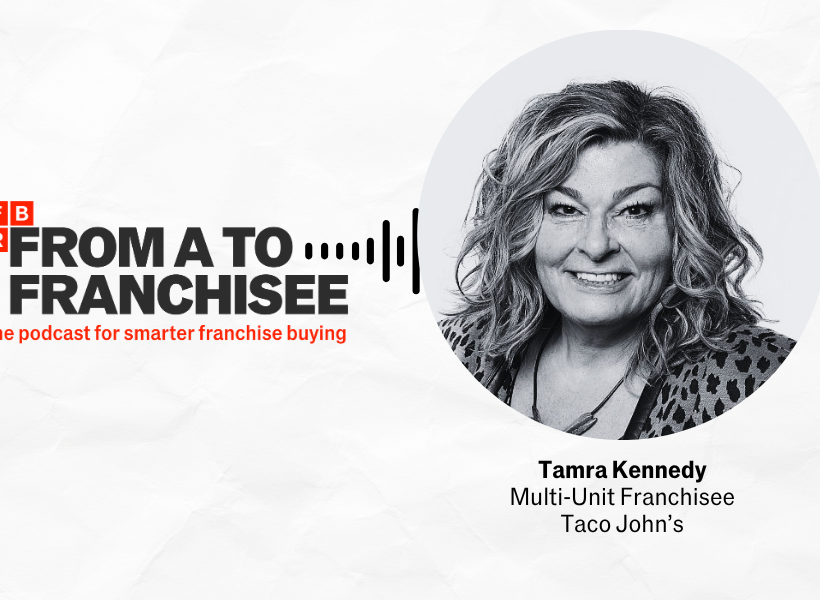
Michelle is joined by multi-unit Taco John’s franchisee Tamra Kennedy to discuss whether the American Franchise Act is good for franchisees.
Listen on Apple Podcasts | Listen on Spotify | Watch on YouTube
Summary
This episode explores the American Franchise Act and why it matters for franchisees, franchisors, and anyone considering franchise ownership. Tam Kennedy shares her decades of experience in franchising, offering clear insight into the joint employer debate, the importance of franchisee support, and why transparency, trust, and strong brand standards are essential for long-term success.
Resources
- Read: The International Franchise Association offers its support to the American Franchise Act
- Congress: HR 5267 Info And Status
Transcript
Michelle (00:52)
Welcome back to the podcast from A to Franchisee. And today I’m excited because I’m being joined by someone who spent more than four decades on the franchisee side of the table, but now has spent a lot of time doing different things. One, helping franchisers be better. And two, she’s using a lot of her time to help educate people on why franchising is really fighting for what we’re gonna talk about today, the American Franchise Act in Washington, DC.
Tam Kennedy owns and operates six Taco Johns locations with her team across Minneapolis and St. Paul area in Minnesota, but her influence reaches well beyond her own stores. She sits on the board of the International Franchise Association, serving on its franchise relations committee, and previously chaired the IFA’s franchisee forum. In 2019, she co founded Performax Franchisee Advisors alongside two fellow franchisees.
Bringing over a century of combined ownership experience to help franchisors and franchisees build stronger relationships. Tam is here today because there’s a piece of legislation moving through Congress right now that could reshape how franchisors and franchisees are legally connected, and she has strong opinions about why this matters for everybody in franchising. We’re talking about the American Franchise Act today, what it actually does.
Why Tam supports it and what’s genuinely at stake for anyone thinking about buying a franchise or anyone who just signed on the dotted line to become a franchisee. Tam, I’m so excited to have you here today and thank you so much for joining us to talk about it.
Tam Kennedy (02:32)
gosh. Well I’m excited to be here. Thank you for having me. And after that very gracious introduction, I I I’m tired. I feel like I’ve done an awful lot in forty something years, so I may need an actor shortly. Yeah. Yeah. Okay.
Michelle (02:45)
You ha you have. You you you deserve a nap. You deserve a vacation. and I will
say too, it’s I think it’s gotten better where we see franchisees are more engaged with everything that’s happening with the association and our space that we hold in business and in our country. But you were one
Tam Kennedy (02:59)
Yeah.
Michelle (02:59)
of the first. You know, I’ve been around for twenty years and and I always remember you showing up
and having a voice for other franchisees. So they don’t even know how much work you do to just really have a voice within the International Franchise Association and to make sure that franchisee perspective is included in all the things we do. So it really it has been a lot of work. You’re real you’ve really been a trailbla trailblazer on that front for sure. Yeah. Hopefully
Tam Kennedy (03:22)
Appreciate that. Thank you. It
Michelle (03:24)
you can lighten your load as more franchisees step up. That’s my hope for you.
Tam Kennedy (03:28)
And that’s my goal to introduce
Michelle (03:29)
Yes.
Tam Kennedy (03:30)
as many franchise franchisees, franchise operating partners to the conversation and get them
Michelle (03:37)
Yeah.
Tam Kennedy (03:37)
more involved in it and have them be more representative and have all of these bodies be more reflective of the importance of the franchisee voice in all of the conversations around franchising for sure.
Michelle (03:50)
Love
that. I love that. Okay. So I want before we get started on the American Franchise Act, I want to get just a little bit of a biography on. I you’re so fascinating. You’ve done so many things. I just want to get a little bit of how you got into franchising in and your Taco John story, and then just a little bit of kind of what you’re working on now, being a franchise owner, what your day-to-day looks like now, because you’re, I think, in a little different space than when you were like.
in it maybe twenty years ago. So just a couple of of I d a little bit of a history of like how you got there and then what you’re really doing in your role now for your for your locations, your units, your team.
Tam Kennedy (04:30)
Sure, happy to. So very non-traditional story f of how I became a franchisee. I started as a secretary for a gentleman that was a franchisee of a couple of brands. And I remember my interview very well. it went something like, Bring a book, you’re gonna be bored, you’re gonna open the mail, and you’re gonna answer the phones. And at the time I had two choices. I had a job offer from a bank and a job offer from him.
And I thought at 20 years old, assured that I was gonna run the world at that point, I would never own the bank, but there was a chance that maybe someday I could own a business in the franchising space. And so I took the job with the with the franchisee. And I would it it was a job that paid quite a bit less, but I I thought it was worth the risk and it really paid off. I worked very hard on that.
kind of space trying to understand franchising, certainly understanding restaurant operations.
But mostly on the administrative side. And so 17 long hard years of paying my dues, I had got the opportunity to buy the business from him. And at the time, quite a few restaurants, I think maybe 14, 15, something like that, when I bought all of it in 1999. And so you know, for another 10, 15 years, the day-to-day for me was every day in the restaurants, seven days a week.
really making sure my company was my own. It was such a joy to work in the restaurants, to be connected that closely with my team and certainly our customers and really feel the brand every day. Today I not so much. I am blessed to have an amazing team. I talk about them all the time. I have general managers who make me look so good and I’m so fortunate to have them look
Love the brand as much as I do to kind of share the the love of running restaurants with their teams. And that’s really where our focus has always been. The real reason I stay in the business that I’m in, in the restaurant space specifically, is because it gives the opportunity for young people to start their first job. That’s what’s always called to me. It was my very first job, Pizza Hut, $2 an hour.
back before there was pizza delivery so yes I am very old but I have lived kind of through this arc of what franchising is and what that means in the restaurant space and today although I don’t spend my days on Taco Tuesday making tacos I still certainly have a hand in the day-to-day so
Michelle (07:23)
Yeah.
Tam Kennedy (07:24)
it’s been a it’s been a wonderful journey. I still love what I do and I look forward to doing more with that part of my life.
Michelle (07:37)
Love it. Yeah. And I I know that and we can include this in the link to in our notes for the show. I know that there was an it we did an interview with the women’s franchise committee, and that is will make that available too. So people can hear your story because again, we’re passionate about getting more women involved in franchising. So it’s a great story from
Tam Kennedy (07:55)
Absolutely.
Michelle (07:56)
that standpoint. And also, too, you just you have the dream story that most franchisees don’t know getting into it is.
That the hardest part of any business, really, not even franchising, is having a team that cares as much as the owner cares, that runs the business while you’re away from it. So you just have so much, I think, to share with new business owners, people thinking about being business owners. I just you’ve you’ve done a really great job with that hourly workforce, which is a challenge for a lot of leaders.
Tam Kennedy (08:24)
Yeah.
Michelle (08:26)
Yeah.
Tam Kennedy (08:25)
And I appreciate that. We’re working
across four generations now in terms of staffing.
Michelle (08:30)
Amazing.
Tam Kennedy (08:31)
And I you know, I have lived through all of those generations too. So I learned something from every generation in our workforce. Every day there are lessons to learn. It’s a different workforce model than what we started with for sure, but I would not say it’s worse or bad in any way. It’s different, and so
Michelle (08:51)
It’s just different.
Tam Kennedy (08:52)
that means adjusting to today’s
You know, demands for what our consumers want for sure, and then what our staff can bring to that. And I would tell you that the the gift that I’ve been given to work with young people and the ability to make sure that they care as much as I do really comes from a strong connection to our values, how we believe we serve, and what
I guess one of our founding my company’s kind of founding principles is that it’s very simple, it’s four words. Our family feeds friends. And if we go to work every day thinking about that, we have a pretty vital role in every community, right? So we wake up happy to make a meal for someone that didn’t have time to make one for themselves or are looking for a treat. And we all can use a little bit of that in our life,
right? Yeah. Yeah.
Michelle (09:45)
Yes, we can. That’s right. That’s great. And that’s,
I mean, that brings us to the American Franchise Act, which is really all about people. So
Tam Kennedy (09:51)
Sure.
Michelle (09:52)
I’m going to explain a little bit from my perspective and what I know around the American Franchise Act. And then I’m gonna ask you to help share your perspective as well, because you’re definitely more into it. And the whole point of this is to build awareness around how really important this is to franchising. So
The the core issue that the American Franchise Act is attempting to make permanent is this concern around joint employer. So previously and and today, it goes back and forth on whether the employee of the franchisee could be considered an employee of the franchisor. It tends to go back and forth. Sometimes they say yes, it’s joint employer, sometimes they say no.
It’s a very gray area or tends to change based on who is in the White House, what they align with, what they’re what they’re representing. So the idea of the American Franchise Act is to formalize the relationship so that it doesn’t go back and forth, put it into law so that it’s very clear that the employee of the franchisee is not an employee of the franchisor. A franchisee has their own business, they have their own control over how they
Work with those employees in their organization. The franchise or does not. And that’s, I think, the gray area that people don’t understand. And I’m gonna say, because there’s been so much concern about joint employer, franchisors have been very hesitant in how they support franchisees in issues like hiring, training, and retention.
From my standpoint, and again, I want you to weigh in on this, people join a franchise system because they want the tools and the support to make running their business easier. So franchising has this huge opportunity for business owners because you are connected with other business owners running the same exact business as you. So there’s so much to learn from each other, and there’s so much that the franchise work could do to support franchisees in how they
take care of their people. So what this would do is say, hey, franchise or can offer you advice, tools, video things that you can use, and you can choose to use those in your organization or not. But we’re not telling you you have to use them. We’re not mandating that you do it our way. We’re s we’re just providing you support on how to hire the best people, how to keep them happy within your organization. So I think that’s my my
standpoint of what the American Franchise Act is trying to formalize and put into place and make it permanent. So that relationship is very clear who that employee works for. And then it’s gonna we’ll get into like all the things that could change if this actually happens, right?
Tam Kennedy (12:47)
Sure. Sure.
Michelle (12:50)
Okay. So that’s my explanation. Now I want to hear yours. and I’m totally fine if it’s different or if you want to add different stuff that I haven’t thought of.
Tam Kennedy (12:59)
No, I think he did great. I think he did great. I think
Michelle (13:01)
Okay.
Tam Kennedy (13:02)
this story goes back quite a long way. And rather than be wrong about some of the details, I can tell you that my involvement in this joint employer conversation goes back to 2015, when we were kind of upended in the legislative space around what
Is a joint employer. This comes from the Department of Labor working on some issues between companies and their employees. And at the time it wasn’t necessarily a franchise business that had the issue. It was a different
Michelle (13:37)
Right.
Tam Kennedy (13:37)
kind of business. But it raised the conversation to a level about control. And control is really at the heart of this. The distinguishing words in all of the current mandates that we all operate under in franchising are.
direct and indirect control. And the way it reads today is something about you know the brand having the ability to
indirectly or directly control the employees of the franchisee. And this is where we start splitting hairs, right? We all know,
Michelle (14:14)
Yes.
Tam Kennedy (14:15)
and certainly every legislative body understands that our employees belong to us. We pay the taxes for them. We run their payroll. We hire them. We choose them. We train them. We keep them as long as we can and we wish them well when they go. But in the end, the the life cycle of every employee
in a franchisee business belongs to the franchisee. Where the control conversation comes in is around this HR human resource function that you spoke of. Things like being told what uniform you have to wear, being told how to greet a guest, being instructed by the brand, you know, how late
business should stay open and what what time they should actually open the doors. even defining job titles what the responsibilities under those job titles would be inside of the business. The perception can be and has been interpreted in many ways that that assumes control. That means that the brand is telling my
16 year old cashier what to do. And it’s just not the case. I think
Michelle (15:32)
Yeah.
Tam Kennedy (15:33)
the best opportunity we have to really flesh this out is in this American Franchise Act to really put a put a a fine point on the idea of who does what in the franchising relationship, right? We all know that the franchising relationship is requires
recorded through f documents, right? There’s a contract.
Michelle (16:02)
Yeah.
Tam Kennedy (16:04)
it happens that the contract is kind of guided and shaped
by another government body, right? The FDD contract the FDD document has to meet certain criteria that the government has already put into place. They’re kind of at odds sometimes when you think about we already have rules around this making sure that everybody kind of understands what’s going on. but it is a contract nonetheless. And I think you know this this issue of d direct and indirect control really has slowed down
the opportunity to for franchisees to grow and to risk making some of the decisions that they probably would like to make because that they lack some of the guidance that they need. and
Prior to 2015, that guidance came from the brand. Brands had full HR teams, well skilled and deeply knowledgeable about best practices and tools that they provided to franchise operators. Certainly when you became a franchisee, you onboarded with the brand. This was a toolkit that you expected, counted on, and actually used. Very valuable. Something as simple as ads.
that you would place, getting help with how to correctly write that ad, or even better, how not to misstate something that could get you into trouble, right? There’s so much structure around that. And if you think about the way I do about this, this
American Franchise Act. I would love to be able to call my HR team at my brand and say, you know, a whole bunch of new laws just passed in the state of Minnesota around employment. work with me today to make sure that all of my recruiting tools are correctly stated. help me understand what this new, you know, benefit that the state is requiring that we provide.
fits into what I’m doing and help me understand how to roll it out and implement it. Those conversations don’t happen anymore. And speaking as a very small company as a as a franchisee with six restaurants, this is not a large enterprise that I own anymore.
It it’s expensive to go hire your own attorney. I recommend that you do. I always recommend that you have a great accountant and a great attorney because you’re gonna need both of them for the rest of
Michelle (18:45)
Mm.
Tam Kennedy (18:47)
your business ownership life. But it would be great if some of those resources were made available again from our franchise brand. because they would be tailored to the type of business we ran, whether it was doggy daycare or a hair salon or restaurants. that’s where the you
Know the guidance, the important guidance would be beneficial to franchisees and ultimately, and I say this all the time to the franchise or as well. They want our teams operating at it peak capacity, they want them to be skilled and knowledgeable and happy to deliver on the promise that the brand has put out there. that’s their stake in franchising, right? This brand promise that this is who we are, this is how we come to the market.
And franchisees make that promise come true every day when they transact. So I know I probably should take a breath, but I think, you know, I had the opportunity in s 2016 or 2017 to testify before Congress on this exact topic and what it cost us, just me,
to lose that benefit. my example was a solid example of what happened at the time.
I had to go out and have a an employee handbook created by our attorneys that used to the template used to be provided from the brand and those tools were not you know, they’re not available anymore. And so nine thousand dollars later and back at you know, that’s a that’s a I will just say that’s a lot of tacos. I say that a lot. That’s a lot of tacos that I have to, you know
Michelle (20:28)
Yeah. Yeah. That’s a lot of tacos.
Tam Kennedy (20:31)
right? And and that money too could be put to better use, recruiting and and rewarding more
and you know more team, all of those things. It’s a very small example of the many things that are slowing down franchising. And so the AFA, the American Franchise Act
directs the focus back to what this relationship is about, that the employees belong to the franchisee, that the brand certainly should and can and should have standards around part of the HR model, right? Uniforms should not be considered direct control. They should be part of the brand standard, right?
Michelle (21:13)
That’s right.
Tam Kennedy (21:14)
How else could we, you know, recognize who we are if we weren’t in in the proper uniform?
And having the logo on a piece of apparel doesn’t mean that the person wearing that piece of apparel now works for whoever owns the logo, right? So it’s it seems silly that we’ve had this fight now for 11 years, but it’s it’s not. It is critical that we get this bill, that we get this passed.
Because it would, I think, once and for all finally end this conversation and bring us back to a level of support that franchisees deserve, brands should be obligated to give, and in the end, everybody will be better for it.
Michelle (22:00)
I love it.
Yeah. And what’s exciting is that there is bipartisan support in DC to make this happen. So what we need to do is just build awareness around it because especially if you’re considering coming into the franchise space and becoming a franchise owner, you want to understand where we’re at now and have that reassurance of how do we how do we resolve this so that you can build a business plan? I mean, if you don’t know what you’re gonna have to pay for this outside help. And some franchise ours
have found third parties that help them do some of this stuff, but not all of them. Some of them will just say, nope, we can’t, we just can’t get engaged in that area because it’s a gray area. So I thought that was great. That was a great context to it. So I know that when you came into franchising, it it was different, whether it was considered joint
Tam Kennedy (22:47)
Sure.
Michelle (22:47)
employer or not back then. But how do you feel like knowing, being certain about this relationship, how would that have helped you?
When
you look at whether I want to become a franchise owner or not. And that could be that I want to become a business owner versus a franchise owner, or just like, is this worth the risk? Is this worth the investment? How would having this kind of conversation or knowing this help in that decision making process?
Tam Kennedy (23:12)
So I think, you know, when you want to become a business owner you you
have to make some decisions about what type of business that you want and and then you also have to think about where’s how much do I know about it and how fast can I get to where I want to go. Whatever it is, if it’s one corner bakery shop that you want to open, if it’s one car wash that you open. But whatever your goal is, you make this decision. You look at franchising for what it does. It provides scale. It provides you the opportunity to not start from scratch
Scratch, you’ve got lessons learned from people that came before you, you’ve got structure around how to advertise, how to you know operate. Those two things combined means how to transact, right? We put the word out, we make this thing, this thing gets sold, and now we’re in business. After sale one, we’re in business. But of course, then in the middle of all of that, you need someone.
To help you do that, you need someone to sell, you need a person to be on your team to do some of this, and so that’s where the HR piece of this comes in. that guidance, that structure, move we know, we know from data that
Businesses that start in franchising are more profitable, employ more people, certainly repres are more reflective and representative of a diverse workforce than businesses that are not in franchising. And I’m very proud to say that. I think that’s a wonderful thing. franchising gives you that model and that playbook to get you going faster and to help organize the
entrepreneur push that you have
I think, you know, the that relationship in and of itself is is difficult to explain but easy to understand when you’ve done it, like someone like me. You know, I wanted to run my own business. I knew that when I from a very young age. I wanted to be in in control and I really you know, a lot of people desire that still today. Young people,
Michelle (25:32)
yeah.
Tam Kennedy (25:33)
people that are in college or thinking, you know, where do I go when I graduate? So many of them.
really do want to control their own destiny. Franchising is a is a path that leads to I mean the store the stories, the history and the remarkable successes that are out there affirm that franchising is a terrific path for business you know, entrepreneurial kind of minded business people to think about. I think, you know
The
It’s a relationship. We’ve we talk about this quite a bit, right? And so if I was looking at becoming a franchisee today, one of the very first questions that I would want answers to is what will you provide me for support and guidance along my franchise ownership journey from not just from when I, you know, get getting started in O Grand Opening Day, but forever. and that conversation has changed over the years. You’re right. Brands offer third-party affiliations.
Many do in tr in this kind of on this topic and many others, but you also get the pleasure of paying for those as a franchisee. Where 20 years ago that was included in our franchise fees every month, now it’s not. So there are additional expenses that we, you know, pay to get access to some of the things that we need. you know, all of the
kind of all of that swirling thing that has happened has been for the protection of both franchisees and franchise, the pullback a little bit. But there’s been a cost. definitely
Michelle (27:15)
Yes.
Tam Kennedy (27:16)
been a cost to the franchisee.
Michelle (27:18)
Yeah.
Tam Kennedy (27:18)
it’s expensive to get good advice and I I hope that this bill will
lessen the gap between what a franchiser wants to do and what they actually are doing. It should take away the fear and the indecision. And then it’s
Michelle (27:35)
Yes. Yes.
Tam Kennedy (27:37)
our responsibility as franchisees to say, give it to me. Lay it on me. I’m ready for it. Let’s work together to build some more of these tools to cut down on our expenses, align with the brand’s perspective along some of the guidelines that we’re talking about. Let’s get it, let’s get it done. We’re all waiting for this bill.
Michelle (27:57)
Yes. Yep.
Tam Kennedy (27:57)
For that. Yeah.
Michelle (27:58)
Well, and so I’ve I’ve I’m just jotting down so many notes over here. So the other thing I think that is important to think about is I always talk about one of the benefits of franchising that I’m not sure gets talked about as enough enough once you’re in the system as a franchisee, is for what franchising does well is that it allows you to keep your focus on your business and the corporate team is doing all the the things to
focus on innovation and keeping your brand relevant and they’re testing things out and they’re definitely protecting brand standards and assessing those risks. So I would put this into that category as well is that it’s not just expensive for you to have to do all this on your own, but it’s extremely confusing because laws change by state, laws change by industry that you’re in, a segment of business. So that’s another and it’s a risk, right? If you’re not doing things right, it’s a risk
your business, it’s a risk to the franchise or brand standards. And we, I mean, we haven’t even touched on the the whole taking care of the employee is that employees want to work for good employers. So if you know that you have you’re doing everything legally and above board and you’re doing it the right way, that’s where an employee wants to go work versus a a chaotic business environment where they’re like, is the check going to come next week? I don’t, I don’t know.
So I think there’s a lot of stability and and there’s a lot of alignment with what franchising brings to an employee in an organization too, because they do want to work for great employers and great brands. And no matter what happens with this bill being passed or not, when that person leaves your organization, they will talk about Tam as a leader, but they will certainly be talking about the brand. So this is absolutely a brand standard.
Tam Kennedy (29:48)
It is a brand standard. that
Michelle (29:49)
Yeah.
Tam Kennedy (29:50)
structure that the employee operates under is something that once learned, they count on. And it
Michelle (29:56)
Yeah. Yeah.
Tam Kennedy (29:57)
means that I don’t get to walk in tomorrow and change everything from purple to green and like, we’re gonna redo everything, we’re gonna start selling sushi today. Well, you know, no, we’re not. We’re selling tacos. And so
Michelle (30:06)
Yeah. Sushi taco. Yeah, yeah, yeah. We’re taco.
Tam Kennedy (30:11)
while the creative part of my mind often pushes
back against what I am working with on my brand. It’s not, it’s pushing together for I you know idea generation. You’re right, the brand is always innovating, working on future business,
Michelle (30:27)
Yes.
Tam Kennedy (30:28)
working on future opportunities, structuring not just the product itself but how it’s messaged, right? I I I think all brands do that. All brands that want to continue have to look forward. Well operators are looking at today.
And how to execute, right? So we’re executing today’s plan. The brand is working on tomorrow’s plan. The alignment comes through the communication. And the employees themselves follow the plan. I laugh about this a lot. So I’ll talk to my brand and I’ll I’ll literally say, Why are you making me do this? Let’s talk. Give me specific, concrete reasons why you want to make this change.
Michelle (31:09)
Yeah.
Tam Kennedy (31:10)
Change is hard for someone like me sometimes, especially when I’m like, what are we doing?
So I’ll say, Why are we doing this? And they’ll explain it and I’ll be like, Okay. Be and I am always on board with the fact that I am a franchise partner, right? I don’t break the rules. I’ve been known to
bend them a little bit but not not lately maybe way way back I might have a time or two when I thought that I could you know have my own way and all of that. You learn you learn that you know rules are there for a reason. So they’ll say you know Tam this is what we’re gonna do. Your input’s been great. We can make a couple of changes but this is how we’re gonna move forward. Then I’ll have to turn around to my team and I’ll have to say they’ll say Tam why are why do we have to do this? And I have to say well blah blah blah blah blah
Here’s why.
And it’s really one of those because I said so, like
Michelle (32:03)
Yes.
Tam Kennedy (32:04)
long answers, right? The brand said so. So I’m stuck between my management team and my employees saying, We don’t want to do this, and me going back to the brand saying, We don’t want to do this. And they’re like, Yes, you will. And I turn around and say, Yes, we are. It is like that in every brand, but it’s always done with respect. And that, that mechanism of the structure makes it all the way down to your frontline employees and
yeah, I think you know, you’re right. the with the American Franchise Act, we have a great opportunity in front of us. And I think if brands support this bill, like if they really understand how it could benefit them selfishly, it would mean that they can move forward on their standards faster, that performance will go up because standards can
Be more clear, and the more clear they are, the more they can be aligned when the field support staff comes out and make sure that every operator is following whatever the standards are. Vague standards do not help anybody.
Michelle (33:09)
That’s right.
Tam Kennedy (33:10)
Clear guidance moves everything forward, and
Michelle (33:13)
Yeah.
Tam Kennedy (33:14)
as a franchisee, I expect that from my brand. I ask them for clear guidance when they can give it, they do, and they should.
should expect that when they give it that we are following the path that they’ve set forward. This is a big opportunity for franchisees as well. those franchisees that have put off expanding because look worst case scenario here. Worst case scenario the bill doesn’t pass.
a leadership at the White House changes hands again and they really decide on the other side of the conversation that they’re gonna once and for all change the conversation indelibly to their perspective which is the
My employees belong to the brand and no brand will want to take the risk and the liability
Michelle (34:06)
That’s right.
Tam Kennedy (34:07)
of being in charge of HR decisions. They’ll just stop franchising. They’ll
Michelle (34:11)
Mm-hmm.
Tam Kennedy (34:12)
just start buying back these franchise units. And if I mean if they’re want to stay a brand, they’re gonna want to be able to directly control those employees that now they’ve been saddled with. They’ve never met them, they’ve never hired them, but now through a swipe of a pen, they now belong to them in terms of responsibility.
Someone asked me not long ago what would be an example of that and I said, well, think about it like this if one of our employees fr in in any franchise business broke a law while at work and it caused a lawsuit.
the brand would be rolled into that lawsuit. The brand would now be, you know, the one responsible for the actions of that employee. there’s certainly stories out there over the last 50 years of where that’s actually happened. The pr there’s protections for the brand and certainly for the franchisee. And you would think in all of today’s world that the the employee themselves would be the most responsible. But those looking to exploit
bad things we’ll find a way to loop in the deepest pocketbook.
Michelle (35:24)
That’s right.
Tam Kennedy (35:24)
That is where this whole thing kind of started. How can we get to the brand to control this function? And certainly there’s no, you know, mystery around unionization and how this kind of came out of the need for unions to want to unionize fast food. that’s kind of where it started, but franchising is so much more than fast food. There’s so, so many businesses that would be effective, affected if we
don’t get this passed. so it it it affects everybody. It will affect everybody positively. It just we need some more support. You’re right. We have bipartisan support in Congress. I’m super proud of that. the
Michelle (36:10)
Me too, ’cause
that doesn’t happen on any issues these days.
Tam Kennedy (36:13)
No, it we’re over we’re we’re over a hundred
and twenty-five representatives that have signed on this from
Michelle (36:19)
It’s amazing.
Tam Kennedy (36:20)
both parties. certainly the bill is authored by Senator Marshall. I had the pleasure of speaking with him a couple of weeks ago. And, you know, I really wanted to know what this bill meant for him and why he is authored it. And he is a true friend of franchising. It matters to him. This isn’t just a bill to put his name.
on. he understands that he has taken the time to to learn as much as he can that he didn’t already know about franchising. And then he has worked very hard to find others like him, s both in the Senate and in the House, to get behind this and
That’s what we need everybody listening to this to do. What we need all of our kind of franchise organizations to talk about is what can we do. So we need to, you know, do the thing that we always do: mobilize, organize, mobilize, and make a difference. And that’s what certainly what our advocacy event in September is all about at IFA.
Michelle (37:23)
Yeah, so
I think we’re gonna be able to release this right before that event. So we’ll put those details when we’ll be in DC. And that’s when we talk to everyone that’s in DC to try and help them understand how this actually affects people in franchising, both on the franchisee and the franchise war side. so that’s important. And I loved your advice that you’re giving to anyone thinking about coming into franchising as far as talking to the franchise or about what kind of support they offer, not just to get your doors open.
But ongoing. And I would specifically ask around the people side of how how do you support franchise owners in hiring, retaining? and that could be that they’re saying a third party, but it will allow you to understand, are they tuned into this American franchise act? And are they talking about what will happen on the other side of it, assuming it passes or assuming it doesn’t? So those are the kind of questions I think that can help you understand what type of support, just so you know what you’re coming into.
It’s it’s o it’s always hard to run a business, but I think franchising just becomes stronger and stronger because as you started this, more and more people want to own their own thing. And that’s what’s so amazing about our country is that
Tam Kennedy (38:31)
Sure. Right.
Michelle (38:33)
we have to make it easy for people to do that. And it’s certainly not easy to be a business owner. So it’s just one of those ways that we can support business owners on doing things the right way. And and the benefit is to the employee, to the customer, to the franchisee, and to the franchise or because people
have,
like you said, guardrails or understand what my role is and what your role is. And everyone’s clear on how we’re going to move this business forward. So that’s that is why this is important.
Tam Kennedy (39:00)
Absolutely.
Michelle (39:02)
what about s there anything else while we have you here that you wished you had known before becoming a franchise owner that you would share with other people that are thinking about jumping on the franchise wagon?
Tam Kennedy (39:15)
gosh. well my goodness. Well that isn’t that a good question, right? couple things. word that comes to mind is sacrifice. And I th that is not a negative word in any way. This is a word that lately I’ve been reflecting on because in order to
get where you want to go in order to have the things that you want if it’s a business that’s fully functional and profitable there are some sacrifices the biggest sacrifice was time continues to be time how much of my time do I want to sacrifice to put towards business and
Yeah, I love the euphemism and have loved it for so long, this work-life balance thing. I I snicker whenever I hear it because you know what, there’s no such thing as a rule. There is how you perceive it. Some days for me it’s 80-20 work, and then when I say I’m gonna quack off for three or four days, then it’s eighty-twenty time to me and my family. And so there’s never gonna be a 50-50 in.
franchising in terms of your time. It’s an investment, right? And so that is gonna come with sacrifice.
Michelle (40:45)
Yeah.
Tam Kennedy (40:46)
You might be sacrificing some of your well-earned capital. You might need to to use some of the money that you saved and some of the equity that you have in order to start. No matter how old you are, you’re going to need to have some resources available. So you’re going to sacrifice something. It might be a boat or a cabin or a college or early college, whatever it is. And it’s a risk. The other word is it’s a risk. And you have
to understand what if you’re risk-averse where your risk level is. What supports that conversation of sacrifice and risk is the partnership that you choose to go into. Which brand you choose, most importantly, who is leading the brand, what are their what are their foundational beliefs, who are they and how do they behave, doing really good due diligence on their operations and
how they how they work with franchisees, how they work with their own staff, is something that I’ve observed many times. All very important to making the decision. So your risk goes down when you partner with the brand that
is doing the same thing you are. They are sacrificing. They are putting some risk there. They are working hard every day. Especially these emerging brands that are near and dear to my heart. The ones that have a dream and they want to become a brand, just like I had a dream and wanted to become a business owner, there’s a marriage, right? There’s a marriage there.
I do say sometimes it’s like dating when you want to become a franchisee, you’re gonna date a lot. I I beg you. Date around. There’s nothing wrong with taking a brand out for a conversation and a cup of coffee. Do that a lot and you will find that in in brands that maybe you never even thought of or even types of businesses that hadn’t occurred to you.
Understanding what’s available that and learning more about how some of franchising works can come just from this process of going on discovery days and learning more about brands. It it’s better to do that now than to get into a marriage that
you loved immediately it was you know instant love and everything’s great and then it’s not and so I would just say that for franchise prospective franchisees certainly do the work be prepared to give up a little bit be clear on what it is that you want like where do you wanna go. Any other advice that I could give would probably be very specific to me but
I would, you know, I’ll give you another one. Surround yourself with experts in fields that you are not. A good attorney, a good accountant, your personal board of directors, those people that will tell you straight to your face, what are you thinking? That group of people, you know, your ride or die people, you need all of that. You’re gonna need
Michelle (44:05)
Yeah.
Tam Kennedy (44:05)
a support system. This is a, you know, this is big deal. Starting your own business is a big deal.
It is you know, it is not without complication, but it is also not without reward. So there’s a couple for ya.
Michelle (44:19)
That’s right. Yeah, I love
it. And the the what I love, so we talk about this a lot with franchisors. And now I’m going to bring it into this conversation because I’ve not heard it put from the perspective of a franchisee, but you really are are kind of reinforcing it is what when we ask questions of franchise owners about their brand, we ask about a lot of different things. But the number one question that we ask that’s the most correlated with the brands that are growing the fastest in an FDD is I trust my franchise.
And you just explained in your diligence exactly that. Like, do you trust the brand? Do you trust what they’re telling you about the brand and where they’re going? Because going back to your conversation about I don’t understand why they’re making us make this change, I ask the questions, they tell me, I then have to tell my team. And we all kind of like, that’s all about trust. Change is extremely hard. But if you trust the direction that you’re being given and the person that’s giving it to you, you might not always align with it.
But you trust that they have done their homework, that they know what’s right for the consumer, for the for the brand, for the location. And it was just interesting to hear you say that. Ha I mean, trust your gut in that these people that you’re getting into business with, it will be a lot easier if you believe in their way that they’re going to get you there is really it.
Tam Kennedy (45:38)
And I
Love that question. I think it’s a great one. And I I I often think about it in this in this way. Rather than thinking about what’s in it for me, think about what’s in it for we, right? So if a decision is made at the brand level, what’s the benefit to them and what’s the benefit to me as a franchise operator? Almost always you will be able to find benefits on both sides. If you constantly are seeing no benefit to you, but all you know, all
upside for the brand, then you have then you start to have deeper conversations about do I trust the pat like do I trust the vision? Where are we going with this? Most of those trust conversations come around big changes or big investments,
Michelle (46:24)
Yes. Yes.
Tam Kennedy (46:26)
one or the other. that’s when your trust is tested. And I, you know, 50 plus years, I have, I have
Michelle (46:34)
You you’ve seen it all.
Tam Kennedy (46:38)
our brand is gonna run. Yeah. Yeah. This is true.
Michelle (46:38)
You’ve been sent through some great times and some very hard times. Very, very hard times.
Tam Kennedy (46:44)
and and you know what, also franchisees should know and understand that the leadership of your brand today very well may change tomorrow. and with a leadership change might come vision change. So looking at founding principles for the brand, looking at who the board of directors is, looking asking for a three and five year strategic plan from your brand, I think, you know, all
are critical that if if they can you know if they’re gonna prove what the path is and I can trust it when I can measure some of the actions that we’re asked to take against a plan that’s been given to us. So transparency is huge in matters of trust, right?
Michelle (47:29)
Yep.
Tam Kennedy (47:30)
And so are honest conversations. And
Michelle (47:33)
Yeah.
Tam Kennedy (47:33)
so franchisees should never be potential franchisees particularly ask all the questions. Ask all the questions
Michelle (47:40)
Yeah. That’s right.
Tam Kennedy (47:41)
of current operators too.
Michelle (47:43)
Yes.
Tam Kennedy (47:44)
no brand should be afraid to give out a list of franchisees to visit with about how they’re doing as a brand. So a lot of trust is built in whether or not they wanna, you know, hand pick who you talk to, or if they say wide open, go talk to everybody and and then we’ll talk again about whether or not you want to join our brand with us, right? That’s
Michelle (48:05)
Yeah.
Tam Kennedy (48:05)
trust.
Michelle (48:06)
Yes. Yeah. Great. Those are great, great pieces of advice. Okay. So thank you so much for coming and talking with us about American Franchise Act. We
Tam Kennedy (48:14)
What?
Michelle (48:15)
will link to a lot of stuff just to help people understand what this is, how they can get involved. We’ll share International Franchise Association because they have a lot of educational content and for their event in September. so thank you so much and we’ll see you on the other side of this hopefully passing. Yeah.
Tam Kennedy (48:31)
Well yes. That is
my wish and it takes everybody to help do that.
Michelle (48:35)
Yeah. That’s right. Yes. And then we’ll
talk about all the things that will change for the better after. Yeah.
Tam Kennedy (48:42)
We will.
We’ll have we’re gonna have a positive follow-up conversation, I’m sure. Yeah. Great. Thank you for having me. I appreciate it so much.
Michelle (48:46)
Absolutely. I believe it. I really believe it. Awesome. Thanks, Tam. Absolutely.