
This episode focuses on hiring mistakes every future franchise owner should avoid.
Listen on Apple Podcasts | Listen on Spotify | Watch on YouTube
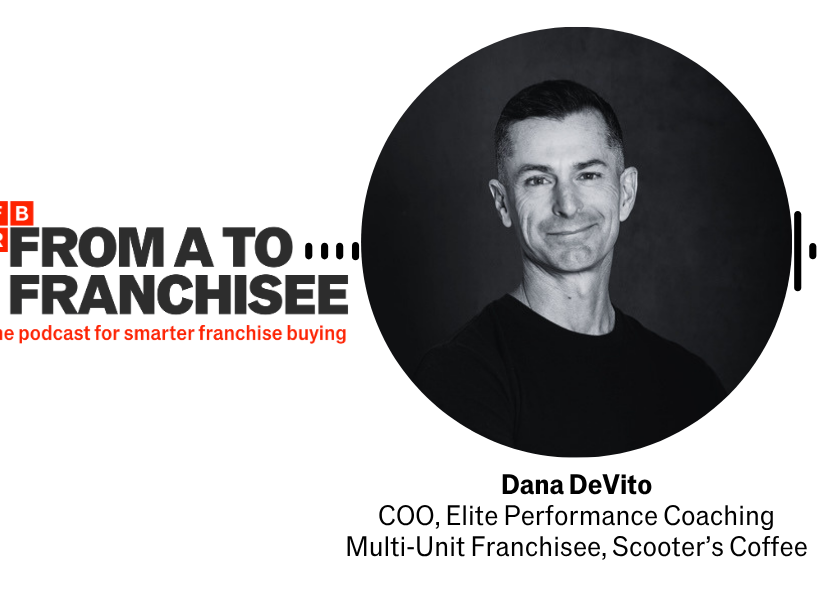
Dana DeVito went from working in IT to owning Jack in the Box restaurants, and he started with almost 100 employees from day one and no idea how to hire. Turnover eventually reached 300 percent, and one Monday a restaurant that needed 22 people had seven. In this episode of From A to Franchisee, Dana tells host Allison Dudas what those years cost him, how he learned to delegate with an “acceptable level of imperfection,” and why he now treats hiring as a relationship rather than a transaction. He also covers what got him through eight or nine grueling years, the questions to ask a franchisor about turnover and training before you sign, and what new owners should focus on in year one. If you’re weighing a franchise purchase, he’s candid about the people mistakes he’d help you skip.
Show notes
Guest: Dana DeVito, a longtime Jack in the Box franchisee who now owns two Scooter’s Coffee locations and coaches owners on hiring and retention through Elite Performance Associates.
What you’ll learn
- Why Dana bought into Jack in the Box, and how ownership differed from what he expected
- What it’s like when the business never closes and every problem lands on you
- How he went from zero to almost 100 employees overnight, and what he got wrong
- What 300 percent turnover costs in money, time, and your own sanity
- Why skills are a yes-or-no question while character and culture fit drive performance
- The questions to ask a franchisor about turnover and training
- What to focus on in your first year as a new owner
- How community, mentors, and scheduled rest helped him through the hardest stretch
Key takeaways
- Franchise ownership can be far less hands-off than buyers expect, especially when locations are open 365 days a year.
- Dana’s turnover hit 300 percent, and a single location needed 22 people with only seven on staff, which forced him to cut hours.
- Hiring works better as a two-way relationship than a quick transaction, and it starts in the interview.
- Decide which skills are mandatory, then hire for character and culture fit.
- Before you buy, ask the franchisor about system-wide turnover and how their training was built.
- In year one, learn the franchisor’s systems well enough to teach them to your team.
- Dana’s advice for anyone about to sign: be prepared to be part of the team.
Resources
Listen and read next
- What You Inherit When You Buy an Existing Franchise: Another From A to Franchisee episode, with a multi-unit owner who bought an existing location and replaced the whole team.
- Owning a YogaSix Franchise: A Married Couple’s Journey to 7 Studios: Two owners on doing their due diligence and managing people across multiple locations.
- Inside Year One: A Travelin’ Tom’s Franchisee Tells All: A coffee truck franchisee on what her first year of ownership was really like.
- A Place At Home Franchisee Talks Culture and Grit: A franchisee on choosing a brand for its people-first culture, plus the questions he asked franchisees and the franchisor before buying.
- Employee to Entrepreneur: Taxes, Cash Flow, and the Mindset Shift: An earlier episode on the shift from employee to owner.
Research tools
- Top Franchises for Culture: FBR’s list of brands whose owners rate their culture highest across 17 factors.
- FBR Franchise Academy: A course on how to do your due diligence and what to ask when you’re pursuing a specific brand.
- Food & Beverage Sector Report: A free report on the biggest challenges for food franchises, based on owner feedback.
Transcript
Allison Dudas (00:52)
Welcome back to the podcast from A To Franchisee. We are so excited to talk about some of the big mistakes that people make when they buy a franchise. And of course, those mistakes often have to do with people and hiring. Our guest today is Dana DeVito. And he spent two decades running Jack in the Box restaurants and now owns multiple Scooters Coffee locations.
And has now made it his mission to help owners hire well and keep their people. So if you are thinking about buying a franchise, his stories about what to do and what to avoid could save you real money and real headache. So Dana, thank you so much for being on the show. Welcome.
Dana DeVito (01:33)
thanks Allison. I’ve been so excited to get on and and chat with you. I’m really been looking
Allison Dudas (01:39)
Good. I know that your experience and your advice is really gonna help some people today. So let’s let’s get right into it. So first just take us back to the beginning. What what led you to buy a Jack in the Box? And I’m pretty sure you started out buying multiple units at once.
Dana DeVito (01:55)
Yeah. Yeah. So I was in IT. I actually for a small startup. we were in medical imaging and just really impressed with the courage it took the founders to launch their company. And and so I got this idea that I wanted to go out and own my own company. And so I did a lot of dabbling into different ideas. And then serendipity came along, and my wife’s cousin was looking to expand his current portfolio of Jack in the Box units. And so he invited me to join him as he bought a
couple more. And so my first response was, Not a chance. No way did I want to get into food. but I as fortune would have it, I I was able to go and visit him and see the operations. And and what won me over is that there was structure. There was a lot, the details had been there. The Jack in the Box had been open since the 50s. And so they had gone through a lot of the pain and the processes that I was still uncertain and unknowing of. And so that really appealed to me. he
showed me one of his very successful restaurants with a very successful and established crew. So I like, this is gonna be great. I I can do this. So that’s why I chose it.
Allison Dudas (03:01)
Yeah, you’re like, no problem.
This is totally, totally locked in. So what did that’s what you thought owning a franchise would be like. But what what was it really like? How did it really compare once you jumped in?
Dana DeVito (03:14)
I you know, I thought that once I got the hang of it, right? The systems had been there, that it would be really I wouldn’t say hands off, but it would be less involved that I ultimately found it to be. I fought you know, going in when when I first we we we moved to a new community, we didn’t know anybody, we didn’t have any friends, we didn’t have any family. I was going in an industry I didn’t know, and we had our first child that year also.
So it was just a whirlwind. And I thought, you know, I’ll get it settled and then I’ll be able to step back, be with my wife and child and just kind of live life. But our units were one of them was open 24 hours a day. We were open 365 days a year, and it never slowed down. So that was the thing that caught me by surprise. My business partner had warned me that it doesn’t stop, but that’s all theoretical until you get your boots on the ground and really start to experience it for yourself. And I was unprepared.
through nobody’s fault but my own. and that’s what that was one of the hardest things to adjust to is that at the end of the day, the buck always stopped with me. If there was an emergency, if there was a challenge, if there was something that went wrong, I had to be there
Allison Dudas (04:24)
Yeah.
Dana DeVito (04:25)
in some fashion.
Allison Dudas (04:28)
Right, right. So maybe you weren’t, you know, slinging burgers in the back, but you were the call. You were the call if, the friar fryer’s not working today, or so and so didn’t show up for their shift. You were always having to be on. And especially with a young growing family, probably with not a lot of support. It’s not like you can call your your mother in law and say, Hey, can you watch our baby? ‘Cause my wife needs a break ’cause she’s been, you know, doing all that or whatever. man,
Dana DeVito (04:54)
So my daughter was a couple months old. She was probably about six months old and and I stopped into one of my we had three three jack in the boxes at the time and I stopped in to see how the staff was doing through a lunch rush and they were getting swamped. And so, you know, I did sling a lot of burgers. I did w work there for yeah, yeah, I
Allison Dudas (05:09)
You did. I love it.
Dana DeVito (05:11)
was I was doing it all. And the cause I anyway, so so I ran into my restaurant at that time and they’re just getting hammered. So I
Stick my daughter into this is gonna get me in trouble, but I stuck my daughter into a high chair and strapped her down as tightly as I could in the office and I ran out to the floor, started working. A couple minutes later, I hear this piercing scream and I had to run around the corner. My daughter had tried to get out and you know, kind of shuffled over and jumped, and she was hanging from her foot in the strap that I had strapped to. I was like, I’m the worst dad I could possibly be.
Allison Dudas (05:40)
my gosh. Yeah. Yeah. Yeah, but I mean what
an image of like somebody trying to do it all, right? Like you’re just trying to do it all. And especially, I mean, there’s nothing like early parenthood. I also have kids. There’s nothing like early parenthood to make you feel like you are just at your wit’s end. So I have so much empathy for you there because
you’re running this company and people’s livelihoods depend on it. And then you also have your child and you’re just popping out for a second and taught six six months old toddlers, they all be crazy. So it’s I I
Dana DeVito (06:17)
Yeah, that’s right.
Allison Dudas (06:18)
I I definitely, definitely understand. Okay, so so life is crazy. You’re owning three jack in the boxes. And then how long did you stay in this craziness? Like how long did it last?
Dana DeVito (06:31)
Yeah. much longer than I would have hoped. I I probably did it like that for eight to nine years, where
Allison Dudas (06:43)
Wow.
Dana DeVito (06:44)
I, you know, I take a lot of pride in what I do. And I have a, you know, coming from the IT world, you you really wanted a s a certain level of excellence and performance and because it’s a transferable and repeatable result that you’re looking for. And so my going in with the same idea, you know, systems matter to me. I wanted
things to be perfect each and every day. And and anybody in the restaurant or hospitality world knows it, it’s there’s very few things that you get that you can guarantee every day. Everything is different and changes. There’s so many dynamic and moving parts that it it really was a process for me to to develop what I call the acceptable level of imperfection, where I could delegate and empower my team to operate without me having to pull it together or feel like I needed to pull it together. And that was a that was a long process. Luckily my my wife was
know encouraging and supportive through that and through some mentorship I was able to to pull out. and it and oddly enough it it led me to working with other business owners. That was kind of the segue to that. as people in the community were asking for my help, I had to figure out a way to create space to provide it. And so
Allison Dudas (07:50)
Right.
Dana DeVito (07:50)
that’s where I started to structure things differently and allocate my time and expectation differently.
Allison Dudas (07:55)
Hm. And I do think there’s there’s a lot of benefit in doing things the wrong way because you learn a lot of life lessons. And then if you’re if you’re good, you’re gonna pass those, you’re gonna pay it forward, you’re gonna pass those life lessons on to other people. And then maybe instead of eight or nine years of them grinding and doing that, they shorten it. Maybe it’s five years, right? Yeah.
Dana DeVito (08:16)
Yeah, please, please.
Allison Dudas (08:20)
Right.
Right. So okay, now you you no longer own Jack in the Boxes, but you’re into Scooter’s Coffee.
Dana DeVito (08:28)
Yep. Yep.
Allison Dudas (08:30)
And how many locations do you own of scooters? You have two locations. Okay. And then what drew you to scooter?
Dana DeVito (08:33)
I have two locations of scooters. Yeah. Yeah. So I operated both brands.
Allison Dudas (08:38)
Okay. you operated both simultaneously for a little bit? Okay.
Dana DeVito (08:41)
I did. Yep. Yeah. So
we overlapped for five years where I was running both jack in the box and scooters.
Allison Dudas (08:51)
Wow. So a super relaxing time.
Dana DeVito (08:55)
Very relaxing. I opened
up the scooters in in the heart of COVID. So it was 2000 August and November of 2019, then COVID hit as we were launching those businesses in a in an emerging market. So it was a little bit challenging. but
Allison Dudas (09:08)
Yeah.
Dana DeVito (09:09)
you were asking me what what appealed to Scooters brand, especially as I was, you know, moving towards the end of my contract with with Jack in the Box. and and I will say prior to being introduced to the Scooters brand, I had sworn off.
franchising actually. I I had the the the relationship we had with Jack in the Box was pretty tumultuous at times. And I felt that you know we’d gone through a lot of different changes in senior leadership as every brand will do. And and it
Allison Dudas (09:35)
Mm-hmm. Mm-hmm.
Dana DeVito (09:36)
just didn’t s align with me as well as when it I had started. And so I just was choosing to move away from that. And then I got to meet the senior leadership team at Scooter’s Coffee. I got to meet the founder and his C suite and they were lovely. Just such wonderful people.
And really epitomize their core values, I thought from the outset. And so it’s it’s courage, humility, integrity, and love. And to have love as part of the core value of an organization, especially a large one, really caught my attention. And it it highlighted what some of the principles that I’d started to establish in my own business was this idea of pouring into people first. It didn’t matter what business that I was doing.
And it encourages for anybody. It doesn’t matter what you do or what you make or what service you provide, you’re in the people business. And so
Allison Dudas (10:27)
Yes.
Dana DeVito (10:28)
the heart that Scooter’s senior management team was was showing and expressing in how they were growing their business really won me over. And I was like, How do I sign up? This is this is a perfect
Allison Dudas (10:36)
Hmm.
Dana DeVito (10:37)
fit. I I love it.
Allison Dudas (10:38)
Well, and so interesting because you know, Scooters at the time that you invested, you said was more an an emerging brand. And
Dana DeVito (10:44)
Mm-hmm. Mm-hmm.
Allison Dudas (10:45)
then Jack in the Box was obviously incredibly well established. So you’ve really s had both both experiences. So let’s talk a lot about what not to do. Now you’ve been super forthcoming and super honest thus far. So let’s I wanna he I wanna hear all all the stuff. So firstly
tell
Dana DeVito (11:04)
Drive.
Allison Dudas (11:05)
You know, obviously like hiring and retention, that’s your focus. When you talk about the coaching work that you do, you’re teaching people how to make the right hires, you know, pour into people, you’re in a people business. but as you’ve been frank about, you’ve made some mistakes along the way. So what was a hiring mistake that you made that taught you something?
Dana DeVito (11:27)
That list is so long.
Allison Dudas (11:30)
Ha.
Dana DeVito (11:30)
you know, I didn’t know anything about hiring coming in And I started out of the gate, I had almost 100 employees from one day to the next. I went from zero to almost a hundred. And trying to navigate that was super challenging. And through that, I made a ton of mistakes. and I, you know, you you kind of prepped me on this question. I was thinking through one of some of the the most significant and the lessons that I learned.
The one that really stuck out was one of my first. When I bought the pre-existing Jack in the Box, I was given the opportunity to either retain or go out go out and get new staff. And we had an assistant manager that was a convicted felon. So in the corporate structure, she was never going to be able to promote above the assistant manager role. And she had been there for a long, long time. Very skilled, proficient, great at her job. And I thought, gosh, what a great chance that I can have to to.
Poor into her and give her an opportunity
Allison Dudas (12:27)
Mm-hmm.
Dana DeVito (12:27)
to step into the managerial role. So I decided to retain her, and that was my hire. I brought her into my organization as not just the manager, the assistant manager, but as the restaurant manager. And it was, I didn’t do the vetting that I needed to. I didn’t
Allison Dudas (12:40)
Hmm.
Dana DeVito (12:41)
really, I didn’t know what questions to ask. I just saw her running a successful
Allison Dudas (12:45)
Mm.
Dana DeVito (12:46)
business and corporate had put her in charge. The other manager was retiring. So I thought this is going to be a great fit. Look at all the things that she can do for me.
Allison Dudas (12:55)
Hmm. Hmm.
Dana DeVito (12:55)
Because she’s experienced,
she knows what she’s doing, this is going to be great. And, you know, unfortunately, it caught her at a bad time of her life. And she, the same behaviors that got her her felony, she went back to. And it took a lot of you know, she she ended up paying the price for that. But it it taught me two things is one, I can’t want another individual’s success more than they do. And two,
Allison Dudas (13:19)
Mm.
Dana DeVito (13:20)
if I’m going to establish a working relationship, and the key word there is relationship.
I have to make it bi-directional, not just transactional. I have to look
Allison Dudas (13:29)
Hmm.
Dana DeVito (13:29)
past this idea of it being what can she do for me, but really what can I do for her as well and what can we do together as a team? And that takes a lot of conversation, not just, you know, hey, you look good on paper, you’ve done it for years, let’s plug you in.
Allison Dudas (13:43)
Yep. Yep. And especially I think if you are already in a role with a previous owner, transitioning to a new owner of the franchise, there’s a so much complicated stuff that comes with that, right? Maybe you’re inheriting bad habits or the relationship that that person had with the previous owner doesn’t translate, right? that’s
Dana DeVito (14:07)
That’s
Allison Dudas (14:07)
very, very interesting. what
What about in terms of like financial? What’s like the biggest, the most expensive mistake that you’ve made, either with turnover or hiring?
Dana DeVito (14:20)
Yeah. So from the financial side of it, one of the most challenging things I in and this was right around the co COVID era, but my turnover is upwards of 300%. And it was brutal with how many people that we were churning through. And and the cost, you know, on at the outset of it, it you you don’t quantify that, right? You’re just trying to staunch a a a flood.
or put out the fire as it were. And so you’re just, you’re going through the hiring, but it takes time and energy and effort. And at the end of the day with that turnover, we start to think, you know, what is missing from the offering that I’m doing? What can I, what am I not doing that will retain them? And so you start to overpay for underperformers. I I joked at the time is, and this is really crass, but it was the truth of it is, you know, if you could fog a mirror, I’d hire you on because I had such gaps. I tell the story often. I woke up one Monday morning, one of my I was I had five active units at the time.
One of my restaurants needed 22 people just to meet the minimum number of staff to run every shift. I had seven. And so,
Allison Dudas (15:23)
Mm-hmm.
Dana DeVito (15:26)
you know, it cost me business. I had to shut it shut down the number of hours I opened every day, which violated my contract with Jack in the Box. I had to you know, spend my time and energy not just working the floor because there was nobody else there, but also trying to go out and recruit, trying to interview, then trying to train and hire. And so there’s all these.
you know, at the end of the day, we can quantify and and qualify all of that and put a number to it. And that was just being repeated over and over and over again. So that was such a costly time in my business, both
Allison Dudas (15:58)
Yeah.
Dana DeVito (15:58)
personally, professionally, and financially, that it it it it almost quite honestly, Alison, that that almost buried me.
Allison Dudas (16:06)
What I we’ll get to the we’ll get to this in a little bit, but I I am I guess I wanna plant a seed. I wanna hear like what the turning point is, like what got you through this because you’ve been so honest. but but let’s put a pin in it because I I wanna I wanna make you answer some more tough questions. I’m I’m really enjoying I’m enjoying myself over here, you know? other other people’s hardships, you know.
Dana DeVito (16:21)
I love it. Yeah. Just s yeah.
Allison Dudas (16:30)
no, you’ve been so great because I know that this is in your rear room here, so it’s it’s something that you can talk about and process. can you okay, can you see now working with owners as you do, what are what are owners, franchise owners getting wrong with their teams? What are you seeing that maybe the mistakes you made yourself or even across a system or with other people like you owning a franchise?
Dana DeVito (16:56)
Yeah. You know, it’s something two things that I’ve already said, but to really highlight is we look at hiring as a transaction-based relationship. We go in with this idea of what what can the individual do for me from the outset. I mean, that’s the start of the conversation, start the relationship, because you’ve got a need. You’ve got a hold of fill or a role that you you’re you’re creating, whatever it is, you’re trying to take a person with a certain skill set and experience and put them into that and come to a solution as quickly as possible. You want them to solve that problem fast. And so
Allison Dudas (17:24)
Yeah.
Dana DeVito (17:25)
You’re you’re starting off on the wrong foot. You don’t get to know them well. They don’t get to know you well. You don’t commit to them, other than in oftentimes a superficial manner, what you’re going to do to grow them and walk alongside them through this time in their lives nearly early enough. And so that’s that’s where every every organization I’ve worked with starts starts this idea that it’s a it’s a transaction. And I would just love for us to shift that and say instead of a transaction, this is a
a bi-directional relationship that we need to nurture from the outset, not just when they earn it after I get to know them. We got to start that when we interview.
Allison Dudas (17:59)
Mm. Hmm.
Dana DeVito (18:01)
let’s see, and and the other side of it is they value or overvalue skill versus cultural integrity or cultural fit with the organization. you know, and I’ve hired people both
For companies I worked for and for my clients at doctorate levels, all the way to what I do, where my businesses were, which is oftentimes first jobs. So from 16-year-olds all the way to people that have
Allison Dudas (18:27)
Yeah.
Dana DeVito (18:27)
been at the highest level or peak of pinnacle of their profession. And it’s the same thing. The skill is a binary. You have to be super clear on what skills are mandatory. Everything else is superfluous and largely unnecessary for the fulfillment of that role.
And then you need to evaluate the character and quality of individual that you’re bringing into the organization because their performance as a team member far outweighs whatever skill set they list on their resume.
Allison Dudas (18:59)
for people listening who are considering buying a franchise, I think it is critical to think about your hiring because the the amount of franchisees that I’ve talked to, the ones that have been able to become multi-unit franchisees that have scaled, that are really experiencing the benefits of franchise ownership.
They have found those partners and they have poured into those partners and those people, those leaders in their business have allowed them to scale. You know, you can’t
Dana DeVito (19:28)
Hundred percent.
Allison Dudas (19:29)
open five mathnasium tutoring centers, for example, unless you have pretty rock star center directors established at each
Dana DeVito (19:38)
Mm-hmm.
Allison Dudas (19:38)
one of those locations. I imagine that’s true with Scooter’s Coffee. I’m sure it’s true with plenty other of franchise brands, but
you have to find those partners. And I think too, if you’re thinking about buying a franchise, especially if it’s one that requires those people leaders, those partners, ’cause some obviously some franchises you can you you’ve got your truck, you’re doing your thing,
Dana DeVito (20:03)
Sort of. Mm-hmm.
Allison Dudas (20:04)
it’s gonna be you for a little bit solo, and then slowly maybe you start to expand. But maybe you already know somebody in your life.
who you can bring on as that person, as that point person in your business. So I think it’s so good to plant these seeds for people thinking about investing in a franchise. Like it’s not too early to think about this.
because
Dana DeVito (20:26)
Yeah.
Allison Dudas (20:26)
if you are if you’re going into it with that forward thinking, like it’s gonna be way more likely that you’re scaling. It’s gonna be way more likely that you are going to benefit from that franchise dream, that wealth building, that legacy building, that
Maybe eventual exit or maybe eventual, you know, legacy for your family.
Dana DeVito (20:46)
Yeah, a great a great point, Alison. The the, you know, it’s it’s how you scale. It’s the people that you surround your yourself with and how do you empower them to be the best version of themselves and especially within your organization. Without it, you know, you go back to my first eight or nine years where I’m scrambling and running around and spinning like you know, a headless top. And and it’s so that was a it’s a hard lesson, but one I I would encourage people to recognize that people, people are your business.
Allison Dudas (21:13)
People are your business. And then also, so this is back to what I what I was trying to bug you about before is I think it’s an important thing to talk about too is wondering like what got you through those really rough eight or nine years. Because if you’re a franchise owner, if you’re a business owner, any kind of b business owner, you’re gonna have some tough times. And I would say I I guess my question for you is like, what do you think people need?
if they’re going to invest in a franchise business that isn’t what you necessarily think on paper, right? It’s not like the financing. It’s not the maybe it’s not even like the amazing employees. Like what’s that secret stuff that you need behind you to make sure you can make it through?
Dana DeVito (21:53)
Yeah.
a couple things. one, there’s a a guy named Andrew Huberman, he’s a very famous podcaster, but he talks about grit and what some of that takes. Because I believe that there’s there’s a necessity here in in assuming some of these responsibilities. and he frames it this way: he says, the only way to get good at doing hard things is by doing hard things. And so I would encourage anybody that’s that’s exploring.
franchising or business ownership at all is there, there’s hard times because you are ultimately the responsible figure. everything stops with you. So be practice that, practice it in small ways, being a little uncomfortable. And how do you what’s your mentality through that? Fortunately, when I was in college, I was on the crew team, so I was a rower, which is a miserable sport, but I loved it. and
Allison Dudas (22:41)
Ha ha.
Dana DeVito (22:41)
it taught me how to persevere through tough times. And it, but
Allison Dudas (22:44)
Yeah.
Dana DeVito (22:45)
the second lesson behind that was I I couldn’t do it alone. I was on a crew with eight.
Eight guys or seven other guys and a and a coxswain. And so that group were my family. Those were the people that I leaned on when I was tired and fatigued. And so the perseverance that taught me, I mean, I could tell stories about that, where I was on the verge of tears, but knowing that I had a community around me to lift me up when I was in pain was the the greatest attribute that I could that I could assign there. And and so in in turn, so I when I was going through my own struggles, you know, my wife.
walking alongside through me through that and just being a support group. Not not f mean I didn’t go, I missed every Thanksgiving and Christmas for my family for the first those first eight or nine years because we were open. So if we were open, I was there. And I never got any grief from that. You know, she she supported me in what we had signed up for and that then walking alongside that. and then I was blessed enough to find a great community of other business owners in in the area. Because I told you I didn’t know anybody, didn’t have any family.
Allison Dudas (23:46)
Right.
Dana DeVito (23:47)
and they they were people that lift lifted me up. You know, that they didn’t say, you know, yeah, that’s the worst thing that, you know, and and pour into my negative thought, thought. They they they gently walked me through it and with me so that I could come out on the other side just by encouragement and support. I think the last thing I wish I had learned earlier is it it’s a skill that I learned later from using the tool of time blocking.
is adding in the idea of leisure as a priority in your calendar. And so that’s now something that I take very dear to heart is, and especially even when you are opening your own business or buying a franchise, whatever it is, make sure that without fail, you schedule the time of recovery that you will absolutely, even the highest performers, need. Rest is a huge portion of the success. And it was a painful lesson for me to learn, but one that is.
Man, I can’t I can’t speak highly enough about it.
Allison Dudas (24:46)
Yeah.
Yeah, what a great point. And I think you don’t want to miss that lesson when you’re learning all the lessons about grit and hard work. ‘Cause it’s that
Dana DeVito (24:53)
Yeah, right.
Allison Dudas (24:55)
it’s that other side of the coin and you you need it just as much. so getting back to kind of your your practical work, your coaching work that you do, can you talk about a time that you helped turn around a struggling location? And what you what you did
Dana DeVito (25:11)
huh.
Allison Dudas (25:11)
specifically with like the the team?
Dana DeVito (25:15)
Yeah, you know, it’s first of all, it’s about setting expectations. because it’s it’s the these these processes are really simple. It just isn’t easy. And so holding to the process, letting you and I mentioned before is this acceptable level of imperfect imperfection. I I would imagine that almost every person who buys the the a franchise or opens their business is has this idea of excellence. Like, I want to be the best, and that’s great. And
There are going to be times when you can’t meet those standards. So what do you do? I think what what it is is, and so I can I can look at it, I’ll I’ll just reference my own business. when I had a need for 22 staff members and I went down to seven. And that was just at one of my locations. So, so what did I do? I I reduced my the the influence that I had, the, the space that I was working with. So I I cut the hours of my daily operations by a third.
I had to get a special dispensation to do that, but that was what I needed to do. And then we we realized that we weren’t going to be serving the guests to the standard that I hold to. Right. I want to be able to take my my elderly grandmother to any business that I have and have her treated like royalty. And I expect that for anybody who walks through my doors to be treated just as kindly as my grandmother is. And
Allison Dudas (26:36)
Mm-hmm.
Dana DeVito (26:37)
I realized that we weren’t doing that. And I had to be okay with that. It’s it’s prioritizing what my
expectations are on performance and then planning out with small iterative steps, how do we get back there? And so it was hiring,
Allison Dudas (26:50)
Mm.
Dana DeVito (26:50)
taking moments of training, being diligent and thorough in the training, recognizing going back to my two shoe tying analogy, is you’re gonna mess it up. And I can’t be frustrated because I expect it. So how do I serve you in that time when you’re still learning? Because I had to get back up to 22 staff members. And if I kept being frustrated and angry and yelling at them because they weren’t getting it fast enough.
Because they weren’t doing what I needed them to do. I would just continue to drive them away. And so I had to eat a lot of crow and say, I need to be the gentle rock and reminder, even though inside I’m just torn apart because I’m not meeting my standards. And and at the end of the day, it’s I I’ve walked alongside like my buddy Grant now, who who owns FFC, we we’ve gone through a lot of cycles and changes, even a partnership separation where his original business partner,
we we separated ways with because we weren’t in alignment. And those are extraordinarily painful times to to come back together and really, how do we, how do we circle the wagons and and get centered and right and slowly move forward, progressing towards a really established and trigger goal that we’ve set.
Allison Dudas (27:59)
Hmm. So for prospective franchisees that are are thinking about opening a business, and and we’re gonna keep talking about this, but I guess my question is like, what’s one thing that they can do to keep culture really positive in their workplace?
Dana DeVito (28:19)
Yeah, communication. It’s it’s all it’s conversation.
Allison Dudas (28:20)
Communication.
Dana DeVito (28:22)
Yeah. I had a great and I didn’t listen to it early enough. One of the other Jack in the Box franchisees, as I got into the business, gave me his best I asked him for his best advice. And he said something that sounds a little ridiculous, but he said this. He said, Never get tired of hearing yourself talk. And I didn’t really understand what that meant. because again, I come in
I I want to be a high performer. I want to do things with excellence. And so there’s a part of me that really feels if I told you once, I’ve told you enough.
Allison Dudas (28:56)
Right.
Dana DeVito (28:57)
Right? Tuck in your shirt. Come to work on time. Follow this standard. Wash your hands. You know, all these things. just focusing around the food industry. And
Allison Dudas (29:06)
Mm-hmm.
Dana DeVito (29:07)
the the heart behind it is that there’s a lot of imperfection. Everybody that works for you comes to the table with different circumstances going on. It doesn’t mean our standards have to go below.
Our acceptable level of imperfection, but we can’t be frustrated or we shouldn’t be frustrated in in repeating ourselves. It should become an expectation. And in turn, strengthen the relationships that you have. You know, it’s obviously about correction. You correct people by providing more expectation and follow-up and follow through,
Allison Dudas (29:37)
Mm-hmm. Mm-hmm.
Dana DeVito (29:38)
but also nurture the relationship with the individuals. Go back to those high performers that they’ve been with you for we’ll say as a new new hire, a new hire, newly spot.
Franchise, you’ve hired on the star employee that came from somewhere else. You’re like, this is my rock star. They go off and run and they do their business for you. pour into them. Don’t just walk through the hall and ask them how they’re doing and they’re doing great and you know, fantastic. Like you should, hey, you know, you found a great amount of success these this past quarter. What do you want to go accomplish this quarter?
And how can I best support you? Because I see these skills and attributes in you that I’d love to pull out of you even more, maybe challenge you and grow you. so that’s again, those partners that you’re you’re just further to entrench yourself in their lives and and and their working life to to build those relationships. And then everybody else spend the time, energy, and effort, not just on the correction side, but I think that’s important, but also the development side. Build the relationship
Allison Dudas (30:37)
Mm.
Dana DeVito (30:38)
and and and retain it. You don’t somebody one of my
Favorite business book authors, her name is Susan Scott. She said, the relationship is the conversation. And the conversation is the relationship. You can’t have one without the other. So just because you work together, just because you’re friendly to each other, doesn’t mean you’re in a relationship unless you’re having a conversation. So those two things.
Allison Dudas (30:59)
Hm.
Dana DeVito (30:59)
Don’t get tired of hearing yourself talk and pour into the people by having and developing and maintaining those relationships.
Allison Dudas (31:06)
Yeah, I love that. I love that. Well, I’m thinking too about okay, so you’re you’re a new franchisee, or maybe you’re even exploring owning a franchise. Obviously, like hiring and training and all of that stuff is going to be connected with the franchise or to a certain degree. And I guess my question is is if you’re shopping around for franchises, and I know you can speak mostly to food, but you certainly I I know I’ve coached a variety of of business owners.
What are some questions that people should be asking of the franchiseur about hiring, training, etc.?
Dana DeVito (31:42)
Yeah. Yeah, great question. So quite a few things that I think is important to ask the franchise or one is what what is your organizations across all all units, your turnover rate? and has it deviated or changed? Have you seen any spikes in recent years or not, for the good or for the bad? Then two is what are the formal training mechanisms and systems that you’ve got into place within the organization? Would you provide an offer to me? And then how did you develop and create those? What systems and mechanisms did you learn from to poll?
or did did you come up on this or come up with this on your own? And if so, why? Why did you make the choice to implement it this way? Understand the mechanisms. The, you know, it’s one of the things that won me over Jack in the Box. I wanted to know what was going on, and they had a great training system and it was awesome. I was like, this is gonna be great. But then I found chinks in the armor, and no fault of Jack, right? They it’s just it’s gonna be true of any. And I would say,
Know that your voice as a franchisee matters, even if the change isn’t immediate or significant, never stop or never get tired of hearing yourself talk, even with the franchise, or ask good questions. What type of training? Why? And if it doesn’t meet or align with what you have seen in the past from your own experience or what you would hope to see as results, see about like, have you tried this? And is it okay for if I can try it?
Allison Dudas (33:08)
Hmm.
Dana DeVito (33:08)
Now, franchises
obviously have a lot of rigidity in how they like to deploy things. There’s more oftentimes flexibility in some of the training. but get to know their systems once again. Why do they keep them? Why do they follow them? Why do they hear to them? There’s a funny sorry, do you mind if I tell a quick little story?
Allison Dudas (33:26)
Great.
Dana DeVito (33:27)
Funny little story. Somebody told me that really resonated with me. her mother made the best pot roast in the area and her
Friend asked her to sh teach her, not just give her the recipe, but teacher. And so she invited her friend over, made the pot roast, got the piece of meat, cut off both ends, stuck in the pot, and cooked it. And the friend was like, Why do you cut off the ends of the roast before you cook it? She’s like, I don’t know. Let me go find out. My grand let me go ask my grandmother. And so she went and asked her, or the woman’s grandmother. And she said, Well, I cut off the ends because when I did it, my pot was only this big and I had to fit the meat into it. It’s like
so so I say all of that because sometimes, especially in a long-standing franchise like Jack in the Box, you know, they’ve been around for almost 80 years, we do things through habit as opposed to them being the best process. So as a potential
Allison Dudas (34:18)
Right.
Dana DeVito (34:19)
franchisee, ask good questions because sometimes the answer is just because that’s the way we’ve always done it.
Allison Dudas (34:25)
Right. It makes me think of Fiddler on the Roof when they’re like tradition, you know? And it’s like all about tradition. Like you just keep doing
Dana DeVito (34:29)
Yeah yes. Yeah.
Allison Dudas (34:32)
it because it’s just what’s been done. And I think you bring up a great, great point. always ask why. Always figure out why. And then too, then you’re then you’re buying into the system more or you’re figuring out if you’re shopping around, maybe that’s not that wasn’t a great answer. That wasn’t a great response. It doesn’t make sense to me. And then you know, to pass.
Dana DeVito (34:55)
Can can I qualify this with one addition? you know, I I I’ve seen this, there’s been a lot of contention with franchise. And even when I struggle with Jack in the Box, I I wanted to be honoring of the brand. And so what
Allison Dudas (35:06)
Sure.
Dana DeVito (35:07)
I would encourage is somebody that’s approaching the idea of buying a franchise, you’re getting you’re part of a team. You have to go in with this idea that it’s not Dana’s franchise, it is somebody else’s.
business and vision and we are buying into that. And so when we come in, we should have a humble heart. And even when I ask poignant or challenging questions, it is for the success of the brand and my own business. If
Allison Dudas (35:33)
Yeah.
Dana DeVito (35:34)
I think of it as a fight out of the gate, like I’ve got the best ideas and it’s going to come my way, don’t get in a franchise. But if you want to be part of something bigger than yourself and see yourself fitting in, I think a franchise is a great, great model to do it.
Allison Dudas (35:48)
Yeah, that’s a very, very fair point. all right, so thinking about new franchise owners, what do you think owners should be focusing on their first year? I’m imagining you’re gonna say something with regards to hiring. So let’s just get right into it.
Dana DeVito (36:01)
Yeah, you know what? I was I was thinking about that question. And no, I I don’t think it’s hiring as the emphasis, although it’s my bread and butter, and that’s what I lean on. You you can’t ignore it.
Allison Dudas (36:14)
Mm-hmm.
Dana DeVito (36:14)
I do believe you have to explore the systems and become intimately knowledgeable. And I mean that’s the value of a franchise is that systems exist, they’re created for you. And it like I was just saying, you you need to buy into that idea. So get to know it.
with open hands and just say, how do you guys do it? Why do you do it? And how can I be part of this system? And you know, if you’re gonna be a scooters franchisee, I don’t expect you to be the breast best barista in your shop. You shouldn’t be, but you should know how to make a cup of coffee. You should know the the art and the science and the structure behind it. So get to know them. Because at the end of the day, when you get to pour into the people, you should know the process of it so that you can share it.
even if you’re not the the the formal trainer, you you need to be able to
Allison Dudas (37:02)
Mm.
Dana DeVito (37:02)
speak to it. and so get to know the heart of the systems, buy into it and and through that build relationship. You know, it’s it’s it’s
Allison Dudas (37:12)
Hm, yeah.
Dana DeVito (37:13)
really humbling. I cause I bought pre existing restaurants, it’s really humbling to go in and say, hey, I’m the owner, can you tell me how to make a hamburger?
Allison Dudas (37:20)
Yes.
Dana DeVito (37:21)
Right. And it it’s it’s a really great experience to go through though. I I loved every mo I can’t say I loved every moment of it, but I appreciated every moment of that.
Allison Dudas (37:31)
I
love it. I love it. Okay. I am going to make you do a rapid fire. Are
you ready? Okay. So I’m
Dana DeVito (37:37)
Yeah. I’m ready.
Allison Dudas (37:39)
gonna give you some. I’m gonna give you some questions. First thing that comes to mind, let’s go. All right. One interview question every owner should ask when they’re hiring somebody.
Dana DeVito (37:50)
I think what’s the hardest thing you’ve ever done? And I don’t care if it was successful or not, just tell me about it.
Allison Dudas (37:56)
Ooh, I love that. One hiring red flag.
Dana DeVito (38:00)
You know, I do such a great job, but I I don’t get enough hours.
Allison Dudas (38:06)
What do you mean?
Dana DeVito (38:08)
So, so often somebody will come and say, hey, you know, I love what I’ve where I work. I’ve worked there for a year and a half, but they don’t give me enough hours. So I wanna be full time, but they’re only scheduled me for 20. I’ll tell you this.
Allison Dudas (38:19)
I see.
Dana DeVito (38:22)
A star employee, a partner employee, you cannot give enough hours to. So there’s something
Allison Dudas (38:25)
Yeah. Okay.
Dana DeVito (38:26)
there that isn’t being, you gotta dig deeper. You gotta find out why, why and what.
Allison Dudas (38:31)
I get it now. I get it now. Okay. The biggest myth about employee retention.
Dana DeVito (38:37)
It’s all about the money.
Allison Dudas (38:41)
Pay or culture, which matters more?
Dana DeVito (38:44)
Culture, a hundred percent.
Allison Dudas (38:48)
The first thing to do when a great employee gives notice.
Dana DeVito (38:55)
celebrate it.
Allison Dudas (38:59)
One book, podcast, or resource you’d recommend to new franchise owners?
Dana DeVito (39:06)
the E myth.
Allison Dudas (39:09)
If you could give one Okay, it’s a book. Okay, that’s good clarification because I did give you options there. If you could give one
Dana DeVito (39:09)
It’s a book. mm-hmm. Mm-hmm. Yeah, yeah, sorry. It’s the entrepreneurial myth. Yeah.
Allison Dudas (39:18)
if you could give one sentence of advice to someone about to sign a franchise agreement, what would it be?
Dana DeVito (39:29)
be prepared to be part of the team.
Allison Dudas (39:33)
Yeah. I love that. We at franchise business review, so we we make our living doing market research on franchises and franchise owners. So we help franchisors survey their franchisees to find out how they’re doing, how they’re feeling about working for the franchise brand, how things are going with their business, etc.
So one thing that we hear from franchisees a lot when they’re talking about the brands that they love is that being a part of the franchisee community is incredible. And certainly we think about the relationship between the franchisee and the franchise or corporate, but you also have to think about the relationship between franchisees that ex you know, so that you can call up another Scooter’s Coffee franchisee that’s in a similar demographic, a similar territory than you are in a state.
one over and hear, hey, how’d that rollout go? it was hard for me. What did you do differently? Et cetera. And I think that that cannot be undervalued. And that, to your point from before,
Dana DeVito (40:32)
Hundred percent. Mm-hmm.
Allison Dudas (40:33)
that’s one of the the big, big benefits of owning a franchise, for sure.
Dana DeVito (40:38)
Yeah, that’s a that’s a topic in and of itself. We could talk for an hour on that. So yeah, I agree.
Allison Dudas (40:43)
absolutely, absolutely.
Okay, well Dana, the final thought. What are you hoping that listeners, so people thinking about buying a franchise, pe maybe just entrepreneurs in general, what’s a final thing you really want people to remember?
Dana DeVito (40:57)
To even in the hardest of times that there’s there’s hope out there, right? This is there and I and I don’t mean to start with something negative and and think about the challenge, but there will be challenges. There’s gonna be things and adversity getting in front of you, but there is the the
Oftentimes the answer is simple, just not easy. And if you put in some of the stuff that we’ve talked about, just being diligent, being clear on what are the circumstances, standards, and expectations, and then how do we adhere to the integrity and the quality that we’ve established already and build towards and then at the end of the day, always try to be better tomorrow than you were today. but there’s hope. There is absolutely hope. So
Allison Dudas (41:38)
Yeah, I love
that. Where can people find more information about you and your coaching?
Dana DeVito (41:43)
Yeah. I just released a book. It’s at nowhiringbook.com. I’ve got some free resources, some of the some of the systems that I talked about. so it’s forward slash resources there. And then my main organization, Elite Performance Associates, at Elite Performance Associates.com.
Allison Dudas (42:00)
And we’ll be sure to link too in the show notes. Well, thank you so much. I really
Dana DeVito (42:02)
Yeah. Thank you, Austin.
Allison Dudas (42:03)
appreciate you sharing your experiences. You certainly were forced to share a lot of things that you went through.
Dana DeVito (42:10)
Ha ha.
Allison Dudas (42:10)
And I appreciate your good humor about it. but I think that that’s the benefit is that people can learn from other people’s mistakes, not just their own, and we can all grow stronger together. So thank you so much for taking the time.
Dana DeVito (42:24)
it’s been a pleasure. Thank you so much.