
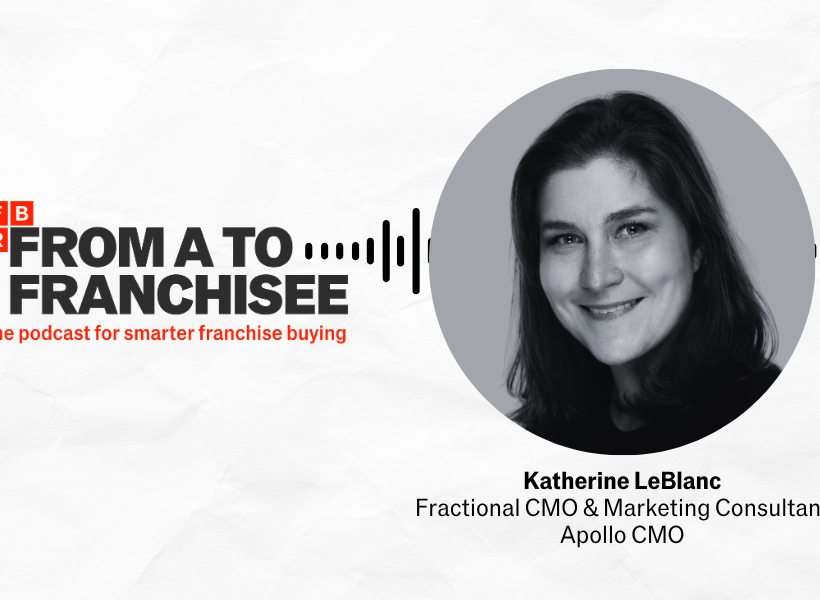
In this episode, Michelle talks to fractional CMO Katherine LeBlanc, who has over a decade of marketing experience in the franchise world.
Listen on Apple Podcasts | Listen on Spotify | Watch on YouTube
Resources
- 5 Most Important Questions to Ask Before Buying a Franchise
- Key Questions to Ask Before You Buy a Franchise
- Franchise Research Checklist
- Franchise Due Diligence Checklist
- What to Know Before Investing in a Franchise
Episode Summary
In this episode of “From A to Franchisee,” Michelle Rowan and Katherine LeBlanc discuss essential marketing questions to consider when evaluating franchise opportunities. Katherine, with over 20 years of marketing experience, shares insights into the complexities of marketing within franchising. They explore the importance of understanding brand funds, the role of marketing in franchise success, and the need for transparency and collaboration between franchisors and franchisees. The conversation highlights the significance of local marketing efforts and the value of investing in community connections to build trust and brand recognition. They also provide practical questions for prospective franchisees to ask, ensuring they align with the brand’s philosophy and long-term vision.
Transcript
Michelle Rowan (00:00)
All right, welcome back to our podcast from A to Franchisee. And today we’re gonna talk about five questions to ask when you’re looking at franchises before you invest that are specific to marketing. And before we get into that conversation, I wanna set the stage a little bit and our host that we have.
So today joining us is Catherine LeBlanc, who has 20 years in marketing. 13 of those years have been inside franchising. She has built brands from scratch. She’s operated inside a brand that has 500 to an 800 unit growth. She’s been part of that growth strategy. She’s also been a fractional CMO. So she’s been an employee. She’s worked for franchisors.
And so that makes her really an excellent guest for us to have this conversation around marketing, because it is so important to all businesses and franchises are no different. She also has two podcasts, Franchise Leader Spotlight and Dear Franny, which is an advice column for brands in the messy middle of growth. So she’s really got these relationships. She’s done the work and she’s got the relationships in franchising. So, Catherine, before we start talking about
candidates and questions that they should be asking the franchisor. I want to just talk about how complicated marketing really is just in general ⁓ and just kind of talk about the skill sets. I mean, you really have to be good at marketing. And so we were talking about before we record. Some people think they’re great at marketing. ⁓
Katherine LeBlanc (01:15)
Mm-hmm.
Yeah.
Mm-hmm. Yeah. Well,
everyone’s a marketer, Michelle. That’s just the bottom line. And everyone’s a marketer because everyone’s a consumer, right? So you see your social media feed and you see the brands in your social feed. You see commercials. You see how you interact with the brands that you interact with on a daily basis. And you have an opinion about everything that you’re seeing. And so in that respect,
Michelle Rowan (01:32)
That’s right.
Katherine LeBlanc (01:52)
everyone is a marketer because they are consuming what marketers are putting out there. And so that it does create some complexity when it comes to what should I be doing for marketing. And in franchising, I think that the marketing kind of arm of franchising is the secret weapon of franchising. You are pooling your dollars together in a brand fund that is going to do more for you as a collective than you could do on your own as a single operator.
you are learning from the collective. So not only do you have experts in the marketing seats that are kind of talking about strategy, talking about what you should do in your local market, but you have peers that are doing it, that are performing well, that you can learn from. And then, thirdly, it’s around the brand and the brand awareness, right? So when you join a franchise, you’re joining a brand and you’re not building that brand from scratch. And so I do think that marketing is one of the secret weapons of franchising.
Michelle Rowan (02:47)
Absolutely.
Katherine LeBlanc (02:47)
But,
and I think that you’ve seen this in your research, it’s also the thing that makes everybody mad. Everybody hates marketing. And I, you there’s a couple of reasons why everybody hates marketing. One of it is that, I think the biggest reason is that marketing is momentum. Marketing is the thing that is working when you’ve put in the work six months, nine months, 12 months before, and you’re seeing the fruits of those efforts compounded over time.
Michelle Rowan (02:53)
Yeah.
Katherine LeBlanc (03:16)
come to life when that momentum hits. And what’s frustrating is that you cannot point to one, two, or three things that created that momentum because it’s not one or two, three things, it’s 10. And they’re all working in perfect harmony to drive that momentum. And so the frustration comes when as a small business owner, I’m investing in my marketing, whether I’m investing time in my grassroots or investing dollars in my media spend, and I’m not seeing the fruits of that tomorrow.
And it’s just not how the world works. It’s not how consumers work. It’s not even just how marketing works, right? And the other frustration comes from what should I be expecting from my franchise or, and what should I be doing on my own? ⁓ And so, I completely understand where the frustration comes from, but the complexity really comes from the fact that everybody’s a marketer, everybody has an opinion and…
And when you’re not kind of trained at how to approach it, that’s when that complexity can sneak in.
Michelle Rowan (04:19)
Yeah, okay. So we’re gonna start with the data. So when we survey the franchisees and their brands, marketing and promotional programs always comes up in the bottom three, I would say, consistently. So right now, I just went and pulled this data, marketing is the lowest scored question on our survey. It’s still not a bad score. So when I say that, 72 of franchisees are rating their franchisors marketing and promotional programs.
above average. That means they’re answering it’s good, very good, or excellent. So that’s awesome. 25 % or so though are not happy with it. So, and some of the common complaints that we see in those are that they’re throwing things at us too quickly. They’re throwing things at us without a plan. We can’t respond and get these out into the… So like the marketing is there. I think that there’s an execution issue. And I think that…
Katherine LeBlanc (04:52)
That’s great.
Yes.
Mm-hmm. Mm-hmm. Mm-hmm.
Michelle Rowan (05:13)
there’s communication, there’s all the things that happen within a franchise. But I wholeheartedly agree with what you said is that franchising, the secret superpower of it is you’re being handed a playbook of what to do to grow your business. It doesn’t mean it’s going to do it without your effort. So the franchisor, if they’re a good franchisor, they’re providing you with a marketing plan, they’re providing you with assets, but you still have to execute. And so I think that that’s what we’re going to talk about today is
Katherine LeBlanc (05:29)
Mm-hmm.
Mm-hmm.
Michelle Rowan (05:43)
What are questions to help these people vet the marketing component of the franchise you’re buying into? But I also want to talk about just that beginning step of franchisors having to be really, really clear as far as, as the franchisor, here’s what our role is in marketing. And you already nailed it in that we are doing the research on the consumers. We are coming up with a strategy. We are creating the assets for you. We are…
Katherine LeBlanc (05:45)
Mm-hmm.
Mm-hmm.
Michelle Rowan (06:11)
focused on your competitors to make sure that we’re showing you how to differentiate. They’re doing all the strategy stuff and hopefully handing the franchisee something that is leaps and bounds ahead of what someone could do on their own, right? So, yeah.
Katherine LeBlanc (06:23)
Right. Yeah. Well, I
like to say like marketing amplifies what you’re doing at the local level. The franchisor is amplifying it. It’s not they’re not doing it for you. They can do it for you. That’s the whole point. And but but we should be amplifying it. And and there’s a number of different ways you can amplify it. And it really depends on the stage of where you are in the brand for this for the emerging brands, for the way that
franchise marketing works is that there’s three layers. The first layer is the brand fund. This is a percentage of your gross revenue that you are contributing to a brand fund that is a collective pool of dollars that should go to fund, and I have a philosophy on this, but my philosophy is that they need to go to fund things that are going to make it easier for you to invest in your local market and or they are, ⁓
investing in long-term sustainable brand building activities. So they are making sure the brand is going to be around in 10 years. Those are the two things that that brand fund should do. And at, in an emerging stage, those are the only two things really that the brand fund can do. And so when I talk about amplifying it, that means that if I pull up ⁓ email, for example, into the brand fund and I’m paying the platform fee for that email, that means that
$20, $100 that you’re paying per month can now go to local media. And the more you have in the external activations that you’re doing for your store, the bigger the brand is going to feel and you can build magnetism into your store through those efforts. And so that’s what I mean by amplification. We’re either pulling dollars up into the brand fund so that you can spend them locally.
or we’re investing in things that is going to make it feel like a brand, which then increases the magnetism that you have in your local market.
Michelle Rowan (08:17)
Okay, so emerging brand, people are coming into this as their first episode and not listening to kind of the past stuff we’ve done, smaller system, certainly not national awareness, more regional focused awareness, maybe under 10 franchisees, there’s different ways that people define emerging, but we’re talking about a small brand just getting started. ⁓ One thing, as you said that, I think that there’s varying degrees of how transparent franchisors are with.
Katherine LeBlanc (08:28)
Mm-hmm.
Michelle Rowan (08:45)
where they spend those dollars in the brand fund and how they spend them. I think that you’re gonna give us some questions that we can ask around that. there’s, you nailed it when you said, this is my philosophy. Any person in charge of marketing strategy is gonna have a different thing or way that they think about it. It’s just understanding how that brand defines the brand fund and what they’re using it for.
Katherine LeBlanc (08:51)
Yeah.
Yes, and I would say, you know, there’s no wrong answer as long as they are investing it in the things that they are legally obligated to invest it in. And so that, you know, that does bring us to the first question that as you’re going through Discovery Day, what are some things, you know, and this really stems from, look, I’ve been the marketing leader for six brands. I’ve been in franchising for the last 13 years. I’ve sat through a billion Discovery Days for a billion different, not a billion, a handful of different.
types of franchises, so from restaurants to wellness to experiences. And when I walk through the Discovery Day, and granted, the candidate has been through a number of different educational resources before they get to this day. And so this is just a question to ask during the process, but that brand fun question is important. And it is public knowledge. You have to…
publish in your FDD what that brand fund is being spent against. I had to build these reports for the lawyers every single year. But asking the next question around, how do you think about your brand fund? What is your brand fund philosophy? We’ll give you insight into are they investing in things that are going to make sure that this brand is around in 10 years, or are they investing based on the loudest voice in the room? Right? Because
and I’ll give you a little peek behind the curtain. One of the reasons why marketers are throwing things out fast and furious, we get a lot of pressure. We get a lot of pressure from the leadership team, the CEOs, the leaders that are running the brand, and then we get a lot of pressure from our franchisees. And then we’re trying to bring the voice of the customer into the strategy and the planning. And so all of that can lead to rollouts that are happening faster than we may have liked them to.
Rollouts happening on top of each other, right? One of the biggest problems is that you’re rolling out a marketing program and a new technology and a new ops program all at the same time. ⁓ so understanding, you know, how are they investing that brand fund? What are they looking at? The two things I would listen for are, are they investing in things that are considered brand building, right? So that would be things like research, things like creative, things like brand development, things like website investments, things like.
partnerships, even if you’re not at a national partnership level, if they’re investing in the influencer partnerships or the PR opportunities that as a small business owner, you are not going to have the opportunity to invest in, those are brand building activities that you can say, okay, they are thinking about the future. They’re thinking about the vision for this brand. The other thing that you want to listen for is are they investing in things that make my marketing spend ⁓ better?
Right? So that’s the things like what are the platforms and the technology that they’re putting into the marketing fund? Is it something that is going to help me spend my time and money in a more efficient way in the local market? So those are the two things that I would listen for if I was in the franchise prospect seat and ways that you can kind of push on that brand fund question ⁓ as you’re going through that process.
Michelle Rowan (12:18)
So the FDD, the Franchise Disclosure Document, the big document we’ve gone over it, we can link to the past episodes, will have, it’s either, it’s usually a percentage of revenue that you’re contributing towards this brand fund, or it’s a flat fee in some cases, a flat monthly fee. So those are the two ways that they’re usually presented. ⁓ I have a question for you. Do the second example that you gave of,
things they’re doing that make your dollars go further in your local market. Can you give an example of that? I’m trying to ⁓ just kind of like spell that out for a business owner to understand what’s a way that they could see that in action.
Katherine LeBlanc (12:48)
Mm-hmm.
Yes.
Yeah, and this is a way that
I have tried to communicate the value of brand fund dollars to franchisees in the past. And what I’ll do is I’ll put up a chart of these are all the things the brand fund is covering that would be double, triple the price if you were doing it on their own. So some examples are graphic design. This is pretty standard. First thing that brands usually invest in is going to be the creative that keeps everyone consistent in what they are saying because the way to
build brand is to be consistent. ⁓ And so the creative is one space where if you’re not having to pay a graphic designer to create a flyer every time you want a flyer, that’s a way that the brand fund investment is coming to life. The other thing is around marketing tech platforms. So this might be email, this might be text, this might be your loyalty program, ⁓ anything that to operate as a business, you would need to invest in.
⁓ That is things that we want to bring into the brand fund because if you’re not invest, if you’re investing in them through that 2%, we’re able to get economies of scale. So those dollars can go faster and you’re able to spend your local dollars on the things that are actually going to be transactional. ⁓ so marketing tech platforms. ⁓ The other big one is around website SEO, GEO, ⁓ building the website, ⁓ anything that they can do to enhance your Google business profile.
Most of the time, this is going to be a shared expense, but some is going to be in the brand fund. Some is going to be the responsibility of the franchisee because it’s become such a complex, heavily invested channel. ⁓ But you want to see some of that effort supported in the brand fund. So those would be three examples of ways that we are ⁓ making that you’re going to have to build a flyer, right? How do I make sure that that flyer is on brand? Because that’s going to help you
become noble, likable, trustable in your market? And how do I build a flyer that either you can edit or it’s gonna be turnkey so you’re not spending a lot of time on it? It’s those little things that really add up.
Michelle Rowan (15:02)
Yeah, perfect.
Okay, the other thing that you just kind of said in there quickly, but I do want to call it out, is you mentioned your brand fund dollars and your local marketing dollars. I think it’s important for us to also share that. The franchisor will usually, I think it’s more often in there than not, require you to spend an additional amount, usually a percentage, on your own in your local market. So,
that is separate from the brand fund. And I will say, and that could be a whole nother episode, it’s so important that you do this. And it tends to be the first thing that franchisees will stop doing when revenue is in a weird place. But like you said, the marketing is not usually, I market today, I see the dollar tomorrow. It’s a plan, it’s a strategy. So that’s why they’re asking you to do this on a monthly, on a consistent basis, because you’re building something.
Katherine LeBlanc (15:34)
Yeah.
All right.
Michelle Rowan (15:57)
And it’s important that you invest locally and not just in that brand fund and sit back and it’s going to drive.
Katherine LeBlanc (16:02)
Well, yeah.
And I would say that what is in the agreement and what you are saying, yes, I’m committing to doing, that’s a minimum. That is going to be a minimum spend. And usually the brands will have like, this is how we want you to spend it. And depending on the brand, there’ll be different kind of minimums they want you to meet. But I often talk to franchisees and want them to think about, you are a small business owner. And so when we…
you can take the same advice that we would give to a small business owner and apply it to yourself. You should be spending, I would say, 15 to 20 % of your revenue on marketing in the first two years of business. And then you can drop it down to around 8 to 10 % in years three through five. And then you can drop it down a little bit further, depending on your growth goals, to about seven to eight. And so in those agreements, you’re going to see…
typically it is a one to 5 % brand fund contribution and those percentage amounts vary based on what the brand is doing and how big the brand is. And then you’re gonna see either a flat monthly or percentage spend on local marketing. And so another, I would say one to 2%. That equals four, right? Two and two equals four. And so what I’m saying is that the folks who are really invested in growth and doing
doing kind of things by the book. The books say, heavier investment in the first part of your ⁓ launch and then dial it back, but it’s still around 10 % of your spend going to marketing. And that doesn’t mean, you know, it’s all going into paid media, right? As we’ve said, marketing is a plan, it’s a strategy, there’s lots of stuff involved with it.
But thinking that you’re going to be able to grow on a 4 % investment in marketing is a bit misplaced. And so those are some of the conversations that I have with franchisees on a regular basis.
Michelle Rowan (17:55)
Okay, that’s great. All right. So question one was how is the brand fund allocated and what does that get me? Let’s go on to question two. What’s the second question you would encourage people to ask?
Katherine LeBlanc (18:05)
So the second question is, what are your most successful franchisees doing for marketing? And this seems like a very simple question, but what I want you to listen for is, do they know, right? Are they saying generic, they’re doing grassroots and they’re following our program or do they know, hey, they are out every single week at a tabling event at the Whole Foods Next Door sampling this, this and this. They are sponsoring the big race of the town.
every single year and showing up with their whole team, with a team involved in it. ⁓ Do they know what creative is performing best for them? What products are selling best for them? A lot of times, ⁓ as franchisors, as brands, we have a bunch of different products that we sell and some do, the market split on your product mix is going to be different. So you wanna hear that they know exactly what their best franchisees are doing because it gives you two things. One, it…
says, hey, I’m paying attention to my franchisees. I’m not just developing marketing plans in my, what do they call it, my glass castle. ⁓ But number two, I am going to share what those best practices are with the system, right? So if they know it and they’re rattling off the top of your head, you know there’s a playbook that you’re gonna be able to follow. You know there’s a share that you’re gonna be able listen to ⁓ in what that best franchisee is doing. And so it’s.
they’re going to have an answer. It’s not whether or not they have an answer, it’s how much are they communicating the details of that plan and then saying, and this is how it can apply to you, because that shows that they’re really sharing and scaling those best practices.
Michelle Rowan (19:40)
Yeah,
well, and some systems do a great job of highlighting the top performing franchisees, either based on revenue, based on those skill sets they have, and they’re fostering that learning amongst the franchise community. So I think you can also flesh that out from asking that question too, and just how tapped in are they, but also too, how much are they really encouraging that community share? Yeah. Love it. All right, what is your third question that you would have them ask?
Katherine LeBlanc (19:51)
Hmm.
Hmm?
that her ex yes 100 percent.
Okay, so my third question is, what is working now and how do you know? And again, this is not like a gotcha question. None of these are gotcha questions. They’re just uncovering some things, some details around how they approach marketing so that you have your eyes wide open as you enter into this brand. And so what you’re listening for in this is number one, that they know what’s working. ⁓ And then number two, they can explain like, we think this is working because of this. And you know,
One thing I would listen for throughout all of these questions is the openness for collaboration, right? And so in this question, the way that you’re gonna hear openness to collaboration is going to be, this is working, this is how we got to trying this out, right? So let’s pretend like it’s a new product that’s working. Okay, well, what’s working really well right now is that we’ve just launched our refreshers line and our beverage program.
And we got to that because we looked at what our competitors were doing. We heard from our franchisees and we decided to launch with these. So, you you’re listening for, hey, I’m paying attention to the external world. I’m listening to my franchisees. And then I launched ⁓ a product that’s now working. And then the how do you know is, are you measuring it? Right? A lot of times marketers, and we’ve talked about this around, hey, we’ve got it. We’re pressured to what’s the next thing? What’s the next thing? What’s the next thing?
If we’re always launching and we’re not evaluating what the results of those launches are, we can’t learn and then grow and then do better the next time. And so in this question, you’re really listening for, they collaborating? What is working coming from collaboration and are they measuring it to then improve and grow on the backend?
Michelle Rowan (21:52)
Yeah. I also think that that question might also help you uncover ⁓ how many ideas or if they’re getting ideas from the market, like from franchisees versus that top down, like everything that are they tuned into your consumer in your local market, not just this kind of strategy down. I don’t know if I explained that right or not.
Katherine LeBlanc (22:04)
Yeah. Yeah.
and
Well, but I think you
hit on something that’s really insightful, right? You want to hear them talk about the customer because that’s the marketer is the voice of the customer in the room. And you, as the franchisee, tell you what, you’re not going to remember to be the voice of the customer. You have so many hats on it.
Michelle Rowan (22:20)
Yeah.
Yeah. Well, you just,
think this came, Allison can always ⁓ point it to another episode if I’m right on this one. But somebody said, cause the common thing that we’ll see in our franchisee surveys is that it’s a cookie cutter, it’s a one size fits all, it doesn’t work in my market. And the whole nature of franchising is follow the playbook.
It works no matter where, like the size of your community, where you are, it works. And somebody, I think it was on our podcast, if not, was something I was listening to somewhere else, talked about the marketing plan is the right structure and there’s flexibility for the things that make your market unique. I think I captured that correctly, but I was like, that’s like the perfect way to do it is like, this works no matter where you put it. And there’s a little flexibility for that kind of
Katherine LeBlanc (22:56)
Right.
Mm-hmm.
Mm-hmm. Yeah.
Mm-hmm.
Michelle Rowan (23:25)
local flair, flavor, whatever it is you want to put on it. I know it’s common and franchisors also think that they’re very unique and it’s unique to their brand. You have seen as we are, because we’re in so many brands, that you’re not as unique as you think you are. Similar challenges, similar successes, and there is a commonality in that it’s the franchise model.
Katherine LeBlanc (23:29)
Yes.
Yes.
Yep.
That’s right. No, look, and I, every brand I joined, it’s like, we’re a unique brand and every franchisee. My market is unique. It’s like, yes, okay. We’re all special. Now let’s, let’s work the program. Yeah.
Michelle Rowan (23:54)
Yes. That’s right. But yes, this franchise
was built that this will work no matter where you are. Yeah, that’s good. Another question I have before we go into your next question is, do you think marketing strategy or dollar spent changes whether you are a brick and mortar business versus a service business?
Katherine LeBlanc (24:00)
That’s right. That’s right.
But certainly the strategy does, yeah. I think that the strategy changes, the spend is a pretty standard spend. Where you spend might change. The base of your marketing strategy is the customer. It’s not the type of business, right? And so the customer, most of us are all targeting 25 to 45 year old women. We make the decisions in the house, right?
That’s the customer. And so how are you showing up for that customer when they’re ready to make a decision about your brand? And that’s where marketing strategy should start. ⁓ And where you’re going to see a lot of similarities in marketing strategy is going to be top of mind awareness. We all need to be top of mind and ready to be pulled down in that customer’s mind when they’re ready to make that decision. And so, I guess it’s both.
There’s similarities in the fact that you wanna be top of mind, which means that you wanna be present in the space that the customer is thinking about where you are. So as an example, health food brands, ⁓ let’s go be at the races, at the farmer’s market, the partner with the IV lounge down the street, because these are like-minded.
Michelle Rowan (25:20)
in the
Katherine LeBlanc (25:40)
they’re in that mindset of I’m trying to be healthy and here’s a food that I’m gonna associate with being healthy. Whereas your service-based brands might be, what’s happening at the school? Do you have a banner up at the school? Are you ⁓ visible at sponsorship in the true, the sports teams? Because you wanna be seen as part of the community, you’re not gonna necessarily attract a bunch of people to the plumbing convention, right?
But as part of the community, when I’m ready to do something on my house, I wanna go to a trusted resource. And so now I’m part of, my top of mind awareness comes from being part of the community. And so that part of the community is similar, but how you show up and where you show up is going to be different.
Michelle Rowan (26:23)
Okay, so for a franchisee that’s running their business, they shouldn’t be thinking about investing different dollars, different dollar amounts, whether they’re brick and mortar or service, it’s just gonna be a different strategy that the franchisor gives them to execute on. Okay, got it. All right, so we got questions one, two, and three. The third was what’s working now and how do you know? ⁓ And then next question that you would recommend people ask.
Katherine LeBlanc (26:36)
Yes.
So this is a little bit of a piggyback on the question three, but it’s what has changed in your marketing strategy in the last 12 months and why? And again, not that I gotcha, but you’re listening for I am learning and I am pivoting where I need to pivot. Because as we talked about earlier, right? Here’s the box, we want you to play in the box, but you wanna hear like, okay, I was at 10 units and now I’m at 25 units and…
What I’m seeing in this market means I’m going to try this over here. Right. And so you want to hear the innovation. You want to hear that they’re constantly thinking about what do they need to be doing differently. And this is also a window of listening for that collaboration and feedback. Well, it wasn’t working because we had three franchisees that ⁓ really couldn’t see the same success that we had replicated in our corporate location. So we took it back and we retooled how we rolled it out. And now it’s working. You know, that’s an example of something that you might hear.
And so in this question, you’re thinking, you’re really listening for, are they being thoughtful about their marketing strategy or is it, know, well, everything’s working. So it’s like, okay, well, then what do you do? What do you do if everything’s working? And so that’s what you’re listening for with that question.
Michelle Rowan (28:03)
Yeah, and I think we’ve talked about this in other episodes too with franchisees that have really called out. It’s common for when you’re a first, not a first franchisee, when you’re new to the brand, so your tenure is under a year or so, you think the franchisor is amazing. You’re leaning on them for so much support and as you get settled into your business, years two through five, you start going, why am I paying this into the brand fund? Why am I paying this royalty fee? And we had a franchisee share is like,
I think about those dollars going to my corporate team being focused on innovation. They’re testing things out. They’re focused on every AI tool that’s changing, it seems daily at this point. They’re doing all of that work and then rolling out the thing that will work for us in our business. And I was like, that’s a great way to think about it is that that is what your marketing leaders should be doing, that they should always be continually professionally and personally growing.
because they need to stay ahead, really ahead of consumer trends. ⁓ so, and then you have to make it work for a franchise system. it’s a complicated thing, but I think you need to think about how those dollars are being spent, not just for what you’re seeing today, but also all the stuff that’s happening behind the scenes that you don’t necessarily see it till it rolls out into your market plan. There’s a lot of work and learning that goes into that.
Katherine LeBlanc (29:01)
Mm-hmm.
Mm-hmm.
Mm-hmm.
Well, I think, you know, these questions are designed for you to understand what is their philosophy. So that on years five and 10, you’re you have a foundation of I know why they’re making these decisions. And that’s why I said, you know, there’s not necessarily a wrong answer. I I think there’s a wrong answer, but but everything is going to go to your investments. What you you you want to align because marketing is one of the things that is going to be
Look, it is, it’s just going to be the most frustrating thing because you are spending dollars and you’re giving dollars to a fund that sometimes is nebulous on what the return is. And it’s because that marketing is momentum and I cannot put a dollar amount on the brand building activity that I did in year one that is now paying off in year two and three. And so it is a kind of can be a black cloud or black hole nebulous thing. And it does cause some resentment and frustration.
And when you have that framing, Michelle, think that’s an awesome framing of my dollars are going into protecting this brand long-term and you are aligned on the philosophies and the way that this team is thinking about that long-term investment. It, it, that, you know, frustration in the later years can be lessened. And that’s the goal with these questions is to really get an understanding of the root, the foundation philosophies that you’re walking into.
Michelle Rowan (30:43)
Yeah, right.
Yeah,
yeah. we I constantly when I’m talking to franchisees are the franchisors one job is to make sure you get the best return on your investment when you go to sell your business. So when you are in year 10 and you’re in this brand fund and you know that these dollars aren’t helping just your market, they’re helping everyone’s you’re actually building your value of that that unit you want to sell at some point or transition to someone else in your family. So ⁓ I think it’s just not thinking about.
Katherine LeBlanc (30:58)
That’s right.
Mm-hmm.
Michelle Rowan (31:16)
were humans, the natural train of thought is, what’s in it for me? What are you doing for me today? But yeah, this is a long play. Okay, so that’s question four is what’s changed and why, or how are you staying ahead of the curve is another one. And then last question that you would give people to kind of suss out if these marketing teams know what they’re doing.
Katherine LeBlanc (31:19)
We are, yeah. That’s right.
Mm-hmm.
My last question is probably the most important. So how does a franchisee give feedback on marketing and does it actually get acted on? Now, having been in this seat multiple times, ⁓ it is hard to get feedback from 600 people. And as we’ve discussed at the beginning of this conversation, everyone’s a marketer. So everyone has an opinion on is this working? Is this not working? Now, certainly you need to look at the numbers, but everybody has a feeling about it, right? And so.
On one hand, it is hard to take in all of that feedback. But on the other hand, what you’re listening to is do they have a mechanism for it? Is there an FAC, a Franchise Advisory Council? Is there a Marketing Advisory Council? And if there’s not, there a channel to it? Do we have a monthly call where franchisees are open to giving feedback? Does the CMO say, actually, that’s a great question.
⁓ I like to get feedback directly. So I have an open door policy and we’ll take meetings whenever possible. Right? So what you’re listening for is you’re not, not necessarily like they have to have a marketing advisory committee, but you’re listening for this is, I enjoy getting feedback because the best ideas come from the field and the best action, actionable kind of initiatives come from conflict, conflict in the, in between marketing and operations conflict between marketing and the franchisees.
and it’s constructive conflict, right? Like this is why it’s going to work, this is why it’s not going to work. And so then that has the best result. And you wanna hear that openness to collaboration, constructive feedback, and then how do we make things better? So you’re listening for, do they have a committee stood up? If they’re a larger brand, they probably should. And if not, is there an open door policy? Is there a mechanism?
Can they say what their feedback mechanism is, is really what you’re listening for. And then does it actually get acted on? In reality, you don’t want this answer to be, of course, because if that’s the answer, then y’all are running and you are throwing spaghetti against the wall. You wanna hear ⁓ yes, when it makes sense for the entire system. You wanna hear, am a steward and protector of the brand. And Michelle, you said it perfectly.
I have to protect this brand so that your value is protected. That’s my job as the head marketer. And so that’s what you wanna hear is it does get enacted when it makes sense and it’s vetted out in a collaborative way. You don’t wanna hear everything gets acted upon because then they don’t really have a system. And so those are the things that you’re listening for in that question.
Michelle Rowan (34:18)
Yeah, well, and are they testing it? How are they testing it? Are they using different markets? The other is, do they do franchise business review? Because we do ask those questions too on it that can kind of give you a high level look at it. ⁓ But also the other is, are they in the markets? I think that’s a common thing too is the marketing team doesn’t necessarily get out into the markets. They might know their local market, but again, are they moving around and kind of understanding the brand perception from?
from different angles. So I think I would add all those to that. ⁓ You mentioned, well, I wanted to just talk about some of the common things that we see and we touched upon a little bit as far as like what’s in it for me versus everyone. What I see is it’s the transparency piece that can calm a lot of misalignments in that you don’t have to say yes to everything, but I think franchisers sometimes miss the no, but here’s why. Like we tried this and it doesn’t make sense.
Katherine LeBlanc (34:48)
Mm-hmm.
Right. Yeah.
Michelle Rowan (35:15)
for the entire brand and the transparency to the brand fund and not just like the, know what we’re doing and that clothes vested thing. I think just being more open and talking about the reasons that you came to your decision of no or yes can help people align with you even if it wasn’t their first vote or they didn’t align with you. So they respect it even if they don’t agree with it. I guess that’s what I would say.
Katherine LeBlanc (35:17)
Thank
Michelle Rowan (35:38)
Every franchisee seems to want national TV advertising.
Katherine LeBlanc (35:41)
Yeah. Yes, they
do.
Michelle Rowan (35:45)
Yes, so I think that’s just a good thing to tell people that are looking at franchising is it probably doesn’t make sense for your brand. ⁓
Katherine LeBlanc (35:50)
Yeah. No. Well,
I’m actually getting that question a lot less lately, ⁓ and it’s because of the fragmentation of channels that we’ve seen in the marketing world in the last five years. ⁓ TV is actually a lot more achievable at the local level than it used to be. And so there’s things that there’s.
Michelle Rowan (36:00)
Yes. Yeah.
Katherine LeBlanc (36:12)
platforms that will allow you to go OTT is over the top, CTV is connected TV, and then there’s even ⁓ some digital plays that you can get into the TV kind of space ⁓ in a more affordable way. So I don’t get that question as much, but certainly at the time that we form a brand fund, that question comes up. then at a time, anytime that you’re kind of talking about the initiative that’s not an external investment, that’s when that conversation comes up a lot.
But you mentioned something about transparency and I think that yes, transparency is where ⁓ trust gets built and understanding the why is where ⁓ that trust can get extended. But a lot of times I find that the franchisee frustration is coming from a place of fear and coming from a place of scarcity. I don’t know how I’m going to achieve my goals and I don’t know if what you’re working on is going to help me achieve my goals.
And so I think in addition to that transparency and adding the why is adding structure to it. Here’s how I’m going to be transparent. Here’s how I’m going to tell you the why. Because when people know what to expect, when you can create some predictability in how you are communicating, that’s what makes people feel safe and can bring down that fear and that scarcity mindset so that the messages land. I have found that when that fear and scarcity mindset is at
at its peak, it doesn’t matter what you say, the message is not going to land. And so I would encourage any system to develop, what is your cadence? What is your communication cadence? How can they expect to hear from you? And that almost needs to be protected so that the messages will actually land.
Michelle Rowan (37:59)
Yeah, I like that. ⁓ Then the other thing I will say is, ⁓ we talked about this a little bit before, is that business owners, franchisees included, are wearing a lot of hats. And so you get all this stuff from the franchisor, you still need to execute on it. So if you’re not good at it, if it doesn’t bring you joy doing it, I think just being aware that you can hire someone on your team or outside help to help you with your marketing efforts. And I think that that’s one thing that
I mean, I own a business with my husband, not a franchise, and I see him struggle with the marketing side of things. So I would just say, I think people just need to really put a lot of importance on the role it has in your brand. ⁓ So just understanding that if it’s not something that your franchisor provides and you’re not good at it, you can still find people that can help you with your business and help with that function and get it off your plate and see better results.
Katherine LeBlanc (38:33)
Mm-hmm.
Mm-hmm.
Yeah, well, I think the biggest investment that I want my franchisees to make is becoming knowable, likable and trustable in their market, right? So the brand creates something that is known. The brand creates something that is trusted. The brand creates something that is liked. That’s the job of the brand. And that’s what you’re buying into as part of the franchise. As the franchisee, you have to make it trustable, like a bull, knowable. And how do they, how do you do that?
You have to develop trust in your market. And that comes from being the face of your franchise, being the mayor of your community. And Michelle, think when you mentioned, if that’s not you, if you don’t want to go to the chamber meetings, if you don’t want to shake hands and kiss babies, that’s the hire that you need to think about making. ⁓ Becoming ⁓ noble, that’s investment. That’s going to be all media, right? So that’s not something that you have to know. But if you don’t know how to place the media, if you don’t know what media you should be running,
That’s something that you should hire for. And then becoming likable is the five-star customer service, right? That’s the word of mouth, the gold that you’re after. And so when you think about, I good at marketing or not? There’s so many different layers to marketing and really honing in on what do I need to invest in in order to get 10 times that investment? That’s what you really need to think about. And when I think about what, if I were the, when I coach the franchisees,
that number one investment is going to be community connection. And it’s different for different brands, but how are you developing that community connection? If you need to hire a face of your company, that’s the hire that you need to make. If you need to hire that likable piece, if your operations are not top notch, if that’s not your jam, that’s what you need to hire for. And so when you think about hiring out the marketing function,
Well, I want you to invest in the thing that’s going to give you the biggest return. And I’ll give you a hot tip. It’s not a social media manager. We want you to hire a social media manager later. That is part of becoming trustable, but it’s not the first. The first is, if it’s not going to be you, who’s going to be the face of your business and is going to be shaking hands and kissing babies every single day so that you become the trusted resource in your community for what you’re selling.
Michelle Rowan (40:54)
That’s right.
Yeah, well, and you’re responsible to drive that customer being a repeat customer. So that’s the other difference between the brand and the local experience is that is taking care of your team so that they deliver a perfect experience and you get the customer to come back. that’s all, that’s all on the local.
Katherine LeBlanc (41:20)
That’s right.
Yeah. No,
number one marketing task is to create a five star experience.
Michelle Rowan (41:37)
Yeah, yeah, I love it. All right, do we have time to do a quick lightning round of some questions with you? All right, what do you think is the biggest myth about marketing and franchising?
Katherine LeBlanc (41:50)
The biggest one. ⁓ Well, you know, look, the biggest myth and the thing that I fight against is that I can impact your sales tomorrow. I just I can’t. ⁓ Marketing is momentum and it takes 10, 10 different things working together to create the momentum that you’re looking for.
Michelle Rowan (42:07)
Yeah, well, and you gotta measure all those things too, to see kind of what’s working for you. Okay, so this lightning round question is one thing franchisors should stop spending money on, but I’m also curious what you think business owners should stop spending money on.
Katherine LeBlanc (42:22)
Specifically in marketing? We’re just going try. Okay. The one thing that I think franchise wars should stop spending money on in marketing. This is going to be a hot take. ⁓ I think we over invest in our websites. I think that ⁓ the website is starting to lose efficacy as a channel discovery channel in
Michelle Rowan (42:34)
⁓
Katherine LeBlanc (42:52)
consumer in the consumer space. And we are obsessed with being top of the heap with search results, which is important. But sometimes we invest in that over the long term brand building activities that are actually going to make us more findable because people will be searching for our name. So that I think we over invest in websites. And then on the franchisee level, ⁓ franchisees over invest hands down in digital marketing.
It is an easy button that they push and it loses efficacy within 12 to 18 months and it does not build momentum is a flash in the pan.
Michelle Rowan (43:32)
All right, I like that. You might get some comments on that one. All right, so this one is red flag that you can spot in the first five minutes of a discovery day.
Katherine LeBlanc (43:35)
Bring it on.
Yes, there’s a couple. ⁓ One of them is, ⁓ I’m trying to think of a non-obvious one. ⁓ One of the red flags that I can spot is engagement. Are they leaning forward? Are they excited about what they’re telling you? You can see the gears turning in somebody’s head, and if it’s blank, or if they’re turning too much because they’re figuring it, how does…
game the system, those are two red flags.
Michelle Rowan (44:16)
I think that works for really anyone you’re talking to.
Katherine LeBlanc (44:19)
That’s true.
Michelle Rowan (44:23)
What’s the one question franchisee candidates should ask but almost never do? ⁓
Katherine LeBlanc (44:32)
I think they should ask what is the long-term vision from the owner? What is your exit strategy, essentially? Not long-term vision, because you’re gonna get some brand platitude, but what is your exit strategy?
Michelle Rowan (44:39)
From, we’re the leader, yeah.
of the leader of the brand. Okay, okay. So that’s just.
Katherine LeBlanc (44:49)
of the leader of the brand. Yeah. Yeah. Because that gives you a
clue into how long are they going to be around? ⁓ Are they looking to sell? And sometimes, you know, they might skirt around the answer, but you’ll get some insights into like, how are they really thinking about this? And are they in it with me? Or am I going to be, you know, going through some changes, which are all part of normal day to day business, but you want to have a heads up.
Michelle Rowan (45:12)
That’s right. So there’s no wrong answer to that. You just want to kind of know what to expect. That’s really it. All right. So we talked about in your intro that you are a fractional CMO, fractional chief marketing officer. What is the biggest misconception about what a fractional CMO does for a franchisor or for a brand?
Katherine LeBlanc (45:33)
I think the biggest misconception if you haven’t worked with a fractional is that we’re not doing the dirty work. ⁓ The fractional, when you’re coming on as fractional is another word for part-time. And so when you’re coming on as a part-time employee of the brand, your hands are as dirty as your full-time counterparts.
And so I do think that sometimes that there is a misconception of, you’re just going to give me a plan. It’s like, well, no, I’m going to give you the plan. We’re going to get buy-in on it. And then I’m going to work the plan because that’s what you hired me to do. And so I think that’s the biggest misconception.
Michelle Rowan (46:07)
And we actually used a fractional CMO here at Franchise Business Review. So like any business owner can have a fractional CMO come in. And we actually had them fill a gap when we had someone leave. They ⁓ helped us run the business and then they helped us onboard the final replacement. So that’s just an example from our experience too. Like there’s people that can help you part-time too as a business owner that you don’t need to have a full body or pay benefits or do any of that. And that’s always a great solution for business owners to tap into.
Katherine LeBlanc (46:13)
I heard.
and
You know, I would add one more, Michelle, is that I don’t think that people, I think people underestimate the executive level thinking that they’re getting with a fractional CMO. So the perception is I’m just going to come in and do marketing. Anybody that’s ever worked with me knows I don’t do that. It’s you’re getting an executive level thinking on your team. And a lot of times, you know, the companies that we work with don’t quite have that executive team yet. And so you’re getting a ⁓
peek into the future of when I have executives working with me, this is what it feels like. And this is the value that they’re bringing to the organization.
Michelle Rowan (47:14)
Okay, cool. So let’s go back to the brand fund. What’s the most creative use of the brand fund that you’ve ever seen in your time in franchising?
Katherine LeBlanc (47:24)
have worked on some really creative projects. ⁓ And so the most creative use of the brand fund.
So I’ve done the athlete partnerships. Those are always fun. I’ve done the kind of experiential, bringing the brand around in a van types of things that are always fun. You know, I think that my favorite execution of brand fun and brand marketing is those bigger kind of brand building activations that you know are going to end up paying off in the future.
The most creative thing that I saw in a brand fund was leveraging a partnership to reinvest in the brand fund to then ⁓ bring that kind of product launch to the next level, which then brought in more new customers than we could have done on our own. And so the most creative kind of thing that I’ve seen happen in a brand fund is how do I get more money into this brand fund that is then going to amplify what I can do with it.
comes from brand partnerships. so anytime you have a brand partnership, you know, gotta leverage, leverage up.
Michelle Rowan (48:35)
Yeah, so that’s like the Doritos ⁓ taco at Taco Bell. So there’s an example of that. Yeah, okay, got it. All right, so I think this was great. So we’ve given some potential franchisees some good questions to understand how the brand fund is allocated. How does it help me? What are the successful franchisees doing in your system from a marketing perspective? What’s working? What’s changed? What’s kind of the future of the brand?
Katherine LeBlanc (48:38)
Right. And I’ll go, yes, yes. That’s right.
Michelle Rowan (49:05)
And then how are you getting feedback and testing and making changes? So I think these are all good questions for people to ask and know what they’re buying into. I appreciate you bringing your experience to our audience. ⁓ Any final thoughts or tips or ⁓ any ⁓ advice that you would give to someone that’s considering buying a franchise?
Katherine LeBlanc (49:26)
Yeah, I think that the due diligence you do today before you make the decision of what to buy is really going to set the foundation for how you feel about the brand in five to seven years. I think you don’t get pulled into the hype, get really analytical about what you want out of your life, out of your investment, and then make the make the right decision. And of course, you want to be pulled into the hype because you want to be passionate about what you do. But, you know, remember, you’re entering into a 10 year agreement. And so this is
one of the longer term things that you’ll be doing and you wanna work with people who share your foundation and philosophy.
Michelle Rowan (50:02)
That’s right. I love it. Well, thank you again for joining us. ⁓ And we always want to recommend people check out our site. You can get more data that we’re collecting from franchisees. And if there’s a brand you’re looking at, you can see if their report is available. And we’re always here as a resource as you do your research.
Katherine LeBlanc (50:04)
Thank you.