
Listen on Apple Podcasts | Listen on Spotify | Watch on YouTube
Episode Summary
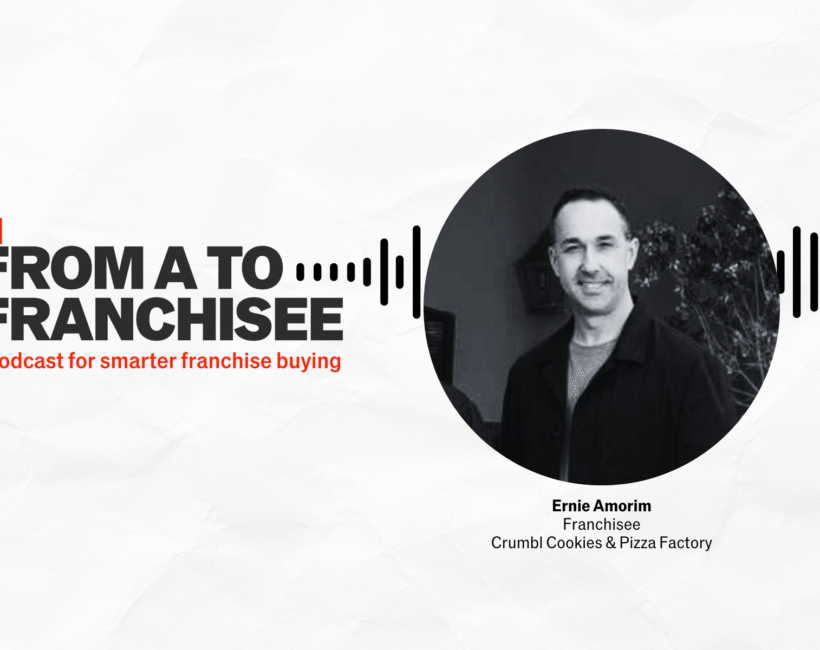
Michelle Rowan talks to Crumbl Cookies and Pizza Factory franchisee, Ernie Amorim, about the intricacies of operating a brick-and-mortar food franchise. Ernie, a seasoned multi-unit franchise owner, shares his journey from purchasing his first Pizza Factory franchise at the age of 23 to expanding his business empire to include multiple restaurants and Crumble Cookies outlets. The discussion highlights the challenges and rewards of managing food franchises, emphasizing the importance of community involvement, employee retention, and customer service.
The episode concludes with advice for aspiring franchisees, emphasizing the need for thorough research, understanding the financial aspects of purchasing and operating a franchise, and the value of patience and strong customer service skills.
We also share insights from our new Food and Beverage Industry Report, where we share our data from surveying over 5,000 food and beverage franchisees this past year.
*This podcast is NOT sponsored, but it does feature a franchisee of our clients, Pizza Factory. We encourage you to check them out and read their full Franchisee Satisfaction Report. They are on our Top Food Franchises List, which means they survey their franchisees, and their clients rate them highly!
Resources
- Download our FREE Food and Beverage Industry Report for 2026
- Read: Should You Buy An Existing Franchise?
- Listen: The Pros and Cons of Buying an Existing Franchise
- Read: The Top 5 Reasons to Hire a Franchise Accountant
- Listen: Industry Spotlight on 2 Mobile Food Franchisees
- Top Food & Beverage Franchises
Transcript
Michelle Rowan (00:52)
Welcome back to our podcast from A to Franchisee. And today we are talking more about franchises in the food and beverage space of franchising. Today we’re joined by Ernie Amorim, a multi-unit franchise owner in the food and beverage space. Ernie has spent years operating brick and mortar restaurants, building teams, managing the fast pace of restaurants and learning what it’s really like to run a successful food business day in and day out.
Ernie Amorim (01:00)
you you
Michelle Rowan (01:21)
The food industry can be exciting and rewarding,
but it’s also one of the most demanding sectors in franchising. From hiring and training staff to managing busy rushes and keeping operations running smoothly, there’s a lot happening behind the scenes. I have some data that I’m gonna start by sharing with our audience before we get into our conversation. So, quick service restaurant franchises will account for 322 billion in economic output this year.
That’s up 5.4 % compared with last year. From IFA’s 2025 franchising economic outlook, employment as fast food restaurants, which accounts for 45 % of the franchise workforce, is expected to top 4 million this year, which is up 2.6%. And the number of fast food franchise establishments is expected to grow 2.2%.
Ernie Amorim (01:55)
Okay.
Michelle Rowan (02:15)
to 204,366. So
this is a industry that is not going anywhere. You have to pry people’s pizza out of their hands. So today, Ernie’s gonna give us an inside look of what it’s really like. And so we will talk about the realities of operating restaurants, the pace of his business, and the lessons that he’s learned along the way. Ernie, thank you so much for joining us today.
Ernie Amorim (02:39)
Thank you for having me, Michelle. ⁓
Michelle Rowan (02:41)
I think the most interesting
thing to start with is what were you doing before you became a franchise owner?
Ernie Amorim (02:47)
Well, it’s a little interesting. I grew up on a dairy, a family farm. so from the time I was eight years old, my parents had their own business. And I had just graduated from CSU Stanislaus in Turlock. And my fiance had mentioned that we had an opportunity to buy a pizza place in Gustine where she had worked in a small little town outside of where I lived. And it happened to be a pizza factory. And I had always wanted to own a restaurant.
So we tried Pizza Factory and here we are today.
Michelle Rowan (03:20)
So first of all, my mother dated a dairy farming family all through high school and I married into a dairy farm where, this is a total random story, but we still live on the dairy farm land. The dairy is still in production. It’s now part of the Cabot Collective. But my husband and I own a brewery and our spent grain goes back to the cows on that farm. it’s, I was gonna say, you probably went from the only thing that’s harder than owning restaurants to something.
Ernie Amorim (03:44)
that’s very awesome.
Yes.
Michelle Rowan (03:50)
because those cows, need you day in and day out. That is insane. Okay, so how old were you and was your fiance at the time? How old were you? Okay, my gosh. my gosh. Amazing. So I feel like that’s even less common then, so early to be able to buy a business.
Ernie Amorim (03:54)
Yes, yes.
We were 23 when we first started Pizza Factory. It was a year after we graduated.
Michelle Rowan (04:10)
when you and your then fiance, now wife, decided to buy the restaurant, was it just kind of the goal of owning a restaurant and seeing what it was like? Or did you have a bigger plan even from the start?
Ernie Amorim (04:20)
No, at the time of 23 years old, it’s let’s give this a try and see where it goes. We had no idea we were going to be this involved in restaurants down the line. So.
Michelle Rowan (04:29)
And so you
bought it from an existing franchise owner.
Ernie Amorim (04:33)
Yes, an existing franchise owner. Yeah, it had been there for a while.
Michelle Rowan (04:34)
Okay.
Yeah, so why you said that your wife always wanted to own a pizza. Why pizza? Why was that kind of top of mind for you both?
Ernie Amorim (04:44)
Well, that’s where we first went out to dinner with pizza and then we’ve always just loved pizza and I’ve always loved pizza and so we just thought we’d We start with pizza, but it wasn’t actually because of pizza It just happened to be the pizza factory ended up being for sale and we thought it was a good opportunity To be that was a small community 5,000 people were like, hey, let’s give it a shot
Michelle Rowan (05:00)
Awesome. Okay.
So, okay, at 23, how are you financing buying a restaurant, a franchise? And can you go back and think about what it felt like? Did you have a lot of support from family and friends around you? How did you kind of learn what you
Ernie Amorim (05:17)
Yeah, we did have a lot of support
from my parents and my parents pretty much helped us finance the restaurant and then made a payment plan for us to pay them back and that’s how it started.
Michelle Rowan (05:27)
⁓ So they weren’t on the franchise agreement. It was really up to you and your wife. Okay. And what do you remember about starting? What do you remember about being the best parts of it or the hardest parts of it when you’re that young kind of jumping into an existing business?
Ernie Amorim (05:30)
Yes, yes.
⁓ The scariest part was just hoping that it was going to work because you you ask your parents you ask your family for some money and then if something doesn’t pan out so just hoping that this new adventure that you have an idea of that you want to just not just try but you want to do will work so that was you know and making sure that it goes good it goes good.
Michelle Rowan (06:01)
And ⁓ now how many restaurants do you own now?
Ernie Amorim (06:04)
Today we own, as of right now, 12.
Michelle Rowan (06:07)
what did building your empire look like? How long did you have the first before you decided to grow more? And are all of your restaurants with Pizza Factory or do you have a mix? Okay.
Ernie Amorim (06:15)
We have a mix. have our own
brand and then we also have crumble cookies.
Michelle Rowan (06:19)
Excellent, okay, so
you’ve got the dinner and the dessert covered, so we’re good. Yeah, so take us through the one to 12. What was that like for you? When did you first go into the next restaurant that you purchased and what version was that?
Ernie Amorim (06:23)
Yes, yes.
Yeah, it’s and we still kind of maintain it now that my parents are retired and I also have my brother. So we maintain it as a family business. So yeah, it’s a big family operation. Everybody’s involved. Everybody has a has their part in it. ⁓ My brother is involved also in the pizza factory and crumble cookies. And we started with gusting with one store in 2005. And then we wanted to grow from there. But gusting is a 5000.
Michelle Rowan (06:40)
Excellent.
Ernie Amorim (07:03)
population of 5,000 so it was kind of small and we needed to branch out. So Pizza Factory told us that there was another store for sale in Salinas. So we bought the Salinas store in 2008 and then in 2014 we grew to two stores because we had sold Gustine to a manager and because it was kind of far to run from Salinas to Gustine so we…
Michelle Rowan (07:27)
That’s what I was gonna ask you.
When you went to two, what was the distance or the time it took for you to get between those two locations? Okay.
Ernie Amorim (07:34)
Yeah, it’s an hour and a half. So it was getting,
and sometimes a lot of traffic on a certain highway that we have to take. So we ended up selling dusting off and then we opened a second one in Salinas, which was, which did phenomenal. It’s it’s our best store as of today.
Michelle Rowan (07:38)
Yeah.
And I love that you sold the first door to a manager. I think that we talk about this in a couple other episodes where it’s kind of important to think about what your succession plan might be from the beginning. It can obviously change, but I think ⁓ that’s, we see it more and more with the manager that either you’re helping finance or they’re kind of building up their equity in the business. It’s a great way.
Ernie Amorim (07:51)
Yeah.
Yes.
Michelle Rowan (08:11)
to have someone that has operating experience in your business take it over. So I love just kind of sharing that, calling that out from your first door. Okay. Yes. I love that. I love that. You helped them get started. Okay. So you owned two pizza factories as of 2014. Then what happened? How did you continue growing?
Ernie Amorim (08:18)
And as of today, he’s still a franchisee, which is nice. Yeah, that’s great. Yeah. Yeah, it’s awesome.
Yes.
Then we had an employee that he worked for us part-time and he was a chef at a different, a long-time Italian restaurant and he’s always wanted to do his own thing. So ⁓ we partnered up with him and doing our own store called Pasta Mia. It’s in the mall, in the food court. It’s kind of a fast casual pasta place. So we pretty much just do pastas, garlic bread and salad.
And we also have a dinner restaurant called Patria that’s downtown Salinas. And he is the main chef there and also a business partner. And that restaurant does very well.
Michelle Rowan (09:08)
Okay.
⁓ So now we’re at four restaurants. Okay. And then how did you grow from there?
Ernie Amorim (09:16)
Now we’re at four, yeah.
And then Crumble Cookies came into play. Well, during COVID, everything was shut down. We went back to our hometown to visit some people in Turlock. This was in 2020, where the first Crumble Cookie in California started. And we tried the cookies. It’s really good. My brother actually tried it. He brought them home and it was a summer day. And he’s all, oh, you got to try these cookies. And I was like, oh, okay, they’re good. Maybe we should look into the franchise. And I was like, okay, we do pizza and restaurants, desserts, cookies. There’s 14 people working in there.
I was like, 14 people making cookies? So this was when Turlock was the only store in California and everybody was coming to the Crumble Cookie Crease. So he bought these cookies on a Tuesday, 14 people are working. So then the following week I said, I’ll go try them because we were in Turlock again. So I went in and tried it again. There’s like 15, 16 people running around customers in and out, in and out on a Wednesday and like a Wednesday. So we, from there, we’re like, maybe we should get into this.
Michelle Rowan (10:12)
You
Ernie Amorim (10:16)
So we submitted an inquiry for our Salinas all the way to San Jose area and we did the interview process and all that. Aside from loving the cookies, the cookies were phenomenal. ⁓ We were accepted to do a five store ADA.
Michelle Rowan (10:34)
Okay, so an ADA for our listeners is an area develop agreement, which means that Ernie committed to opening five stores, whether that’s him or other people, five stores in his territory over a scheduled period of time. So all five of those are now open. There we go. That’s 14, right? No, that’s 13. We’re missing one.
Ernie Amorim (10:36)
And that was 2022.
Yes.
Yes.
Yes. Yes.
because number eight is opening next month. Yeah, the equipment’s going in tomorrow.
Michelle Rowan (11:02)
Awesome. Okay, there we go. All right. So there’s
Ernie’s journey of owning his food empire. So Ernie, when you look at all of your organization, how many employees are you employing right now? How many are you dealing with with all these locations?
Ernie Amorim (11:17)
We have about a little over 200 employees. Yeah.
Michelle Rowan (11:19)
Okay, so this
is what I want to kind of dig into a little bit in that when we talk to franchise owners specifically in food and even going to the COVID time where hiring and retention of staff in restaurants is very, very difficult. Do you feel like you have a good, like you’ve done something with the culture, with how you’re taking care of your employees? Is that still one of your top challenges or do you have, how do you manage 200 people across all these organizations?
Ernie Amorim (11:34)
Yes.
Yeah, well have people in place like we have the shift leads that lead each store and then we have for crumble we have actually a pizza factory as well. We have area manager. So the shift leads are reporting to the area manager and I do talk to the shift leads and I talk to probably all the employees because I’m in and out of the stores a lot. ⁓ But basically on stuff that has to get done the day to day the shift leads are talking to the area manager and then we’re talking every day.
Michelle Rowan (12:07)
Yeah.
And do you feel like you have a good ⁓ retention rate with your employees? Do you think that, I just feel like you have to really be intentional about the culture you’re creating in order to allow you to scale and have this many businesses because moving a 200 person organization is very complex.
Ernie Amorim (12:27)
Yes.
Yeah, that’s it.
And I feel like we have a good culture. We don’t have a lot of turnover. Our employees, they like to work for us. A lot of other franchise, like, how do you keep them? How do you keep them? Well, I mean, we do pay the $20. We’re in California. We’re paying the $20 an hour, which I think gives us a little bit of advantage. But we also listen to our employees and what they need. A lot of times things come up. I can give you an example from yesterday.
Michelle Rowan (12:39)
That’s great.
Ernie Amorim (12:59)
you know somebody’s godfather passed away you know it’s like it’s no problem I can’t come the next two days you know we get it covered we find a way to make it happen to whatever the employee needs if we care about them they’re gonna care about us and I know it’s like we don’t we try not to make it like it’s just another person it’s not another person I mean we really need them and I really feel that to make our stores great we have to have great people if we don’t have great people you’re not gonna have a great store
Michelle Rowan (13:26)
Yeah, that is fantastic. And I think we’re really trying to encourage franchisees to think more about or just being intentional in the culture they’re creating because it is such a difficult, you can’t grow if you don’t have a stable team. ⁓ Which roles do you think were most important to get right from the beginning ⁓ as you decided to scale? What were those? Was it the area managers? Was it those shift leaders? What is the crucial role for you that allows you the time to continue building new ⁓ opportunities?
Ernie Amorim (13:39)
No you cannot.
At the time when we were smaller shift leads because we were the area managers like me and my brother can oversee a lot. But as we grew it, the main person who’s going to be checking in is very important. That person needs to be on board. And the people that we have now being word that we’re in 2026 have been with us for over the area managers have been with us for over 10 years. So that helps a lot.
Michelle Rowan (14:22)
Yeah. Are there particular qualities that you’re looking for when you hire that kind of, know, will be a good fit to ⁓ get their work done and allow you the space to do the higher level stuff that you need to do?
Ernie Amorim (14:34)
Yeah, well, ⁓ when we hire, ⁓ we’re looking at as far as from a regular employee to all the way to the top, number one, one of the best characters, number one characters is customer service. mean, knowing how to interact with people because the food can be great, but if the customer service is off, they’re just not coming back. I find that, you you need to have an amazing product, but you need to have amazing customer service. you want to, people need to feel welcome. Like they want to come.
Michelle Rowan (14:54)
Yeah, yeah.
Yeah.
Yeah, yeah. I grew up waiting tables and I always look for that when I’m hiring. I think if you have worked in a restaurant, you can do customer service. I love it. Yeah, yeah, yeah, yeah. That’s right. If you were a long-term employee in restaurant. Okay, so food and beverage just in general is known as a really fast-paced environment. What does a typical day look like for you as far as in your leadership position? You mentioned you’re still in the stores a lot.
Ernie Amorim (15:06)
Okay.
Yes, yes, you can. Yes, yes. Well, sometimes. Yes, yes.
Michelle Rowan (15:32)
take us through what it’s like, how you spend your time across all your restaurants.
Ernie Amorim (15:36)
I’m just checking in every day with the area managers. My furthest store is probably an hour right now, about an hour and 20 minutes, which is a crumble cookie. ⁓ I check in on the stores probably four times a week. So I’ll be driving around to all of them, just seeing how things are going, asking employees how they’re doing, how’s the week, how are the cookies, how are the customers responding.
But a lot and also a lot of it every day I talk to the to the general managers. Yeah, we talk every day.
Michelle Rowan (16:08)
Yeah, that’s good. So
you’re kind of getting from the front line, what’s the read on the customers, on the product. So you’re kind of going right to that front line employee and understanding that.
Ernie Amorim (16:19)
Yeah, daily, daily, ⁓
Michelle Rowan (16:21)
What
about, are there any operational systems that you have in place that you feel like help you either ⁓ manage the business when you’re in the restaurants or even when you’re away from it, how are you looking at, or what are you looking at for the processes in those restaurants to know that things are running smoothly or when you might need to spend more time on them?
Ernie Amorim (16:40)
Yeah, on one side, which is our crumble franchise, we have an app that pretty much tells us how many cookies are labor by the minute. So everything that’s happening right now, we know exactly in every store, whether how many hours of labor employees clocked in, how many cookies have gone out in the last hour. We know all that information. So those tools like that help a lot.
Michelle Rowan (16:59)
Yeah, then,
yeah, that’s awesome. Do they give you any ⁓ opportunity to benchmark your performance against other stores or averages or things that help you kind of understand the performance of your store to others?
Ernie Amorim (17:13)
Yeah, they do. Yeah, like everybody in our area that’s doing about what we’re doing. We’re in those categories and it shows everything and how we’re stacking up against them. In terms of ⁓ labor, yeah, especially in terms of labor, how many cookies we’ve sold, all that is being tracked. It’s nice to be able to know those numbers.
Michelle Rowan (17:22)
Yeah, does that help you? Yes.
Yeah, so.
Yeah, that’s what I going to say, just to kind of understand where you fall into that. And then do you have the opportunity to reach out to people that are doing better than you as far as like percentage of labor? Okay, so thank you.
Ernie Amorim (17:41)
Yes. yeah, yeah. And everybody’s pretty,
pretty, very accessible. Other franchises in our area are really good. Yeah. Yeah.
Michelle Rowan (17:46)
That’s great. Yeah, that’s awesome. OK,
how about in the early, either when you’re opening or in those early months, what type of support did you get from your franchise or that really helped you kind of get things going and find your groove in that? And that could be from your experience at any of your brands.
Ernie Amorim (18:04)
Yeah, from the build out or just operating the store?
Michelle Rowan (18:06)
Both, I think because
your first one you bought was existing, I think going through a build out is much different. So just, yeah, if you wanna talk about that, just how did the franchisors support you as far as getting your doors open and then kind of hitting the ground and getting things started once you did open.
Ernie Amorim (18:10)
Yeah.
It is.
Yeah, Crumble pretty much was step by step because every store is pretty much, no pun intended, it’s a cookie cutter store. We’re almost all the same. But so it’s step by step. have, from day one, they tell you exactly what needs to be done. Pizza factories are not exactly the same, but there’s also help involved there in letting us know how we should do it, who we should contact. ⁓ The hardest part in building a store is, you know, your permits, the city and the county.
After you get through that, you’re home free, but that’s probably the hardest part is going through that.
Michelle Rowan (18:56)
Did the franchisor help you as far as picking your location or help you work through those permitting processes or is that really something that’s so unique to your county that you’re doing that kind of solo?
Ernie Amorim (19:07)
Yeah, I did that probably. We had a little bit of help, but I also have a real estate agent that helps us in pick locations. But we have a, and my brother have a good, we’re pretty good at picking a good location. So we don’t have any stores that like are like, we shouldn’t have done this story. So because of the location.
Michelle Rowan (19:18)
Yeah.
Yeah, so
if your franchise or doesn’t help with that, there are outside real estate firms and people that can help you because it is important to get that spot right to give your business the best shot at success that you can have.
Ernie Amorim (19:28)
Yes, yes.
Yeah, especially if you live a little bit away from that location. You want to have somebody who, like we had somebody who’s been in the San Jose Bay area for 30 years. So she was great in helping us. know, every location she’s told us has been phenomenal. ⁓
Michelle Rowan (19:48)
Yeah.
Yeah, that’s a good point too. If you’re not super familiar
like your town, you might know that great traffic spot, but other towns, yeah, go into the experts. I love it. Now that you’ve been in ⁓ Pizza Factory for so long and then Crumble Cookie for a while, what is the type of support that you’re still relying on the franchisor? That you’ve been through build-outs, you’ve done that now. So what do you feel like is the benefit as far as how they support you or your team or what you’re doing now that you’ve been in it for so long?
Ernie Amorim (19:56)
Yes.
A lot of the support that we rely on is marketing and innovation like new products, a new pizza coming out, a new cookie coming out, a new type of dessert, a new drink ⁓ is always helpful and that’s what we rely on the franchise to stay updated so we can stay updated and in front along with everybody else that keeps pushing new stuff out. For example, like the Dirty’s Hoda’s is a big hit this year, like they’re coming out, coming out, so Crumble now is coming out with Dirty’s Hoda’s.
Michelle Rowan (20:38)
Yeah, so this is.
I it. So that was going to give that example. So these are called limited time offers or LTOs. Yeah. So, and they’re a big part of a lot of business models because they give you that product that brings that person in. It’s a limited time. So they got to get it before it goes. And then they’re providing you the marketing to also push it out to your audience as well. So that’s kind of just explaining that to people like that’s why marketing is so crucial from your ⁓ franchise or when you’re in food, because a lot of these things are
Ernie Amorim (20:50)
Yes, or LTOs. Yes, yes.
Michelle Rowan (21:14)
that urgency, they’re driving that urgency of that customer getting into your location or repeat customers coming back. There’s a reason too, because they have a new flavor, they have a new product that you want to drive. Yeah, I haven’t had one of these dirty sodas yet. My daughter’s obsessed with them.
Ernie Amorim (21:23)
Yes. Yeah.
okay. Yeah, that’s awesome. Yeah.
Michelle Rowan (21:30)
Yeah, we have little trucks that are popping up too. Yeah, ⁓ I think you said to the franchisees that are kind of in your local-ish area too, that they’re very accessible. So you guys are talking about your businesses or asking questions of each other. You’re getting that support in the business as well. Okay.
Ernie Amorim (21:33)
okay, yes, I’ve seen those,
Yes.
We are, yeah, on both
sides, the cook, the crumble and pizza factory. We have, I have some great franchises around me for that.
Michelle Rowan (21:54)
Yeah, yeah, that’s
great. And I think that’s really important too, just knowing that you can reach out to them because they’re running the same business as you in a similar market. Yeah. So the other thing I want to talk about is it feels like to me a big part of owning restaurants is also you’re probably heavily involved in your community because they’re usually the ones that are kind of showing up. How important do you think that is to your business or what kinds of things are you doing to make sure that you stay top of mind or you’re supporting your local community?
Ernie Amorim (22:01)
Yeah, they’re going through the same thing.
Yeah, 100%. That’s very, important. ⁓ Schools, for example, in Salinas, we’re in every high school. So we’ll sell pizzas to the high school and they’ll turn around and sell slices at their football games, volleyball games. So we’re involved in every high school. We have banners at every high school. We do the sponsorship. So we’ll put our banners out there. ⁓ We do a lot of the fundraiser nights. Those are phenomenal. we’ll do a pizza. Usually we schedule them on Wednesday nights.
Michelle Rowan (22:47)
Yeah.
Ernie Amorim (22:51)
So people can sign up online through Pizza Factory. And ⁓ as many people that come in and mention the fundraiser or bring a flyer, we’ll donate 25 % back to that organization. And we do this every Wednesday. ⁓ Our Wednesdays are pretty full. So sometimes we’ll even stretch it to like a Thursday or Tuesday if they really need it. Hey, we really need this fundraiser, so we’ll help them out that way. ⁓ We have another fundraiser we also do. It’s a pizza card.
Michelle Rowan (23:06)
That’s awesome.
Yeah.
Yeah.
Ernie Amorim (23:21)
where the student or the people selling the cards will sell them for $10. They’ll make the whole profit. And in turn, there’s like 10 coupons in there, a free pizza with the purchase of a pizza, or a free breadstick, or some wings, or something like that, where the people that are buying the card for $10 will automatically save on their first sticker, and in turn makes a lot of money for that organization. But also in turn, we receive
those hopefully 10 coupons back in as an additional like a sale. A repeat customer, yes, thank you.
Michelle Rowan (23:52)
Yeah, a repeat customer. Yeah, yeah,
yeah. I think it’s important just for franchise business owners to know, like, you have to be very heavily supporting your local community to get that market share and to build that loyalty. And there’s a huge opportunity to do that. I think sometimes before getting into a franchise, you can think, the franchisor is going to get all the customers. But like you said, you have to have a great team that takes care of them, that has great service, that makes these people want to come back to your location. ⁓
Ernie Amorim (24:02)
Yes. ⁓
Yes. Yes.
Yes, very important.
Michelle Rowan (24:22)
What do you find the best part of being a business owner is for you and your life?
Ernie Amorim (24:28)
What’s rewarding the most is you get to make your own schedule, but it is a very busy schedule. You feel like you’re the boss, but you can do whatever you want in a way, but you also have to be there for your stores. Another thing that’s rewarding is having great employees and seeing your employees grow. Sometimes we have employees and for a year or two, six months, they’ll leave, but there’s a lot of them that feel bad when they leave.
Michelle Rowan (24:35)
Yeah.
Ernie Amorim (24:57)
I’m like, oh, I don’t want to leave, but I was like, well, you’re doing something better. So I always tell them, I have no problem if you’re leaving and you’re going to something better, but don’t tell me you’re leaving and you’re going to the competitor. Cause what can we do to make it better for you here? You know, I know they’re offering you another dollar. How can we make it better? Is that the only reason or, you know, stuff like that. But most of the time when a lot of employees have left and then they come right back, you know, whether they go try another field or whatever. But yeah, a lot of times when people are leaving us, they’re not, they’re excited to go to their new adventure.
Michelle Rowan (25:07)
Yeah.
Yeah. Interesting.
Ernie Amorim (25:27)
but they feel, you know, they’re a little sad that they’re leaving our company, which is really nice to see because it’s like we’re doing something right. Yeah.
Michelle Rowan (25:30)
That’s great. It really is. Yeah, yeah. Well, because how they
leave your organization is how they’ll talk about your organization. So it does make your next hire easier or harder depending on that story they’re telling out in your community. So you always want people to leave ⁓ on a high note for the brand.
Ernie Amorim (25:38)
True, true, Yeah.
Yeah.
We get a lot of applications every day. Which is nice. Yeah, it’s very nice.
Michelle Rowan (25:49)
Yeah, that’s so great. That’s yeah, that’s so great.
⁓ Now, how about the hardest part? What is the hardest part of your days or the hardest part of being a business owner?
Ernie Amorim (25:58)
The hardest part is making sure that everything goes good and that you’re not going to fail and you want to continue success on down times or down months. It can be a little stressful, you’re worried, hey, is this going to turn around? Are we going to make it? But it seems to always work out, but you just always have that in the back of your mind. If this doesn’t work, what am I going to do?
Michelle Rowan (26:23)
Yeah.
Ernie Amorim (26:25)
So far for as long as we’ve been doing this, works. The business has a lot of cycles, a lot of up cycles, a lot of down cycles too, but it seems to average out. So that’s probably the hardest. There’s worrying about sustaining.
Michelle Rowan (26:37)
That’s great. and I think that’s, yeah, well,
it’s a good, something to be mindful for people that are thinking about getting into franchises. What is the seasonality of the business and asking those questions of franchise owners to understand how you can prepare for those anticipated slower times. Sometimes you don’t have control over it or don’t know what’s coming, but seasonality you would. And I do remember coming out of COVID, all of the kind of restaurant wars of people just stealing employees for that extra dollar and,
Ernie Amorim (26:44)
Yes.
Right, yes that happened, yeah.
Michelle Rowan (27:07)
that was so stressful.
So I’m glad that you made it through that. But that was, we heard about that a lot, just like, I get that the dollar is really important for them, but it’s so hard to train people and just keep that revolving door turning that you’re just kind of spinning your wheels. It’s hard.
Ernie Amorim (27:19)
Yeah. Sometimes
it might be worth to give up the dollar because if you start thinking about the training of the next person and all that and the time, it’s like.
Michelle Rowan (27:24)
Yeah.
Yeah, that’s good advice. Yeah. Okay, so what kind of person, you’re thinking about a person that would do really well in a food franchise, what is that type of person? What traits do they have or personality or what do they really need to be willing to do to be successful as a restaurant owner?
Ernie Amorim (27:46)
⁓ Number one is probably customer service and being able to work with others. This is a people business, know, it’s people, people, people all the time. You’re serving people, you’re working with people, and a lot of patience. A lot of patience.
Michelle Rowan (28:01)
Yeah, patience is a good one.
Yeah, you’re probably working with lot of younger people as well at the front line. So you got to do some kind of mentoring as well. ⁓ What do you think that they should really think about or do when they’re researching a brand? Are there things you would recommend that they do ask ⁓ or think about before they invest in a brand?
Ernie Amorim (28:06)
Yeah. ⁓
Yes.
Yeah, for sure. would definitely talk to other franchisees, see how the brand is performing, really research the brand, see the trends of the brand. Have they closed a lot of stores? Are they opening a lot of stores? ⁓ Are their stores refreshed? Is it a brand that’s pretty old and every location you go to looks stale, looks old, they don’t update? Because that could affect your brand. If there’s a few stores around you and they’re all look like they’re still from…
you know, versus 2025, that could make a difference, you know. You don’t want to get into something that’s stale or maybe the franchise or is not up to date or is just running, just like a run of the mill store, just going, going, going. There’s no updates.
Michelle Rowan (29:06)
Yeah, I think
that’s a good point, because it is a big investment when your franchisor comes to you and says, we’re going to do this refresh. And it usually happens probably at least every 10 years, if not more frequently, ⁓ for franchisees. And typically, it’ll come up that you have to do it before you can re-sign. So if you’re up for a renewal, they’ll require you to do that. And it’s a big investment. But I think you put it in a nice term that you’re really protecting the brand when you’re staying current.
Ernie Amorim (29:10)
It is.
Yeah.
Michelle Rowan (29:33)
If you think about a pizza parlor from 1990 versus a pizza restaurant now, very different look. And it is important because you want that continuity of the brand and you don’t want someone to discount your store and your location because they’ve been somewhere else that was really dated. So that is a hard thing between franchisors and franchisees as far as getting everybody through that remodel schedule, but it is really important for the brand.
Ernie Amorim (29:39)
Yes, yes, yes, yes.
Right, right.
Michelle Rowan (29:58)
⁓ And if the franchisor has done a great job, they’re communicating to you the why this investment is being ⁓ required. Sometimes they’ll have financing options, the franchisor will. Other times it’s completely on you and out of pocket and it’s usually over a time schedule. So that is something you should think about getting into a food. If they haven’t refreshed recently, it’s probably gonna come up for you soon when you become an owner.
Ernie Amorim (30:11)
Right.
Yeah. Yes,
yes. And making sure that the franchise or cares about a refresh, you know, because if he’s if the franchise or is not making others do a refresh, you might have a nice brand new store. But sometimes people have perception of what the one in the next town over looks like and then they don’t come in or yeah. Yeah.
Michelle Rowan (30:26)
Yeah. Yeah. Yeah.
Yeah, yeah, great point. Okay,
we’ve covered a lot, Ernie. Is there anything else you feel like we haven’t talked about that would be helpful for people thinking about becoming a food franchisee or anything that you wish you’d known before you jumped in at 23?
Ernie Amorim (30:52)
Yes, wish I’d known in 23 is very young. My parents didn’t have any experience with the type of restaurant or with any type of restaurant. If you were to buy an existing one, do some research. How much stores are going for? Talk to an accountant who does accounting for restaurants. I just feel we paid a little too much for our very first store. So that’s one of the biggest mistakes. ⁓ But going forward, I’m, you know, well today in today’s world, I kind of know how much we should pay or shouldn’t pay.
Michelle Rowan (31:14)
Yeah, great.
Ernie Amorim (31:21)
If we’re buying it, we have bought existing stores. So, ⁓ but yeah, do your research when buying an existing store. And then when building a store, get a few different quotes from a few different contractors. You know, don’t go with the first one. It might seem, it might seem like a good deal until it is a good deal when somebody gives you a better deal. a couple of quotes is always great. Yeah. But buy an existing franchise. would definitely run the numbers and speak to an accountant that does.
Michelle Rowan (31:39)
Yeah, that’s good. Yeah, always get a couple quotes that you know you’re… Yeah, that’s great.
Ernie Amorim (31:50)
has a background in restaurant accounting. Yeah.
Michelle Rowan (31:53)
Yeah, that’s great. I
appreciate your time today, Ernie. This was great and I think people will learn a lot and great to hear your story and all your success in restaurants. Thanks.
Ernie Amorim (32:03)
Thank you very much. I appreciate
it.
Michelle Rowan (32:06)
So for our food sector report, I’ll share some data from that, but that is something that you can get from our site where we share just more specific findings from food and beverage franchise owners. This year we surveyed over 5,000 food franchisees across 60 brands, and we do share this list every year. Pizza Factory is on that list, so we definitely would love for you to go and check that out. From food franchisees, what they shared with us is 82 % said that they enjoy being part of their franchise organization.
and also 82 % enjoy operating their franchise business. 78 % respect their franchisor and 78 % said their fellow franchisees are supportive of each other. And then three out of four said that the franchisees are supportive of the brand. So it is a very engaged community. The 30 brands that rank the highest in owner satisfaction, those are on our top food franchises sector report, and they produce annual incomes of 25 % higher on average.
The top 10 highest income brands on our list produce annual incomes of 97 % on average, higher on average. So there is a correlation of franchisee satisfaction and growth opportunity. So we really encourage you to check out all the brands that are sharing their reports on our site and let us know if you have any questions as you dig in to potentially owning a food franchise. Thanks for joining us.