
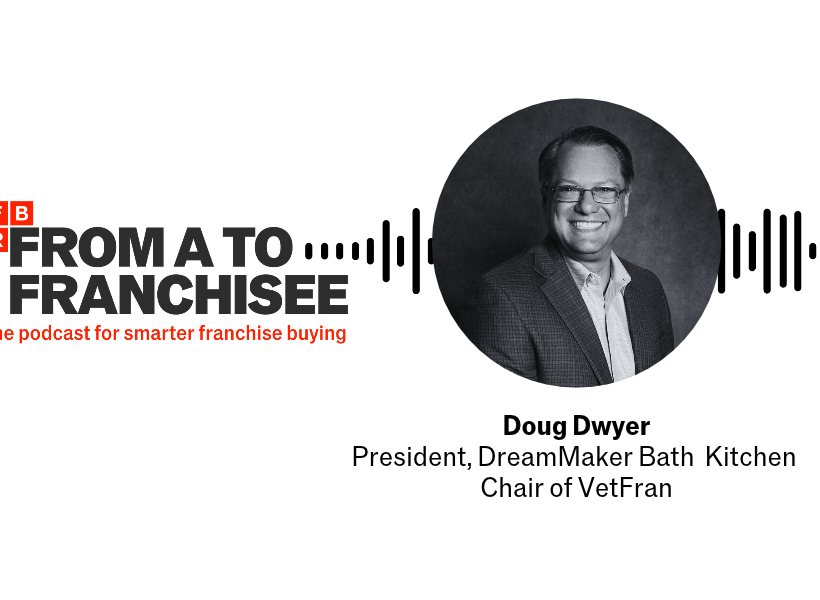
This episode is about Veterans in franchising. We talk to the chair of VetFran, Doug Dwyer.
Listen on Apple Podcasts | Listen on Spotify | Watch on YouTube
Veterans make up 7% of the U.S. population but 14% of franchise owners. Host Michelle Rowan talks with Doug Dwyer, president of DreamMaker Bath & Kitchen and chair of VetFran, the International Franchise Association’s veteran initiative, about why the franchise model fits people leaving the military so well. Doug explains the three things that separate strong franchisees from the rest (work ethic, attitude, and following the system), how VetFran discounts and military-focused programs can lower the cost of getting started, and what to look for in the Franchise Disclosure Document. Michelle adds FBR survey data from more than 2,000 veteran franchisees. If you’re a veteran weighing business ownership, or anyone considering a franchise, this conversation covers how to do the due diligence that protects your investment.
Show Notes
Guest
Doug Dwyer, president of DreamMaker Bath & Kitchen and chair of VetFran. Doug has spent more than 40 years in franchising and regularly speaks at military bases through the Boots to Business program.
What you’ll learn
- Why veterans are twice as represented in franchising as in the general population
- The three traits Doug looks for in a strong franchisee, and why following a proven system is the biggest separator
- How VetFran works, including brand eligibility requirements and the typical 10% to 20% discount on the initial franchise fee
- Which sections of the FDD to read closely, including Item 19 (financial performance) and Item 20 (franchisee turnover)
- Where veterans can find training, financing options and further reading before they buy
Key takeaways
- Skills transfer. Learning a demanding skill in the military shows you can learn a franchise system, including the financials that may feel intimidating at first.
- Follow the critical systems. Strong franchisees follow the system closely, and Doug notes that even hitting the critical parts can produce strong results.
- Talk to existing owners. Nothing replaces calling franchisees. Build rapport first, then ask about hours, a typical year and how long it took to break even.
- Watch for turnover. A franchisor with heavy turnover in Item 20 is a red flag worth investigating.
- Start early. Prospective owners can begin due diligence before leaving the service, and should protect their savings so they still have capital to invest.
- FBR data on veteran franchisees. Of 2,000+ respondents, 83% enjoy operating their business, 82% would recommend their brand and 82% say fellow franchisees support each other. 44% own multiple units, and 82% are age 45 or older. Reported pre-tax income averaged $122,000 on average revenue of $1.6 million (self-reported).
- Resources mentioned. vetfran.org, Boots to Business and Reboot (through the SBA’s Veteran Business Outreach Centers), The Field Manual for Veterans in Franchising by Jack Childs, The E-Myth Revisited by Michael Gerber and Profitable Partnerships by Greg Nathan.
Connect with Us:
Visit FranchiseBusinessReview.com
Follow us on Instagram, @franchisebusinessreview
Subscribe to our newsletter
Check us out on YouTube, @FranchiseBusinessReview
Connect with us on LinkedIn
Transcript
Michelle (00:02)
Welcome back to From A to Franchise E. Veterans make up just 7% of the U.S. population, yet they account for 14% of all franchise owners. Today’s guest is Doug Dwyer, president of DreamMaker Bath and Kitchen. Doug’s also the chair of VetFRAM, the International Franchise Association’s initiative to connect veterans with franchise opportunities. And he knows why this path fits so many people leaving military service.
If you’re a veteran or you’re simply curious about how franchising rewards discipline and follow through, this one’s for you. Doug, thanks for joining us today.
Doug Dwyer (00:38)
Michelle, thanks so much. It’s a pleasure and an honor.
Michelle (00:41)
So I want you to start. I you have you have a personal connection to Vet Fran. So I my first question was gonna be when and how did Vet Fran start? But I want you to tell us a story about your connection and how it started.
Doug Dwyer (00:54)
Sure. So my family got into franchising back in the mid seventies. we’ve been bit at it, what is that half a century now? So
Michelle (01:03)
my gosh.
Doug Dwyer (01:04)
quite quite a long time. But my father is m my father’s deceased at this point, but he he was uh served in the military in the army and in nineteen ninety one when Desert Storm was going on.
he was at a IFA convention, which is an international franchise association convention, and he was getting ready that morning, he just had this brainstorm like, wait a minute, all veterans, they don’t just need to go get a job. we need to give them a pathway and uh an understanding that they can get into business for themselves, leverage their discipline, understanding protocol and following procedures and discipline, and leverage that and get in business for themselves.
And and so that that started as a brain child and he uh he had a guy on we had a guy that was our PR and marketing guy, John Hayes. And anyway he talked to John, they had a breakfast meeting and anyway, it all started out with that spark of an idea. And I will tell you it took a lot of uh effort, fight and m funding by my father to get this started back in nineteen ninety one.
And with a lot of fight, just like military, you have to fight. We’re going we have that’s happening right now in the world, right? But you have to fight, fight, fight to keep things alive, keep something good. And and so ultimately, Vet Fran got started uh August fifteenth, uh, nineteen ninety-one. A memo of understanding was signed by my father as the chairman and the founder of Vet Fran, starting it out, and then the current president of the IFA at the time, and then a gentleman from the
small business administration and that was the start of it and and how it really began. And there’s some funny stories in there, but that that’s how it began.
Michelle (02:53)
Yeah, I l I love that. So veterans own more than one point six million US businesses and employ roughly three million workers and generate around one trillion in annual sales. So this I mean, this is an impact on our country that veteran business owners are having. So what I think is really interesting is when we when we started, it was the the the population of veterans in our country is
half of the percentage that we see showing up in franchise ownership. Why do you think that is that we see so many franchise um owners have that military background? What what what does it work, why does it work well for them?
Doug Dwyer (03:37)
Yeah, yeah. So I I the the the best I understand the stats is that if you take the US you take veterans and active military, they represent seven percent of our US population. And then in the franchise space, they represent fourteen veterans represent fourteen percent of franchise owned businesses. And so I I think it really comes down to what I just rattled off a minute ago. You know, there’s just a a a really strong match of success.
and then the thing about the military uh community is it’s a very tight community. They help each other out, kind of like a good franchise company. They help each other and they let others know about it. So then the word gets out. So they do a better job than the s their civilian counterparts, letting others know, hey, this is something good, and they help their brothers and sisters from the military get into business with them, working for them.
And that can lead to them getting in business for themselves, or they just share the stories and they they go straight into business for themselves. So that I’ve really it’s I’m not a veteran uh from the military, I’m a veteran franchising with over forty years. And but so it’s been a joy. I’ve spoken at three different military bases, uh about I don’t know how many times now, five, six times to presenting a boots to at Boots to Business program.
educating military about it. So one of the biggest challenges is that veterans just don’t know what franchising is. Like the
Michelle (05:08)
Agreed.
Doug Dwyer (05:09)
major they just it they they know there’s McDonald’s, it’s a franchise, and that’s about it. They just don’t really understand that there’s so many opportunities in in a category that would really be an interest to them that meet their passion.
Michelle (05:25)
Do you so do you think that there’s specific skills that they uh are using or they gain in the military that transfer well? So I’m thinking about you as the CEO of Dreammaker, when you’re looking at franchise candidates coming in, what types of skills are you looking for from your franchise owners or potential franchise owners that you find those qualities in a lot of people that are coming out of the military?
Doug Dwyer (05:51)
Yeah, so you gotta have people that uh are passionate about what they’re gonna do, they gotta work hard, they they’ve gotta have the capital, right? So that’s one thing. So that’s gonna kinda dictate what kind of business a lot of times, right? If you you know, you’re not gonna go open a a big hotel space multi million dollars if you’re straight out of the military. That’s typically not gonna happen. But i I I don’t think it’s any different for a
civilian versus military, you you want somebody that wants to grow a business, they got a desire to grow a business. For us, they have to match our values. We have a code of values. We want to match the values that we have. Is that a good match? Are we a good culture match? And then and then you’re gonna get into money, and then the thing about the military, the like the three things that really separate a a very good, good and not so good franchise.
i if you look at just three things, you look at work ethic, you look at attitude, and you look at following the system. And so a very good franchise, they they have tremendous work ethic. They’re gonna, you know, I don’t think you have to work seven days a week, but in some brands you do. But if if you gotta work six days a week to get it up, get it going, they’re gonna put the six days in the week, ten, twelve hour days to get it off the ground. And once you get off the ground, then you can get back to more forty, fifty hours a week.
And then and then attitude. They they they just have that resil yeah. If I can’t go through the problem, I’m gonna go around it. If I can’t go around it, I’m gonna dig under it. If I can’t dig under it, I’m gonna go climb
Michelle (07:24)
Yeah.
Doug Dwyer (07:25)
over it. They are just the most resilient, the very good ones. And then and then it comes down to following the system. Like with our brand, we have twelve categories of our how our system is organized and 188 measurements. And and and so when you look at that, we know that.
the very are very good franchises, they’re in the ninety percentile of following our systems, but they really gotta make sure they follow the critical ones because you could be at seventy percent do really well with us if you’re hitting the critical systems. And so th those three things, work ethic, attitude, and following the system and where the military comes in, it helps with both the first two, but the big separator is
willingness to follow a proven system, that there’s a franchise or a franchisee, hey, well they developed a system. I need to follow it. I need to listen to my coach. So that’s that’s a difference maker.
Michelle (08:16)
Yeah. Yeah. So and and I love what you said in that there there’s a lot of franchise investments that are I I mean, we do our low cost opportunity, which I think is all in is under a hundred and fifty thousand dollars. So I like that you you pointed out the fact that a lot of people coming out of military might think that they can’t afford a business and do this. And so I know we’ll get into vetfran and the and the kind of incentives that some brands are offering, but I think that letting them know how that it this isn’t accessible.
business opportunity for them. But also I think that there’s education to be done in just how their military, the skills that they’ve honed in the military really make them bus great business owners. And you nailed it with their problem solvers. Like they are they are going to figure out what it takes to be successful. And that tenacity, I think, drive is does a business owner of any kind really well because it is hard, especially those first few years. But I think, yeah.
Doug Dwyer (09:11)
Well, and I s
so I I’ve I’ve in speaking live on military basis to, you know, folks that are exiting the military or retiring, I I I ask, you know, how many of you have an interest getting into business for yourself? And usually it’s about half the room, uh and then the other half don’t raise their hand, but they’re in an entrepreneurial training class and I’m like, Okay, so you guys are trying to figure out if business is right for me or not? Yes, that’s what we’re up to.
Michelle (09:37)
Yeah.
Doug Dwyer (09:38)
So I tend to ask a lot of questions ’cause I don’t want surface answers. Typically is not the truth. to help them understand, I said, what’s a skill? And it’s different with every class, but what’s a skill, what’s something you’ve learned in the military that you thought, I’ll never learn this. This is so hard. But then they dedicated the time and they did the energy and it was s some might be two months, six months, or it might have been
you know, a year to become really proficient. One was a helicopter, so that was a little longer. but but they got it. I said, so that’s how franchising is. We have a system, process, and training. You can come in and learn it. So if you learn that, you can learn this. I don’t know all your jargon in the military. I’m not retired. I I’m not I didn’t serve in the military, so I don’t understand all the levels in the military. Can’t rattle them off like you all can. But I know PL’s balance sheets, spreadsheets, cash flow, that’s intimidating to you.
Well, it’s not to us because we live in that space. So just know you can learn it. So you gotta the big the big thing is find something you’re passionate about, get in that space and and then because that that’s half the battle. And then but then be willing to follow the systems and learn. And and then wow, you know, you can get tremendous results. I mean, our franchisee in Ogden, Utah is one of he’s out of the Air Force, to Nate Coombs, a top performer, second generation, bought the business from his dad.
And but it they’ve they they yeah, they almost doubled well they did the best year I think they’ve doubled the company since they’ve bought it and maybe six
Michelle (11:09)
Wow.
Doug Dwyer (11:10)
years ago. So it’s cool to see that live happening.
Michelle (11:15)
Yeah, it’s excit well and the other thing too is I think veterans tend to be more tied into their communities. So I think that’s also something that makes a great franchise owner, uh, in that the hardest part I think I see when we look at data is that uh it’s hard for business owners to understand how important it is for them to be out in their communities.
making uh those connections and and that’s really a great way to build your business. And so I think that’s another skill that they bring in and just that they are community focused and more servant leadership style of how can I serve others. And I think that also brings uh a unique perspective to being a a leader of their own business. So that’s great.
Doug Dwyer (11:56)
Well to tag on what you’re saying is we we have a thing i in DreamMaker Bath and Kitchen or full service, you know, design build remodeling with the design center. So it’s a a larger investment to get into. But what we we started out with the five pillars of marketing, but then we turned it into the five drivers of marketing. So uh you know, one would be face to face marketing, exactly what you’re saying. So there’s all these different ways that you can get involved in your community.
to grow it, but understand, uh just for the listener, I just understand that it takes a mix of marketing tactics from face to face to online to signage to the old traditional radio, TV. now TV’s changing a lot. Those are all changing a lot. But there’s there’s five main categories of that and you have to have a good mix. And so finding a franchise or that’s dialed that in so that you you can be successful using their system.
Michelle (12:47)
Yeah, I think that’s great. So in our data that we do each year, we had uh responses from over 2,000 veterans that were franchisees. And 83% of them enjoy operating their business and 82% of them would recommend their franchise brand to others. And then 82% say their fellow franchisees support each other. So I think that just kind of reinforces what you were saying in that they’re more they’re they understand more of that teamwork, that dynamic of how to support each other or tell others about the opportunity.
I know that you said so Vet Fran, so let’s start with what is VetFran? How does a how does a franchisor, what are they doing, what are they signing up for to be able to share the vet fran symbol uh and show that they’re committed to getting more veteran owners within their system? What does that mean if they say that they’re part of Vet Fran?
Doug Dwyer (13:37)
Yeah, so vet fran there’s qualifications for say if you’re asking about franchisors, right? Brands. And and so for the franchise or they have to have been in business three years so that there’s some miles and they’ve proven themselves. Uh they have to have uh, you know, uh more than ten units. And so there’s some qualifications there and they have to be willing to offer a minimum ten percent discount, uh and uh, you know
Peop typically it’s ten to twenty percent is the most common. Some some will do more. But it the the original vision was to offer ten to twenty percent discount on the upfront front franchisee. So for like for I’ll s for for for my brand it’s a f say a f average fifty thousand dollar franchise fee, so we we’re giving twenty percent, so it saves that veteran ten thousand dollars. So that franchise or needs to be willing to do it and the benefit to the franchisee is they they get a they
They get in for less for joining a brand that’s part of Vet France.
Michelle (14:36)
Yeah. so you’re trying to help them mitigate their risk and their research by saying like, hey, these brands are not just brand new and they have at least ten other franchise or ten units open and operating. and then they have a full list of different brands. And there’s really I I looked at it and there’s brands in all segments of franchising are part of that fran. So going back to your point of you need to find a service or product you’re passionate about and this will give you an opportunity to start with some that
offer you some kind of discount on that upfront franchise fee. So it’s a good place to start.
when I wanted to get into more of the financial picture now. So uh in our data, we had veteran owners report an average annual pre-tax income of $122,000 and an average annual revenue of $1.6 million. So we always like to do the caveat of these are self-reported. So these are uh franchise owners that have have answered this question for us, and every business owner
Handles the expenses through their business differently, but we do try and share some of that revenue ah and uh sales revenue and the pre-tax income just to give people a sense of it. And then we saw fifth 44% of franchise owners own multiple units. Back to your point as far as in the beginning, especially, you have to be willing to put a lot of time into your business to make sure it’s successful. But when we look at our franchise owners that are veterans that answer the question,
They said 62% of them said that they work 40 plus hours a week, and 82% of them are age 45 or older. So these are not people coming right out of the military in most cases, which might afford them to be able to look at other opportunities that have a higher investment level. so I think that’s just interesting data to share if you are a veteran out there listening to this. Um so I think what I would ask you, Doug, just your your involvement in franchising for so many years.
We like to try, we have a separate episode and we can always link to it that goes through an F D D, but what would you tell what would your advice be to a veteran that is looking at a franchise owner? How can they use the F D D and what other things would you recommend t to them for them to just learn more about franchising and figure out if this is the right opportunity? Where would you tell them to go? What would you tell them to look for?
Doug Dwyer (16:54)
Yeah, so in a i i in the franchise disclosure document that you’re talking about the FDD, it it really gives you twenty-three items in there. So it’s like a book. And it tells you that franchise or has to give you the experience of the executives that are leading the company, so you know what they’re like. Has there been bankruptcies, have there been lawsuits? I mean t the that’s the first three or four. Tell you all about that. But then it gets into the the investment levels.
gets into the training provided. So it’s rich with a lot of information and then what the royalties are and fees, et cetera. But the one area that is probably the biggest one you want to look for, because it’ll definitely show some maturity of a brand is item nineteen. And in the item nineteen it’s financial performance representation. So like for our brand we’ll list what is the average uh unit of our
Like our average franchisee does over one point five million uh from last year. And and then how many of those break down in the top twenty-five percent, the second, third, fourth, and and then what average gross profit margin are they able to produce uh as franchisee? What’s our average job average? So when you can start getting data like that, it helps create a little bit more comfort and and security about okay, I I I can get enough.
just data on this, uh, but nothing replaces, and I’m sure we’ll talk about this later, but nothing replaces getting on the phone or go and going to visit franchise locations. I if
Michelle (18:26)
Absolutely.
Doug Dwyer (18:27)
I was gonna do it, due diligence is the biggest miss by anybody looking at getting into business for themselves, whether it’s military or not. You need to do your due diligence and and really dig into it hard. And on vetfran.org there’s
resources on how do you do that? What does that look like? And then there’s a great book by a guy named Jack Childs that is a franchise or has been a franchisee, been he’s US Army and Air Force, and it’s the Field Manual for Veterans in Franchising is the name of it. And it says the unofficial guide for the US military veterans seeking information about franchising. But he just speaks about it as a veteran
the hard truce and he really hammers that due diligence part. And then chapter four is really inspiring to see all the people from the military and how well they’ve done in franchising. Not all of but a a a lot of ’em and it’s very inspiring. So I think that’s just a great resource.
Michelle (19:29)
Yeah, that’s a great so that’s a great call out. Um, what I what I always find fascinating is it seems to you who’s been in this for so long, to us, because we collect franchisee feedback, how much we talk about the importance of talking to existing owners in the brand. It is so crucial. And I was at uh an an industry event that was focused on growth and development a couple of weeks ago and talking to someone on their development team that said it surprises her the number of
Candidates she’s talking to that never talk to a single owner, not a single owner. And I said, Well, isn’t that your role? And she’s like, Michelle, I give them a full list. I give them our FDD, has a list of every single active owner. And she says that it’s they don’t require it, which I think some franchise do require you to have a certain number of conversations. But you have
Doug Dwyer (20:15)
We do. Yeah.
Michelle (20:16)
access to all these people that are running the business you want to run. So um, you know, you don’t want to go at them and say, How much money are you making? Cause they’re they’re not gonna answer that question.
But you want to get at, you know, how long did it take you to be up and running and or break even? Those kinds of questions can help you really build out a plan to make sure that you have the best shot at being successful. So it’s a it’s an underused resource when people are looking at brands, uh, for sure. You mentioned vetfran.org. You I wanted to know, is there
Other kind of resources that you want to call out that are available. You mention mentioned the Boots to Business program. Is that something that they could do virtually or is that only a an e is that something you do at events that are in person?
Doug Dwyer (21:01)
So the boots to business are done on US military bases only.
Michelle (21:05)
awesome.
Doug Dwyer (21:06)
you can sign up to attend those, and um most are exiting military, but some are some that have already exited and they sign up to attend. And then there’s um there’s one that’s done at colleges. Uh there’s not as many of those available, but it’s called Reboot. And and so it’s all it’s controlled by the V boc
Veteran Business Outreach Centers by the SBA. And
Michelle (21:31)
Okay.
Doug Dwyer (21:32)
so that if you if you look up VBoc you know you’ll find that website and you can look up where all these are happening. So this year there was about 60 a month happening across the US for the boots to business
Michelle (21:46)
Wow.
Doug Dwyer (21:47)
and about 12 a month for the reboot.
Michelle (21:50)
That’s fantastic. Do you think, Doug, that it’s something that people that haven’t exited yet, because you’re doing this on basis, could they research, could they talk to brands and get this ball started while they’re still in the military? Or does it make more sense be until they fully exit to really do this research?
Doug Dwyer (22:10)
so my experience is we w uh our personal experience, we’ve had many that we talk to before they’re out. I think it’s always wise to start your due diligence earlier and prepare because what happens is I had one case where a guy uh he already planned like the dream home and the dream spot and all of these things and and he’s sunk all his money to that and really didn’t leave any money to be able to get in business for himself. So so that
wake up call like wait a minute, maybe I need to think about this different. Maybe I need to get the business up and going before I, you know, unwittingly uh give up the opportunity to get into the business I wanted to get into because I’m strapped for cash now.
Michelle (22:56)
Okay. So franchise or teams will typically work with them and have these conversations or help them at least get started as far as where do you see yourself? Awesome.
Doug Dwyer (23:03)
Yeah, I think
any brand worth at Salt will will help them with that. And again, you know, there has to be some initial qualifications and
Michelle (23:12)
Yeah.
Doug Dwyer (23:13)
and and you know, is is there a match? You know, do you have the economics to do it or can you get the economics to do it? So, you know, they’re gonna invest time with you uh if you can prove out that you’ve got the ability or somebody that’s willing to help you.
Michelle (23:26)
Yeah. Okay. So you mentioned the the veterans um focused organization that’s part of the SBA. Are there uh financing options or incentives or discounts for veterans from that side as far as funding their business that we should make make sure that the audience knows that they should be checking those out as well?
Doug Dwyer (23:46)
Yes, all the programs are different depending on what your status is in the military it just varies and you have to really dig harder to find those. So one one bank Navy First Credit does a really good job.
of that and there’s others that offer discounts but th that can come and go. So you need to find you know do do your current research on that and then really talking to our director of vet friend Wendy Coons at the at Vetfriend through the IFA. She could be a great resource so that you know if you’re listening to this, you know, a a year from now, things may change and it may be a different uh finance company that’s got the best deal.
Michelle (24:29)
Yeah. Um, so they can go to vetfran.org, but they can also reach out directly to to Wendy or to the VetFran program if they are looking for additional support or have questions just to kind of point them in the right direction.
Doug Dwyer (24:43)
Yes.
Michelle (24:44)
That’s awesome. Um, okay. So when you think about all the conversations you’ve had with candidates that are or or even just through the Boots to Business program that you’ve been part of.
What is a piece of advice or something that you’d give to a person considering a franchise that they should do before they buy, uh, or just advice in general before they start uh they start their business as a franchise owner? What what piece of advice would you give?
Doug Dwyer (25:14)
uh w late lately I’ve r you know recommended reading a book by Michael Gerber called The E Myth Revisited. And it’s just it’s an older book, but it’s cla it’s awesome. And it’s just got so much truth in it. So just help you understand knowing how to do, you know, to if how to, make a pie, is what the book would use, you marry making a pie or somebody knowing how to do plumbing.
or construction or repairing a car, just because you know how to do the service part of the job, that it’s totally different skill set to run a business. And so just g getting your mind around that to help get yourself prepared, I think that’s that’s critical. And then there’s another book called uh Profitable Partnerships by Greg Nathan, which just explains the franchise or franchise E relationship.
and you could watch a podcast on these guys. You could watch something smaller, so maybe you don’t have to read a whole book. I know there’s times that uh I don’t want to read a whole book. so there’s other ways to get a condensed version, but I I would highly r uh recommend those.
Michelle (26:21)
That’s that’s
great. I’ve read both of those books. Um, so what I would just say is we see veterans being really successful in all areas of franchising. So home services, automotive, business and staffing services, those tend to be the most popular, but you’ll see them everywhere. And when you’re talking to franchisors and learning about their brand, if they have other veterans in their system, they usually know who they are so they can connect you with them as well. If that helps you kind of understand a
Talking to someone that has similar background or experience to you can help you understand what that would be like in the day to day. Um, so I don’t know if you have any other parting words. I have really enjoyed this conversation. I I think that we both really believe in the franchise model and it can be done so well when the franchise or and the franchisee are aligned. so I I’m a big fan of VetFran program and and just helping people understand the opportunities that are available to them in franchising to create their own uh future and and not work for someone else when they come out of the military.
do you have anything else that you’d like to share with this audience?
Doug Dwyer (27:20)
Yeah,
you know, there’s there’s a couple couple I call nuggets I would share
Michelle (27:23)
Yeah.
Doug Dwyer (27:24)
that to help folks. going back to the F D D, you know, look at item twenty and you know, if if a franchise or is having a bunch of turnover, that’s that’s a red flag. You know, so you need to find out what’s going on, but that that’s a red flag. So do do again, just do your due diligence is what I would say. Um
I think franchise business reviews are great resource to look at how how satisfied are franchisees with the franchisor and in a in a pretty detailed fashion. And there’s a group out there called Vetted Franchise that gives you opinions that they have on the disclosure documents and what’s the standing of this company and they they survey all the all the companies have a pretty big team that
uh does that so I think that’s really good. And then back to the it’s Navy Federal Credit Union to get the name right so the on the on the financing uh part. But again I I my my parting words would be really just do your due diligence. You know, read read up on what that means in franchising. But a big part of it is if you just talk to franchisees
And personally, if I’m gonna talk to franchisees, if I’m gonna look at businesses, because we’ve had a lot of them, is I I’m going to build rapport, a ask the easier questions up front and then say, Would you mind if I ask you what kind of money can you make? What you know, what’s been your best year? You know, what what’s been an average year look like income wise, you know, ballpark. And and you know, not everybody will share that with you, but some will. And you know, that way you’re in how many hours do you work? And
And and you know, just the truth about the business, nothing replaces good due diligence. And so, don’t skip that because you’ll regret it downstream.
Michelle (29:12)
it’s great advice. Yeah. And I would say too, you know, what we find in our data the most, um, the the question that weighs the most with franchisees where we look at the answers on our survey and the growth in FEDs is around I trust my franchise or so that relationship, you don’t always agree. Uh the franchisee and franchise or don’t always agree, but you do have to really believe in the team that’s leading it, the vision that they’ve put forth. So doing that due diligence and understanding, hey, even if I don’t
agree with everything every day. Is this a brand? Is this a team that I want to be part of and and build this brand together? So I think that these were all really great pieces of advice to give uh at really anyone, not even just veterans, but any person before they buy a franchise. and would really just encourage everyone to reach out to VetFran. it is a program through the International Franchise Association. So you mentioned vetfran.org and there’s
resources that we can also share in the show notes. Uh but we we really hope that it helps people figure out if there’s a place for them when they come out of the service here in franchising. Thanks for your help today in talking to everyone, Doug.
Doug Dwyer (30:20)
Awesome. Good to spend time with you, Michelle.