
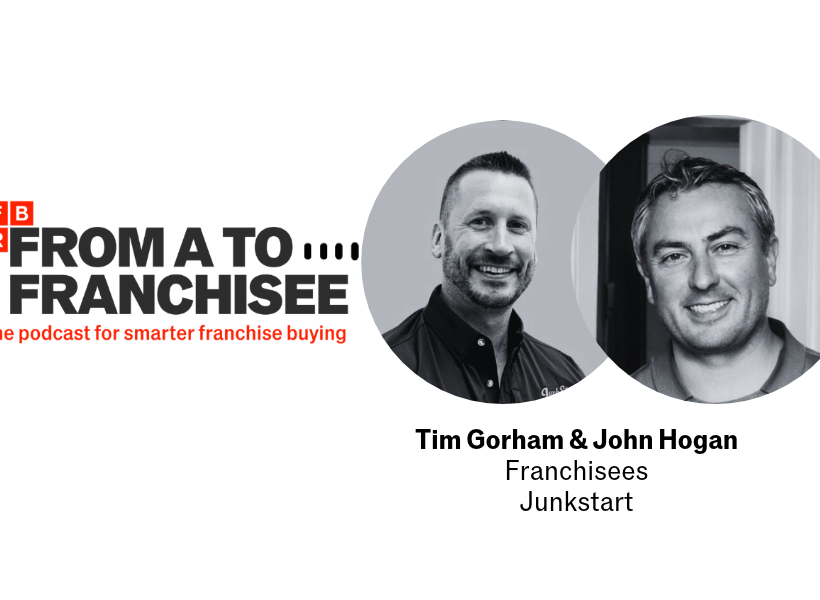
In this episode, we talk to the very first franchisees in a new franchise system.
Listen on Apple Podcasts | Listen on Spotify | Watch on YouTube
What’s it like to buy into a franchise system on the ground floor? Allison talks with John Hogan and Tim Gorham, the first franchisees of Junkstart, a weight-based junk removal brand that opened its first Omaha location in July. They cover how they vetted a brand with no other franchisees to call, how a detailed pre-opening checklist and rehearsal jobs helped them beat their revenue goal by four times in month one, and why hiring for personality and culture matters more than skills. If you’re weighing an emerging franchise, this one is worth a listen.
Show Notes
Guest: John Hogan and Tim Gorham, first franchisees of Junkstart in Omaha, Nebraska. John previously helped grow Home Instead Senior Care to more than 1,000 franchises worldwide. Tim spent 17 years in the fitness industry and owned a gym before moving into sales.
What you’ll learn:
- How to validate a new franchise when there are no other franchisees to talk to
- The pros and cons of joining a system at the very beginning
- What a strong pre-opening plan looks like, from training to rehearsal jobs
- How a three-person ownership team can split operations, sales, and marketing
- Why culture fit comes first when hiring
Key takeaways:
- Ask about support first. With no franchisee network to call, John focused his questions on how the franchisor would support owners, and he checked that the team was already in place before signing.
- Early owners get attention, but the network takes time. The first franchisees often get a lower fee and close support, though they miss out on a peer community until the system grows.
- Preparation pays off. A step-by-step checklist, franchise training, and practice jobs with friends and family left them ready to go on opening day.
- Hire for personality, train for skills. Tim and John both stressed that a bad culture fit can undo a strong team.
- Don’t expect a turnkey business. The franchisor provides tools and a playbook, but you still have to get out there and win business.
- Don’t let the legalese scare you off. A good franchise agreement protects franchisees as well as the franchisor, so keep the concerns in perspective.
- Focus on the service, not just the money. Believe in what you’re providing and be patient while it pays off.
Resources
- Best Questions to Ask Franchisors Before Buying a Franchise
- 7 Questions to Ask Franchisees: Validating Your Franchise Options
- Emerging Franchises: Who Is the Next McDonald’s?
- Franchise Agreement 101
- The Most Important Items in the Franchise Disclosure Document
- The Hiring Mistakes That Almost Buried a Franchise Owner
- Top Home Services Franchises
- Top Multi-Unit Franchises
- Franchise Financing Resource Center
- Franchise Term Glossary
- Inside Look at Life As a Franchisee with an Emerging Franchise
Visit FranchiseBusinessReview.com
Follow us on Instagram, @franchisebusinessreview
Subscribe to our newsletter
Check us out on YouTube, @FranchiseBusinessReview
Connect with us on LinkedIn
Transcript
drunk on funk 273910 (00:00)
oh you
Allison Dudas (00:07)
Welcome to From A to Franchise Z, the podcast for smarter franchise buying. We are Franchise Business Review and we’ve got over 20 years of market research data from the franchise industry. We’re here to spill the tea. FBR is the definitive source for unbiased insight into franchise ownership. We’ll share real metrics, helpful advice, and talk to actual owners. See what great franchises look like and how to spot red flags in others.
This podcast will build your franchise toolbox so you can make the right investment for you. Think of us as your franchise besties with data.
Allison Dudas (00:48)
Welcome back to From A to Franchisee, the podcast for smarter franchise buying. I’m so excited for our guests today because we’re talking about something that hopefully is really interesting to people out there considering buying a franchise. Getting into a franchise system like on the ground floor. So as it’s first starting out. I have two franchisees from Junkstart.
And they are the very first franchisees of this system. They opened up their location. They got their uh they got their paperwork in March and opened up, started serving customers July. Um so welcome to the podcast, Tim Gorham and John Hogan.
John Hogan (01:24)
Thank you.
Tim Gorham (01:24)
Thanks
Allison. Appreciate it.
Allison Dudas (01:26)
Absolutely. So happy to have you. So let’s kind of go one at a time. Um, John, what were you doing before you invested in Junkstar?
John Hogan (01:33)
Well, prior to Junk Start, actually several years prior to Junk Start, I was part of a franchise network called Home Instead Senior Care. My brother founded the business in nineteen ninety-four. I joined him shortly after, and then we began franchising it, grew it over twenty-seven years to over six hundred franchises in the States, over just just at six hundred franchises in ten other countries, doing two billion in revenue worldwide. Um like I said, I sold we sold the business in the summer of twenty twenty one.
five years go by approximately, and I run across a friend of mine consulting the founder of Junk Start on how to franchise his business. Um, this friend of mine that was consulting him asked me to read over their f their first draft of their franchise disclosure document. And I said, sure, I’ll be happy to do that and give you some thoughts. And as I was reading it, I just thought, what a great concept that this guy’s invented that could potentially disrupt the industry in a good way, but also
I kept thinking about Tim and then my son, our other partner, uh his name is Quincy. So uh I approached both Quincy to kind of run the operations and Tim to kinda run the sales and marketing and they both said, We’re in and here we are.
Allison Dudas (02:45)
Love it. Love it. And Tim, what were you doing before?
Tim Gorham (02:48)
you know, I have a couple different chapters, but uh in the past I’ve I owned a gym. Uh I was in the the personal training fitness space for uh about I think seventeen years, and that’s actually how I’d met John. Um and I had owned a gym, closed it down in twenty nineteen, and was kind of just
doing sales for a uh freightliner dealership and then a construction company and that’s when John approached approached me and’s like, hey I got an idea and uh it was John does a lot he does a lot of the analytical side of things. He he uh um puts a lot of stuff down on paper and if if he has a good idea and approaches me about it I’d I trust him a lot and it was a a no brainer once he approached.
Allison Dudas (03:37)
that’s fantastic. And are you both doing this full time?
Tim Gorham (03:41)
I am. Uh Quincy and I are both uh day to day and well John also is doing a lot of stuff on the full time side, but
John Hogan (03:48)
I uh yeah, I it’s really
Tim and Quincy’s uh full time gig and I’m supporting them any way I need to. But really this is about this business being theirs someday. So I just kinda you know, over three or four or five years when I get off the ground and running and then and and they have all the capabilities of running the business and like I said, um I’m happy to support.
Allison Dudas (04:12)
Hm. Yeah, I think this is what you guys are describing is a fairly typical s setup that I’ve seen with franchise ownerships. somebody coming in that has a lot more experience in this i in this area, but then bringing on bringing on people for marketing, sales, et cetera, operations. I love that. So first of all, tell me a little bit about Junkstar. John, you called it a disruptor potentially. So let’s hear a little bit about this business model.
John Hogan (04:36)
Yeah. the junk removal industry, and once again, we’re not like roll-off dumpsters or trucks that pick stuff up and take it to the landfill and whatnot, but the industry almost completely is volume based pricing. It’s a volume based model. So you have a half a truck of junk or a full truck of junk and you pay, you know, a little bit less proportionally the more junk you have.
But yet all the companies, whether you’re one of the franchise brands that exist out there, and there’s about five or six other than Junkstart, or whether you’re Jim Smith on the weekends with your trailer doing junk removal, everybody’s got different size trucks and trailers. So this volume-based pricing becomes confusing to the customer because they’re trying to compare apples to apples, company to company, but the prices just aren’t as transparent based on the volume approach with you know different trucks and trailer sizes.
Junk starts different because what we have is a truck, of course, but under the bed of the truck where the junk goes in, that that part of the truck is custom built, and part of the customization is these patent patented scales that sit under the bed of the truck, and so we weigh the junk and charge by the weight. And what’s really nice about that is the customer doesn’t have to wait until they have a half a truck of junk in their garage or a full chunk.
a full truck of junk in their garage to get the best price. Because the weight is the weight, whether you have one thing or a hundred and one things. And then what what
Allison Dudas (06:08)
Right.
John Hogan (06:09)
and then what’s also nice about it is that, you know, um the customer doesn’t have to well the customer can call us at any time to take away just that dresser or, you know, all this lawn debris, you know, uh and so our residential customers sort of repeat more often. And then I think
Allison Dudas (06:28)
Hm.
John Hogan (06:28)
one of the really great things is that
When we come in, uh the customer points and we lift. They don’t have to take all their junk to the garage or to the curb. And once again, it doesn’t have to be, you know, uh a lot of stuff at time. It could be just onesie twosie things every six or seven months, you know. So it’s it’s a much more positive experience by by the customer.
Allison Dudas (06:54)
Yeah, that’s great. Cause you really did say, like, I saw that this model was different. And it sounds like that was the spark that made you go, I wanna be a part of this.
John Hogan (07:02)
Well, two things. That was one, just the model itself. But also what the founder, Daniel of Junkstart, started doing in his business in San Antonio was really networking and marketing to people in the market that can repeat uh r provide referrals repetitively. So what we call commercial accounts. So apartment complexes, storage facilities, um pest control companies, real estate agents.
So those people run into people with junk all the time and and they don’t know what to do. So obviously um we are and that’s Tim’s role is really getting out into the community and building relationships with referral providers, whereas Quincy’s job is the operations running the running the trucks and the crews and whatnot.
Allison Dudas (07:51)
Yeah. that’s really interesting. Okay, so when you, you know, were consulting and you looked at the FDD and
John Hogan (07:59)
Mm-hmm.
Allison Dudas (07:59)
you thought, okay, I want to invest, what kind of questions did you ask? Now I’m imagining it was like mostly Daniel, the founder of Junkstart that you needed to talk to. What did you ask Daniel? How did you cause validation looks really different, right? I mean,
John Hogan (08:10)
Yeah.
Allison Dudas (08:11)
you don’t have other franchisees you can talk to. The FDD is not gonna be super expansive.
John Hogan (08:15)
Yeah. Mm-hmm.
Allison Dudas (08:17)
What what did you what did you ask Daniel in lieu of being able to talk to other franchisees?
John Hogan (08:22)
Well, I asked a lot of times about um, you know, how are they gonna support their franchisees? Um
Allison Dudas (08:29)
Mm.
John Hogan (08:30)
that’s that’s key. I mean, in my previous two experiences with Home Instead and then Merrymades, the support was fantastic. And that that’s really, really important because, you know, you you feel like you’re on an island out there, especially as the very first one, but
Allison Dudas (08:45)
Yeah.
John Hogan (08:45)
you know, you can save a ton of time, energy, and resources.
by s getting supported correctly versus making mistakes. And and that kind of support you just can’t even get from a local business consultant that is as good. Uh and, you know, you’re paying your royalty. You know, you you need to hold the franchise over accountable for making that royalty worth it. So
Allison Dudas (09:09)
Right.
John Hogan (09:09)
so that was a a part of my a big part of my questions. And and he and when we went down there to visit them, sort of on our discovery day, wow, he’s got a big team
already in place to support even before we were the first franchise. So he’s he’s investing ahead of time and and um
Allison Dudas (09:27)
Yeah.
John Hogan (09:28)
and has since then uh some more a staff members. So that was that was important to me.
Allison Dudas (09:33)
Yeah, definitely that that systemic support. Um, because that’s why you would do a franchise system as opposed to just, you know, going out and Quincy goes and gets a truck and Tim goes out and gets clients. Um, all right. So what do you think what are the obvious, some of them are very obvious, benefits of being the early franchisees? What have both of you seen from that?
John Hogan (09:57)
Uh well I would say you know some things prove now, some things will prove out in time. You know, I think in time, obviously, you know, franchise the initial franchise fee will go up with the net growth of the network.
Allison Dudas (10:10)
Sure.
John Hogan (10:10)
So one advantage is we get in earlier at a lower price potentially. Uh and then also, you know, we I think we feel the um the the the support because we’re the one and only so far, and obviously they want
us to be successful more than they’ll want their second one to be successful because we’re the first and and and and that’s a little dramatic, but it’s really, really important that their first, you know, five to ten become successful. It’s a real building block. So I think the support we’ve gotten is pretty, pretty fantastic. They’ve been there whenever we’ve needed
Allison Dudas (10:46)
Yeah. And then you are all you’re located in Omaha, correct?
John Hogan (10:50)
Yes. Yes.
Allison Dudas (10:52)
And there were obviously no issues with like this is the territory that we want.
John Hogan (10:57)
Yeah, I I mean they they had um not a template already pre described, but you know, there’s you know, Omaha’s a market that makes sense for basically one junk start franchise. Uh yet it would be a good it’s yet it’s a good size one. You know, something like Atlanta, Georgia, there’d be more than one obviously. Uh yeah,
Allison Dudas (11:22)
Absolutely.
John Hogan (11:23)
so um it wasn’t really that
difficult or complex to really identify, you know, what we wanted to what territory we wanted to own. Um the territory we don’t own around our market really is sort of orphaned. It really can’t be added added to any other markets per se. So obviously we can still service it and we we will service it. Um but but yeah, it was pretty simple.
Allison Dudas (11:51)
Now, Tim, obviously you were coming from more of a sales background and a business owner background. When you signed on for this, what were what made you like the most nervous? What were you what were you most fearful about? ‘Cause I’m sure you had a lot of a lot of things going through your mind.
Tim Gorham (12:07)
Yeah, you know, I I don’t know if I could really say this something was fearful. I mean I think there’s the healthy anxiety, the positive, negative, um, you know, jumping into something new. Um
And and different is sometimes uh hard for some people to do, but I’ve been doing that for a long time. Um John has obviously been doing it, doing that for a long time. You know, Omaha’s a great place for entrepreneurship. Um
Allison Dudas (12:32)
Hmm.
Tim Gorham (12:32)
and so our our network of of friends and and business acquaintances, there’s always entrepreneurs in every circle. And so, you know, when you surround yourself with that type of mentality, you kind of it’s easier to to keep that mentality. so I wouldn’t say I was fearful.
It was a healthy anxiousness, but that’s also a driver. You know, it’s we’re jumping into this. Um it’s a motivator to be successful. You know, even if we weren’t the first one, if we were the hundredth, we’d I’d still have the same mentality of, you know, we want to get out there and you know, we’re still a small business. Um get out and and and win. You know, that’s a big thing for us.
Allison Dudas (13:14)
I think you’d bring up a really good point when you’re thinking about qualities of a franchisee, and I I agree with you that it’s whether you’re the one hundredth franchisee or the first, like you all are, you you do need certain qualities to be able to be successful. And what do you feel like besides that like anxious ambition that you describe, Tim, what other qualities do you think are necessary to succeed here?
Tim Gorham (13:38)
Um, you know, you have to uh keep in mind always that not every day is gonna go as planned. You have to be able to pivot, uh positively pivot, um, still make logical decisions, stick with the plan. Um
Do what you uh do what you signed up to do and and and keep in mind it’s not I mean business ownership, just like most people know, is never easy. Um and there’s not a lot of people that do it, but the ones that do uh I think should need to understand that um you you signed up for one thing, stay stay the course, and just keep pushing forward one foot after the other.
Allison Dudas (14:15)
Yeah. John, what do you think, especially as somebody a little more established in the franchise world, what do you think are the important qualities that a franchisee needs to have?
John Hogan (14:23)
Yeah, there’s a there’s always that debate whether franchisees are truly entrepreneurs. And you know, an argument can be made both ways, I think. But if the franchise playbook is really good, you just need to follow the playbook. And and and that and some people have a different style or personality that might be more successful at that than others, but but of course, someone who’s very competitive, very driven, um
But also somebody who’s humble and can and and can lead an organization forward. Because like Tim said, things change every day and if you let it get the best of you, you just you know you can’t shake yourself out of it. And and when a franchise um a franchisee fails, it may not be because of the the concept. A lot of times it’s not. It’s just not the right match between the concept and the person. And so so I think, you know
Uh it it’s it’s it’s you know, I’ve seen a lot of successful franchisees in my life, and I would say they’re the common denominators are that they’re very competitive, but they’re also really humble people. And they also believe that they never stop training, they never stop learning. They don’t know it all. They’re willing to admit they don’t know it all, and they want to learn. And that’s a key.
Part of being in a successful franchise business because you’ll learn just as much from your peers in the franchise network, other owners, as you will the home office, you know, in your support. And you once again, you cannot get a business consultant locally that has that kind of value at even a hundred bucks an hour, you know. So it’s just that’s one of the things your royalty goes towards is is that kind of you know, uh a dynamic in your business.
Allison Dudas (16:20)
Well, I think that’s so interesting too because you you both invested in a franchise system that does not yet have that franchisee community. So how
John Hogan (16:27)
Mm-hmm.
Allison Dudas (16:28)
do you feel like you make up for that?
John Hogan (16:32)
Well, I think well hopefully my background in supporting Tim and Quincy and their drive and work ethic will will make up for what the short term of that is, you know, missing. But I you know, you look at these other junk franchise businesses and they’re they’re pretty big and successful, um, but they’re volume based. So we’ve got a concept that we come in with that can really um
change sort of the education of the marketplace or the the you know the the the the reputation of the marketplace and um
Allison Dudas (17:04)
Mm.
John Hogan (17:04)
and I think it’s just you know uh I I’m not I’m not I’m not nervous about there being uh ah no other franchisees. There’s gonna be franchisees. And I think this concept is one also where you might have fewer franchise owners um and and and they will own multiple franchises. And that’s pretty powerful
Allison Dudas (17:25)
Yeah.
John Hogan (17:26)
too.
Allison Dudas (17:28)
Definitely. It definitely if the model is scalable for sure. Yeah.
John Hogan (17:31)
Mm-hmm. Mm-hmm.
Allison Dudas (17:33)
Yeah. And I think it’s good to point out too that you all entered into the franchise agreement already with a trio, right? That you have somebody that’s committed to operations and you have somebody committed to marketing and sales. Because oftentimes the people who are good at operations are not good at marketing and sales.
Um, I used to own my own business and I think that was sort of the most exhausting part is that you have to wear all the hats
John Hogan (17:57)
Mm-hmm.
Allison Dudas (17:58)
and um I can see I can see how going into it right away and having having people in their designated roles really makes a difference.
John Hogan (18:07)
Yeah, Allison, I I of course talk to prospects every now and then for Junkstart and and that’s the one of the very first things I I say is, hey, my entry to this or or I should say our entry to this is probably not what’s typically gonna happen because you know I I’m not an owner operator. I’ve brought in, you know, all the investment and and a huge part of that investment is Tim and Quincy.
So y you’re gonna have a maybe a different financial kind of entry looking, you know, profile and that’s okay. But it doesn’t yeah, it’s still gonna take a lot of hard work by somebody and and it yeah, so mm hmm.
Allison Dudas (18:43)
Right, right. So presumably th the other franchisees joining Junkstart might not have the the triad situation that you all have going on. Maybe it is a single sometimes we’ll say like a chuck in a truck, right?
John Hogan (18:56)
Right.
Allison Dudas (18:57)
a single owner operator really grinding.
John Hogan (18:59)
Mm.
Allison Dudas (19:00)
And I guess like what what advice would you give them? Because they are entering in, I think, with a hell of a lot of work ahead of
John Hogan (19:09)
Well, stick to the plan, stick to the plan, stick to the plan. And you know, if you can persevere through the the through the early months and years, uh it’ll be well, well worth it. And um, you know, and also you learn a lot in those first, you know, months and you know, first year that you can then uh you know, learn and appreciate from and then
that helps you run your business when you begin replacing yourself in parts of the job like an operations manager, a marketing rep, et cetera, et cetera. And and and you uh you know truly kind of evolve into the CEO of the company. And and that’s where, you know, all that grind and grit and you know in the early months will really help you down the road for sure. Because you’ll always be able to talk turkey with you know somebody else who uh is in the business.
Allison Dudas (20:02)
Hmm. So Tim, let’s talk about so you all basically opened your doors. John, you had said July one before when we were speaking. Um, but I know you signed the paperwork in March. What were those first few months like, especially for you, Tim? Because I’m imagining a lot landed on your shoulders with going out and getting business. Walk me through what was that like? What was your kind of playbook? How did you go go forth and create business?
Tim Gorham (20:29)
Well, you know,
yeah, so the the couple months prior to us opening, you know, we were
on a fast track to you know from the the signing day to to get open um trying to to to make sure we understood all the processes and systems and so you know a lot of the the the groundwork was done obviously right before we opened with Quincy and I trying to just know how to troubleshoot the trucks, troubleshoot um customers, learning our scripts, um understanding who our target or commercial clients could be or customers could be, um figuring out the marketing plan.
you know, uh so so we didn’t have to always look at the playbook. We had to really learn it so we kind of understood and were able to pivot if we had to, and understand when things weren’t going um
maybe they weren’t going a positive direction that we had to to sidestep and and try other things. uh but then leading up or going into our first one we opened, you know, just getting out there and and doing the work, you know, that’s w that’s where we learn everything. I mean Quincy and I are both similar. Um
We could watch YouTubes and read uh manuals all day, but y y the retention of that is for me is generally a little bit lower than actually just getting out there, putting the gloves on and and going to pick up junk. Um
Allison Dudas (21:50)
Yeah.
Tim Gorham (21:50)
so it was a it was a it was a really great experience and I will piggyback a little bit off of what John was saying earlier with the support. the Junkstart Corporate team has been absolutely phenomenal. Um I’m new in franchising. Obviously John has a lot of experience with it, but um
You know, they’ve and we ask the asterisk is we are the first one, so we ha we get a lot of attention. Um
Allison Dudas (22:10)
Sure. Yep.
Tim Gorham (22:12)
But they’ve been absolutely phenomenal in uh if we’ve had any issues, not just Daniel or their leadership team, everybody down to the the truck teams up there. We can call any of them to kind of to figure out if something’s going on that we haven’t learned yet. And um it feels really good knowing that uh it we can call them. If they don’t answer right away, they’re calling us back in five minutes. And you know, it’s feeling the support, it helps us, you know, kind of go out and take some more risks and and put ourselves out there because we know we’re gonna
uh have a little a safety net i in in regards to support.
John Hogan (22:47)
Yeah. And
Alison, I can I can add a sorry,
Allison Dudas (22:47)
Yeah. Yeah, that’s such a great point.
John Hogan (22:49)
and I can add a couple more details. So like we signed our franchise agreement end of March, early April. We we knew we were gonna be going through our franchise training in the second week of May. So between April one and training in May, we we got this fantastic um checklist from Daniel’s team that helped us do everything prep work, you know, we needed before training.
we knew we would get our trucks sometime early June, middle of June, something around there. So when then when we came back from training in May, we had the next part of the checklist to complete. And then and then we get our trucks, you know, early um June. And then we spent a couple of weeks, Tim and Quincy spent a couple of weeks doing what we called rehearsal jobs. So we would call fri family and friends and say, You got junk? Let us pretend you’re a customer and come out and we want to practice our our spiel and our process and our
credit card charging thing and all that jazz. So that when we opened our
Allison Dudas (23:46)
Mm-hmm.
John Hogan (23:46)
doors July one, which also synced up with our digital marketing campaign taking off, uh, we were all ready. We were all buttoned up. And and I’m really proud to say that Tim and Quincy quadrupled our goal in month one of revenue because we were ready to fire. And so for people looking to build a franchise or you know get into a franchise
That preparation of opening is super key. It might feel really mundane and detailed and long, but it’s it’s it’s there for a reason. And and and so hopefully your franchise or is got a a really good plan in place prior to opening and that’s what they had for us. So we just stuck to the plan.
Allison Dudas (24:30)
That’s fantastic and congratulations, that’s definitely something to celebrate. Your first month, holy cow.
John Hogan (24:35)
And
they’ve beaten their goal every month of the four months we’ve been in business so far.
Allison Dudas (24:41)
Wow. Wow. That’s awesome. So much to be proud of.
John Hogan (24:44)
Yeah.
Allison Dudas (24:45)
That’s so cool. And you’re still so fresh at it. I mean, it’s still
John Hogan (24:49)
yeah.
Allison Dudas (24:49)
just been as of this podcast recording, just been a few months. Um, so I think hopefully it’s only up from here, right?
John Hogan (24:57)
Yeah.
Tim Gorham (24:58)
It’s looking like it. Definitely.
Allison Dudas (24:59)
Yeah. Yeah,
John Hogan (25:00)
Yeah.
Allison Dudas (25:01)
that’s fantastic. Okay, so as you become as you become more successful, how I guess like what’s what’s in store for you? Like where where do you think it’s going in the next year or two? Are you gonna kinda stay the course and perfect the model or are there other big plans?
John Hogan (25:17)
Jim, you wanna take
Tim Gorham (25:19)
Yeah, well I I I think obviously the next year, two years, um there’s still things that we’re learning every day. Um we definitely aren’t uh I don’t feel like we’re perfect yet. Um
But I think after we kind of get a we get a really good handle on every every situation that can pop up. Well obviously it there’s we’ll probably never be ready for everything, but
John Hogan (25:43)
Mm-hmm.
Tim Gorham (25:44)
after you know the first couple of years we’ll kind of hopefully we’re at a spot where we’re adding more trucks and we’re um we’re in the top you know two or three junk removal companies consistently. Uh then I I think exploring more territories at some point will
Well it’s definitely on our gonna be on our radar, but we have to crawl before we walk, before we run. and we’re we’re pretty conservative with that. Um you know, we don’t wanna just jump into thinking we’re gonna go spend a lot of time and money building other locations when we still have to make sure that we’re putting in the roots for this first one. But I mean John Maymo you can probably expand a little bit more on future planning.
John Hogan (26:25)
Yeah. Well, yeah, I
mean it no one has a crystal ball, but I think um gosh, I I think a lot of fun is gonna happen too. Uh Daniel’s crew and his culture that he’s established in his brand, i it’s it’s it’s carrying over to Omaha and we’re having a lot of fun with this too. And and and you know, and it’s it’s junk. You know, I mean, how fun can junk be?
Allison Dudas (26:48)
Right.
John Hogan (26:48)
Well, it’s not about the junk, it’s about the people you hire, the teams you build, the
the atmosphere, the culture, the values, the the the mission. And and that’s really fun to have in place too because, you know, uh it’s it it it makes it just a an enjoyable place to come to work to.
Allison Dudas (27:09)
John, I think you hit the nail on the head with that. Every franchise owner that I talk to, and I’ve talked to so many at this point, talks about how at the heart of it, it is about the people.
John Hogan (27:18)
Mm.
Allison Dudas (27:19)
And that it’s about who you hire, who your customers are. And I think at the end of the day, ideally, a franchise owner should be, should be great with people. Um, at least the ones that, you know, you are interacting. And maybe as you scale more and you
knee por more people sort of in the the back end behind the scenes. Those people don’t have to be great with people, but mostly mostly
John Hogan (27:39)
Yeah.
Allison Dudas (27:40)
I think it is a people business. Always, always.
John Hogan (27:42)
Yeah. Mm-hmm.
Tim Gorham (27:43)
Well, I I
can tell you real quick the you know, we’re we do pick up junk, but we’re a customer service business that happens to pick junk up. And, you know, it’s that starts with us but also, you know, with the people that we hire. They have to have a customer first
like mentality where we’re trying to service people and help help those people have an easier time with whatever situation they’re going through. We just happen to be using junk removal as as that mode. uh So anybody that’s in in our shop or in our business or you know now or in the future, it’s it’s always gotta be a a a customer service attitude that happens to grab items that people don’t need anymore.
Allison Dudas (28:25)
So it sounds to me like the people that you’re hiring, uh, because hiring is is an issue across many sectors right now. It sounds more like you’re hiring for their the a cultural fit as opposed to sort some of the skills they might bring.
Tim Gorham (28:40)
Especially now. The the team that we put together first, that’s what’s gonna take us to the next level. And if we if we hire fast, too fast, we potentially could corrupt that culture fit or the culture. And um so we we do need to hire people, but we don’t need to hire somebody so fast where it’s a it’s a cancerous person personality. So um it’s gotta be a you know, a good f a good fit for sure.
John Hogan (29:08)
Yeah. Yeah, Alison, I think you’re right on it’s it’s the personality fit that we look at first because we can always train the skills and the job, you know, and and and if we take that approach, I think it pays off in the long run with better tenure, better retention, less turnover, you know, ’cause people don’t typically leave companies, they leave managers. And if our people at Junkstart are great supervisors, managers, owners, I I think we’re gonna have great people
being attracted to want to come work for us.
Allison Dudas (29:40)
That’s great point. So obviously the franchise system right now is is just you all. What do you see your role as early franchisees when the franchise system is up to fifty, up to a hundred?
John Hogan (29:56)
Yeah. Well, we we always want to be number one on the uh stage at the award ceremony, but you know, we we want success for the whole network because if we’re successful, then Kansas City will be successful, Chicago will be successful, and so on and so forth. But but also at the end of the day, we have a business to run and people to employ, and you know, uh, you know, we’re creating livelihoods for people. So that comes first and foremost.
And if the uh if the competition um with other f with other franchise owners due to the home office’s recognition program is a motivator, great. That’s just icing on the cake, you know?
Allison Dudas (30:37)
I love it. Tim, what about you? Especially as somebody more in the the forward facing aspect of the business. How do you see your role evolving in the larger franchise system as as it grows, as the franchise community grows?
Tim Gorham (30:50)
Well h I
I don’t know about a role, but I’d like to I’m I hope to think that I can do the things now correctly and continue to do things correctly is in regards to the playbook that has been put in front of us. Um to be a support system for new franchisors or sorry, new franchisees or people that have been in for ten years later on. You know, I I wanna be somebody that can provide something valuable and meaningful to help their business grow. But like John said, if we do good a
other areas are gonna do do good but um if those locations are doing well we also are gonna be able to do well you know we’re building a a brand we just happen to be the the tip of the spear so to speak um but pretty soon you know the whole spear is gonna be countrywide and um and so hopefully I can be a good support for anybody that that uh that might need it
Mainly for our people though. We wanna we wanna be first. We wanna be the best. Uh
Allison Dudas (31:49)
Yes. I love it.
John Hogan (31:49)
Yeah. Mm hmm.
Yeah. Yeah. Yeah.
Allison Dudas (31:53)
I love it. Yeah, I feel I feel the competitive edge coming through the screen here.
Well, I think that’s great. And I think Junk Start is obviously very fortunate that you all are its earliest franchisees because everything that you’re describing kind of fits the bill of an ideal franchisee. So so they’re they’re lucky. They are lucky that they found you. All right, so last two questions here.
One is what’s your biggest takeaway from the last six months of being involved in this new franchise system?
Tim Gorham (32:21)
Well, I’ll just throw an easy one out there. Um, this is my first time being associated with the franchise system. Um and I, you know, owned a gym before doing all the the stuff on my own, you know, wearing all the hats and not necessarily having a
a support system, a playbook. I’ve I’ve loved jumping in and being a part of a franchise system. Um, you know, obviously I’ve learned a lot from John prior to even thinking about this. I’ve you know, just hearing him talk about his businesses and and things like that, you pick up little things, but actually being in the in the mix, um, it’s been a a really awesome um step in my business life, being able to experience what a good franchise system uh looks like. And obviously we’re new, so
and I don’t know as much, but as far as I’m concerned, it’s a good franchise system. Um and I can only imagine it’s gonna continue to to be amazing. So I’ve loved it.
John Hogan (33:16)
I think yeah, I think, you know, if you if you focus only on the money, that’s dangerous. That’s risky. You gotta focus on what you’re doing, what the service you’re providing, the money will come. And and if you really believe in the service you’re providing, then then yeah, it’s gonna happen and you just need to be patient with it and and it will pay off. It just takes a little time. So maybe that’s my best advice there.
Allison Dudas (33:40)
I think that’s pretty good. If somebody so h people who are listening right now may be considering entering the a franchise system, what’s your what’s your advice? What would you say to somebody thinking about investing in a franchise?
John Hogan (33:55)
I think people get too hung up sometimes in all the all the legalities of the franchise document, the franchise agreement. You know, a good franch in my opinion, a very good franchise agreement protects both parties, the franchise owner and the franchisee. And as a franchisee, you might be concerned about one provision in the agreement that, gosh, you know, I don’t want to be terminated.
if I, you know, uh if I have an issue with that provision. Well, i if if it didn’t exist though, that provision didn’t exist, then the franchisor would have less, you know, uh capabilities of removing maybe an underperformer in the network. And that underperformer might be your next door
Allison Dudas (34:43)
Mm-hmm.
John Hogan (34:45)
neighbor. And that could cause you a whole lot of other issues. So, you know, I think I think, you know, the franchisors that
run their businesses, run their networks by the spirit of the franchise agreement is the best approach. And then when and only when they need to really use the language of the agreement to to address, you know, something going on. Um, that’s why it’s there. And and it’s meant to protect
Allison Dudas (35:12)
Hmm.
John Hogan (35:12)
the other franchisees as well. So, you know, I think once again,
When a franchisee gets the franchise agreement, gives it to their attorney to review it, and then the returney comes back with all these concerns, I think sometimes that gets really blown out of proportion. And and then, you know, someone passes on buying a franchise because of, you know, the illegal opinion given by somebody when, gosh, I think they may have missed the boat. So um anyway, that’s just some some thoughts I have about it.
Tim Gorham (35:43)
I think um s one piece of advice for someone that may be new to franchisee to be to franchise systems um would be
you still have to do the work. The franchise system has given you a uh support, they’re giving you tools, um, but you are still the business owner and you have to get out and they’re not gonna hold your hand the fr the the corporate or the home office, they’re not gonna hold your hand every day through everything. You have to still have that mentality to to get out and win business, do the right things and um and and win over the brand awareness of the c of the community you’re in. Um
So while the the franchise or is there to help, they give you the tools, it’s on you to use those tools, be masters of those tools, and grind every day. The grind is never gonna end. Uh but that’d probably be more for a new somebody new going into a franchise system. Um most other people would probably understand that already.
Allison Dudas (36:41)
Yeah, I think it’s great advice though, because uh a lot of people do it think that, oh, I buy a franchise and it’s turnkey ready. I just kinda like it runs itself. I can be this absentee owner. And if if somebody’s telling you that, they’re not they’re not being truthful. ‘Cause you’re right, Tim. Um and and John, uh your experience I’m sure has told you that. You gotta work real hard and maybe eventually you can step back, but
John Hogan (37:09)
Yep. Yep.
Allison Dudas (37:13)
Well, thank you both so much. This has been so interesting. Obviously getting in on the ground floor of a franchise system is exciting and you have been doing very well with it and it sounds like you’re very happy with the system. And hopefully it will pique some interest of people listening and they can start to consider maybe a a new system would be would be the best for me. especially if they want a lot of say and how things are gonna operate and they want a a lot of attention from the franchisor. Um all right, well I
I’m so grateful to both of you. Thank you so much for your time. And we’ll make sure to to link a lot of resources for this episode so that you can continue your franchise research. And I hope you have a great day.
John Hogan (37:56)
Thanks, Allison. Take care.
Tim Gorham (37:57)
Thanks, Allison.