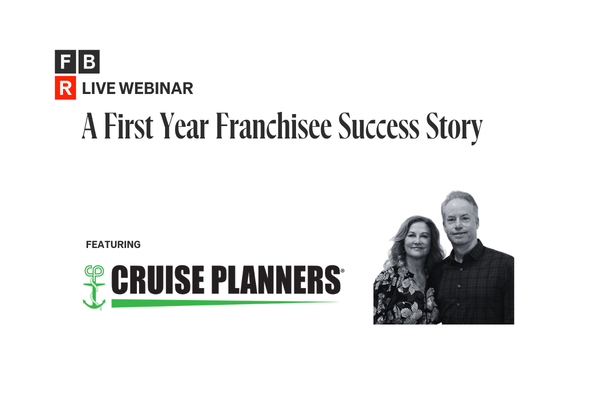

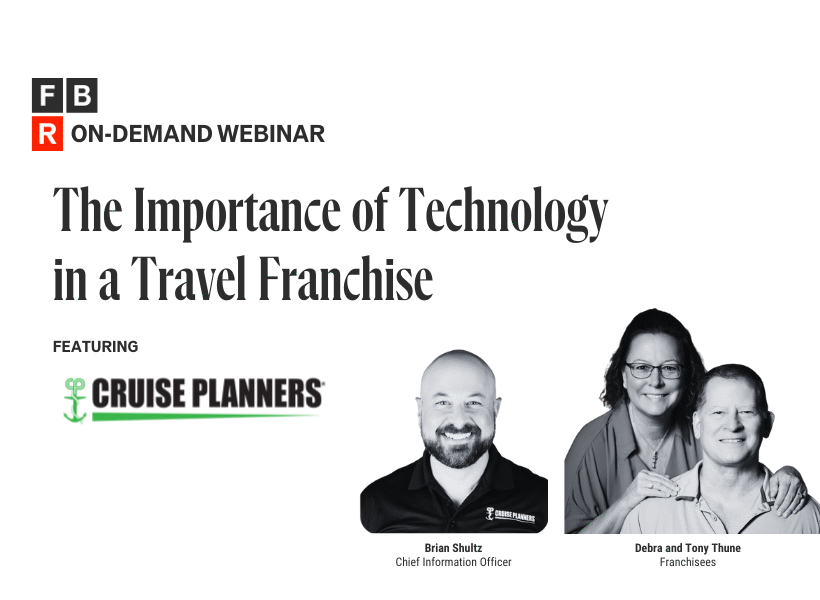
Watch to this conversation from Franchise Business Review with the Chief Information Officer of Cruise Planners. He talks the cutting edge technology of the Cruise Planners’ brand that allows franchisees like Debra and Tony Thune (featured here) to work their business while cruising in the Caribbean. Technology is key in a travel franchise — learn how it allows franchisees to claim the lifestyle they want.
Cruise Planners Recognized As Top Franchise
We collect so much data on franchises! With the data we receive from tens of thousands of franchisees, we make lists that honor the top-performing ones. Cruise Planners slays this and appears in the following lists just this year:
- Culture100 (Best Franchise Culture)
- Top Franchises for Women
- Top Low-Cost Franchises
- Top 200 Franchises
- Most Innovative Franchises
- Best Franchises for Veterans
Learn More About this Franchise Opportunity
Because Cruise Planners surveys their franchisees regularly with Franchise Business Review, we can give you all sorts of insight into the health and culture of their company. You can download their full franchisee satisfaction report on our site to learn so much more.
Transcript
Allison Dudas (00:03)
Hi, I’m Allison Dudas from the Marketing Department here at Franchise Business Review. Franchising is complicated and we here at FBR try to break down its many different facets. We do this so people considering buying a franchise can make the best decision possible with all the best data and we really love data. Every year we survey 35,000 franchisees across over 350 franchise brands to determine which franchise brands are the best to own.
And with this information from all of these franchisees, we create lists like our top 200 franchises to own, or top franchises for women, or like the Consumer Reports of franchising. Today, I’m speaking with representatives from the franchise brand, Cruise Planners. Cruise Planners is the largest home-based travel advisor franchise in the country.
Not only does it provide an entrepreneurial path for thousands of people, but those thousands of people rank cruise planners highly in areas like training, support, and community. Their franchisees rate them so highly that they appear on the following franchise business review lists. Now, buckle up, because it’s a long list, right? Top franchises for culture, top franchises for women, top low-cost franchise.
Debra Thune (01:16)
Thank
Allison Dudas (01:19)
top franchises for veterans and top 200 franchises overall. So those are all the lists that Cruise Planners appears on. Pretty amazing. So today I’m joined by Brian Shultz who is Cruise Planner’s Chief Information Officer and Debra and Tony Thune Did I say that right, Debra and Tony?
Debra Thune (01:29)
you
Thune It is soon. Yes.
Allison Dudas (01:40)
Thun. Okay, thank you.
Debra and Tony Thun, okay, who are cruise planners franchisees. Welcome and thank you for joining us.
Brian Shultz (01:52)
Thank you for having us. Thank you.
Allison Dudas (01:54)
So one of the things that sets Cruise Planners apart is its technology. Since its franchisees are home-based, the software and technological support Cruise Planners offers is key. And today we’ll be hearing a bit more about this facet of the business and how it’s taking this franchise brand and its franchisees to the next level. first, let’s hear a little bit more about you guys. So Debra and Tony, first you have to tell us where you are because this is
one of the coolest things I think I’ve ever done in a webinar.
Debra Thune (02:22)
Yeah.
Well, Tony and I have been pretty much living on cruise ships for the last four years. So we go home every once in a while just when we’re going to the Arctic and we need to grab our winter gear. But for the most part, we are on a cruise ship or traveling to a cruise ship. So we are currently on a cruise ship. We’re in the Caribbean right now.
Allison Dudas (02:31)
you
That’s amazing. That’s amazing. And I’m assuming that you’re working too.
Debra Thune (02:56)
Yes. cruise Planners technology has really been key, absolutely, to our success. Obviously, when you’re not home, we are on the road all the time and being able to.
Allison Dudas (02:56)
Yeah.
Debra Thune (03:13)
literally handle our business from anywhere on the planet. We’ve been in amazing places and still been able to do our business literally from our cell phone and that’s all key to success of our cruise planners business. We have the best office in the world.
Allison Dudas (03:33)
I love it and the office parties must be very fun. So, Debra and Tony, just coming back to you again, what made you decide to invest in a cruise planners franchise? How long have you been franchisees?
Debra Thune (03:37)
Yeah.
We have been franchisees since June 1st, 2019. We were with a small little mom and pop company out of California. And we didn’t really want to work it as a business, but we wanted to learn secrets on how to travel better because we were traveling a lot. the company that we were with, number one, the owner was not the nicest person in the world. You know how when you yell at people in capital letters in an email with
points. That’s when we asked a question, that’s how we got a response. There was no training. Her technology was terrible. The system constantly crashed. There was no IT team. There was a guy in town that she would email when we had IT questions. So it was not working for us. And March of 19, we went to CLIA Cruise 360.
And we just wanted to see what was out there. And all we saw was the sea of green shirts. again, well, not again, you guys don’t know, Tony and I met in jail. We were in law enforcement. We were on the good side of the bars. But we didn’t know anything about sales. were, mean, other than I have to talk a big guy into putting handcuffs on without getting in a fight with him. So I do kind of consider that to
be sales, but not the traditional sales experience. So we asked people like, what’s with your green shirt? And, cruise planners, don’t you know? And we said, no, we don’t know what’s with your green shirt. by the third person of me asking what’s with your green shirt, these people were all happy. They’re smiling. They’re all having a good time at this convention. So we were supposed to be in a Viking breakout group.
And so I told Tony, I said, you go to the Viking breakout, I’m call this cruise planners company and see what this is about. And so I call, I get the sales guy, he’s explaining a franchise. Now,
I only know that McDonald’s is a franchise. I don’t know anything about what that means. He spends 10 minutes. I say, okay, I’ll take one like I’m ordering a burger at McDonald’s and I have no idea what I’ve done. So I go back to the Viking breakout and I go, babe, I think I bought a travel agency. I’m not really sure, but whatever, we’re doing it.
I’ll support her in anything she wants to do. So I just jumped in with both feet with her. So that’s literally how we got started. That was March. We went to training in May and we started our business June 1st, 2019.
Allison Dudas (06:49)
I love it. Did you transition from being in the travel industry because you wanted to travel better to not just doing that, but also because are you coordinating other people’s vacations significantly now too?
Debra Thune (06:51)
I’m
So now we are at that time, we were not intending on doing that. We went to the cruise planners training, which was absolutely phenomenal. It was a week of hands-on in-person training. We learned the computer system, we learned sales, we learned marketing, we learned how to actually do a booking. None of this had been taught to us previously. So that was all new information for us. It was phenomenal training. We got to go on ship inspections, like start to finish.
Allison Dudas (07:06)
Mm-hmm.
Debra Thune (07:34)
A to Z how to run this business. Again, phenomenal training. But then still at that time, we were not intending on working this as a business. We still only wanted to learn how to get a better deal or learn insider secrets on how to travel. So our pivot happened actually during COVID, which our story is very unusual because most people during COVID did not do well in this business. But Tony and I
My 50th birthday gift from Tony was an 81 day cruise. We got on the ship February 14th in Civitavecchia 2020.
And our 81 day cruise was supposed to end April 15th in Tokyo, which as you know, it did not end that way and it was not 81 days. We were going along. We were not watching the news. We didn’t know anything about COVID. No one was talking about it at any of the ports. And we were in King Tut’s tomb all by ourselves wondering where is everybody? This is great. No lines, but where is everybody?
like super crazy.
And March 5th, the captain comes on and he says, okay, everybody off, everybody has to get off the ship. We’re going to find a place to dock. And we said, it’s March 5th. We’re not getting off the ship till April 18th. Why is everybody getting off the ship? So then we turn on the TV and we find out that y’all are hoarding toilet paper. And we said, my God, what is happening? This is crazy. So we told our room steward, we don’t know what’s going on, but we need toilet paper. So.
Steward starts bringing us toilet paper. And anyhow, at that time, the American government was saying two weeks flat in the curve. So everyone’s rebooking cruises. And some people who we had met on the ship, they didn’t want to wait in line to rebook a cruise. So they asked us to book for them. And we said, no, we don’t really do that. But
we were police officers, we help people. So we taught ourselves that cruise line’s computer system. We started doing bookings. They started telling their friends, hey, Debra will do this booking for you. So I got over my Debra will not, and I started doing bookings for people. And we ended up leaving that ship with 75 clients who are real people. These are not friends or family. We now…
accidentally have a business and we now have to work it as a business. all during COVID we worked it as a business and in our first year at Cruise Planners we actually were in the top 50 of the entire company because our business just took off during COVID and so bottom line COVID actually built our business.
Allison Dudas (10:26)
That’s wild.
so much of your story is wild and I imagine, now Brian, I really wanna talk to you because,
I imagine a lot of franchisees in cruise planners have these very interesting stories and they wouldn’t be possible to kind of come in and blend their lives into cruise planners without the kind of support that you are offering. You specifically in your role as chief information officer but also the franchisor in general, the corporate office. So can you talk to us about your role in cruise planners and how you support franchisees?
Debra Thune (10:41)
you
Brian Shultz (11:01)
Yeah, let me just start by saying I’ve heard Debra and Tony’s story before and every time I hear it, I’m blown away. So when you buy a franchise, in my opinion, I’ve done franchising kind of my whole life. My parents owned a franchise. I worked in a franchise at a fast food place growing up. So when you buy a franchise, which sometimes could be an intimidating term, right, to own a business and whatnot. And not everybody’s outgoing as Debra is just to call an order one off the menu. But, you know, what was incredibly
Debra Thune (11:08)
you
Brian Shultz (11:31)
important to me is that the network behind you, the corporate entity behind you has to be very in tune with the needs and demands of the lifestyle that you’re trying to get into. we’re very fortunate. We work in a fun industry for the most part. And we want to empower people who have decided that maybe they don’t want to be in law enforcement anymore, or maybe they’re a retiree looking for a second income, or maybe they’re a veteran looking to find their next phase of life.
We want to provide a system behind the scenes that supports any type of approach that you bring to the business. So when it comes to my specific domain in technology, we work very closely with our franchise network. very fortunate that we have such a cross-section of expertise that we can pull upon to help us really design a platform that allows people to fulfill their dreams. And technology is something that can really assist with that. mean, this example
was perfect. have people in the Caribbean, probably on some satellite internet feed, conducting business and supporting their customers and keeping in touch with their customers’ needs and the suppliers that they have to work with. And what we want to do or what our mission is from a franchising perspective is that business in a box. even if you don’t have a sales background, even if you don’t know tech per se, even if you’re not a marketer, what can we provide to our franchisees that allows them to leverage
Allison Dudas (12:56)
Mm. Mm.
Brian Shultz (13:01)
robust system that’s been in place for more than 30 years and afford them the type of lifestyle that they’re really looking to take advantage of.
Allison Dudas (13:10)
And once a candidate decides to invest, now Debra and Tony had mentioned that the training was great, but what does the training look like? I know a little bit, but I want the people who are watching to learn a little bit too.
Brian Shultz (13:22)
Sure,
sure. once you become a franchisee, straight away you get some e-training, some online training through some orientation courses that we get you set up with. But I want to also mention something that’s really key. Not all training, in my opinion, in the way our philosophy is, is just webinars or videos that you have to watch. You know, I always find that experience to be a little unfulfilling. So what we do is we pair the brand new franchisee with what we call a foundation coach. And that foundation coach is designed
to help you get up and running. You have to set up your bank account, get your phone number set up, registered with our partners in the cruise and tour lines and things like that. And then you come to what we call STAR-U, which is what Deb was referring to earlier, which is, it’s a hands-on class. I teach a class, our CEO, Michelle, our CSO, our COO, all of our top leadership teach classes. My domain is obviously our tooling. What is it that you’re gonna actually use on a daily basis to run your business? But then there’s sales training, there’s marketing training, there’s supplier training.
Debra Thune (13:54)
you
Brian Shultz (14:22)
It’s five days of hands-on, you’re meeting these different entities from within our organization. But more importantly, you meet other brand new franchisees. And one of the things that I find most fulfilling about the experience is that those classes become friends. And they lean on each other for support. And they have conversations all the time about how are things working in your market. In a traditional franchise, sometimes there’s this perception of competition. And certainly if you’re McDonald’s and a Burger
Burger
King opens up across the street. That could be a little bit of a challenge. But in our world, I find the opposite is true. know, Debra’s and Tony are great examples of people who willingly help their what you could consider to be a competitor, but it’s their cohorts, their colleagues, just to help them overcome some challenges that they might be facing. And in turn, they might get assistance from somebody else. Right. And so the nature of the business is come in, we’re going to get you what you need in order to get going. And then you have this huge network of resources behind you, both
from an infrastructure and systems perspective, but more importantly, from a human perspective. That network supports everybody in a really beautiful way.
Allison Dudas (15:31)
I think that’s critical to mention. also just to note that cruise planners, do territories differently. You don’t technically have territories like many franchise brands who, when you invest in a franchise, you are picking Southern New Jersey, part of the state or whatever it is. Cruise planners, there’s no territory. It’s all just networking. And it really sounds like, I this feels like an appropriate cruise pun, but like,
the tide, like high tide raises all, you know?
Brian Shultz (16:02)
That’s
exactly right. And if you look, listen to Debra and Tony’s story, I’m almost going to guarantee that those 75 customers you got, not a single one of them lived close to where they’re actually originating from.
Debra Thune (16:11)
No.
Allison Dudas (16:13)
Right? Right. And then you just end up creating this like really expansive network and you’re not necessarily stepping on any toes, which is so nice. And it makes sense that the franchisee community would be so strong. Yeah. So I want to talk, I want to go back to Debra and Tony, just hearing what Brian said about the technology and the specific support that you’re getting from cruise planners. What’s the tech like that you use in your daily work?
Debra Thune (16:43)
So the cruise planners tech is like I mentioned are the key absolute key to our success. But it’s not only just the tech which actually allows us. This is my office. I use my phone worldwide. It doesn’t matter if we’re on a mountain with the mountain gorillas in Rwanda or if we’re on a rigid hull inflatable boat in
Antarctica or in the Arctic or wherever we are our technology works We can do a booking we can make a payment we can do book a hotel for our clients Whatever we need to do can literally be done right from our phone. That’s life-changing for us Particularly because we are literally traveling all the time, but I also wanted to point out It’s not just the IT that we get from the home office the entire
The of our cruise planners home office is to support us as franchise owners and our associates who work with us as well. They provide comprehensive training, the cutting edge technology, the marketing plans and handling all the marketing for us so that we don’t even have to do that. The negotiation of the contracts with the cruise lines. We do not have to do any of that. The home office supports us.
for the sole purpose of helping us establish our businesses, build our foundations, and then build our businesses as big as we want them to be from that point on.
Allison Dudas (18:20)
Yeah, I feel like world domination is next, right? All from your phone, all from your phone. Now is it an app on your phone or is it the website on your phone?
Debra Thune (18:26)
I’ll turn the phone.
So Cruise Planners has, it’s called CP Max, which is our booking system. And that’s what allows us to do everything. Sorry, our butler’s knocking on the door. He’s bringing our afternoon treats. It’s probably chocolate covered strawberries or something.
Allison Dudas (18:46)
That’s, that’s what.
my gosh.
Debra Thune (18:57)
So no, we have a completely mobile system so we can do all of our bookings, all of our anything we need to do from our phone. And then we can also log into our laptops or desktops if we happen to be home and handle all the exact same programs from the computer as well. So that’s what it allows us to do.
Allison Dudas (19:19)
That’s really nice. it sounds like things don’t often go wrong with the technology, but in the event that something does go wrong, what happens then? Brian, you can answer this if you want. Debra, you can answer it. Tony?
Brian Shultz (19:32)
I have no idea of how anything can ever go down or ever be offline. It’s not something I’m familiar with. No, I think it’s a fair question. When you’re your whole business off of technology, the reality is that things happen to the biggest companies and the smallest companies alike. Our posture has always been to be very transparent and very open about anything that happens. And I would love to say that we never have an outage. I think we’re pretty good, relatively speaking, to give you
Allison Dudas (19:35)
Ha ha ha ha ha ha ha ha
Debra Thune (19:38)
I’m
Allison Dudas (19:46)
It’s true.
Brian Shultz (20:02)
we’re living at a time where Amazon went down for a couple of days and brought the world down. And I’m happy to say even though we are affiliated with Amazon, didn’t miss a beat for any of our franchisees. But no, it’s true. have to have systems and you have to have redundancies. And that’s my job. Part of what I have to do in representing these franchisees is I have to be responsible to make sure that they have redundancies and we have backups and we have failovers and all of these different
Allison Dudas (20:05)
Right? Right? Right?
Brian Shultz (20:32)
back end systems, that’s not a concern of somebody who’s just trying to run their business. Their objective is to be as efficient as possible and our goal is to provide infrastructure that allows for that. Things will happen, there’s no getting around it, but as long as we are proactive and upfront and transparent, I think it usually works out for the best.
Allison Dudas (20:54)
Then how is AI playing any role with CP max, Brian?
Brian Shultz (21:00)
So AI is a big focus of what we’re doing. We’ve actually been a little bit ahead of the curve on the AI front. When everybody was sort of going nuts about this crazy thing called ChatGPT, we actually empowered our advisors with something we called Max Intelligence, which was kind of like a content creation tool within our platform. We have some chat bots that we’ve actually trained on our own information. So one of the things we have internally is a concept we call a care team, which is an inbound support team.
If a franchisee has an issue, they can always pick up a phone and call our care team. But that thing isn’t staff 24-7, right? So what do do when you just have a common question you want to get an answer to it? Well, we made a little chatbot that we trained on all the common questions that people ask. You can ask that question of the chatbot and it’ll respond. And what’s really a…
beneficial about that is it’s our stuff. It’s not something you go out and find on the internet. It’s trained on our partners information, on our content, on our knowledge basis and things like that. In the future, we have a long, long roadmap of AI, but I want to be very clear about something. AI to me.
is an empowerment strategy for our franchise owners because what I think and certainly Debra and Tony can speak to this probably better than I is that they have limited a very limited resource called time and they want to maximize the time they can spend either servicing their clients or getting strawberries from their butler. Either way that time is valuable to them. So if we can use artificial intelligence to cut down on the time of some specific aspect of their business because
In the real world, what they’re doing is they’re processing payments, they’re inputting confirmations that they receive from the travel partners. If we can…
automate that and we can optimize that, then they gain valuable, even if it’s seconds, seconds over a few days, adds up to minutes over a few months, adds up to hours. And that’s a big focus of what I have sort of strategized for the purpose of AI. We hear it all the time, AI, it’s going to do all these amazing things. But if it doesn’t make your life easier, it doesn’t make sense. And so we spend a lot of time talking with our network, figuring out areas of opportunity, and then investing in technology that allows them to be just that
little bit more efficient. And again, that frees them up to enjoy the lifestyle that they want.
Allison Dudas (23:21)
I think that’s such an excellent point, right? AI should make our lives easier if it’s gonna come into your industry, to anyone’s industry. Debra and Tony, I’m curious. I’m sure there’d be a temptation just because you can work from anywhere to work all the time, right? How do you set those boundaries and how does the technology help you set those boundaries? How do you, I mean,
Debra Thune (23:31)
you
Allison Dudas (23:50)
Obviously you have a really good thing going on here. And I’m just curious about that balance.
Debra Thune (23:58)
So the technology is very helpful to us because living on cruise ships, we constantly have to be on a shore excursion or we have to be at dinner or the captain’s invited us to cocktails. So we have to be very fluid in our business timeline because of all the things that are going on in our personal lives with cruising and traveling and being on planes.
Having access to our tools 24 7 whatever time zone we’re in it doesn’t matter because we have access to our tools We can get a booking done whenever we need to we can make a payment whenever we need to one of my favorite tools that are phenomenal IT team came up with is called snippets and So we can copy and paste the things that we use over and over and over again into
a section in our computer system called snippets. So when we send an email to a client that is something that we do repeatedly, for example, hi, thanks for booking your reservation with us. Here’s all your booking information. We don’t have to type that out every time. And it’s what Brian’s talking about, about saving time. I just copy and paste from the last one that I did and change the date and boop, that saves time, a lot of time when you’re doing a lot of bookings like
we are. So it’s those kind of attention to detail things that we get from our IT team, which I also want to commend as being super responsive and open to feedback because we’re the ones doing the hands-on job day to day. So when we run into something and we say,
Hey, IT team, do you think we could dot dot dot whatever it is that that we think would be great for us? it would save time, would make anything easier for us. The IT team is super open to feedback and suggestions. And we don’t even, you don’t wait a year or however long it takes. They’re like, yes, that’s a really good idea. And they rework the magic on their end. And sometimes within a day or
a week you can have this new technology already improved just because they were open to our suggestions. So that’s the kind of partnership and support that we get from the home office that constantly makes things easier for us.
Allison Dudas (26:25)
That’s really incredible because I do think sometimes there’s this idea that there’s always going to be tension between franchisees and the franchisor. So I’m curious too, what’s the structure that allows for such positive communication? How does a franchisee give feedback to corporate?
Debra Thune (26:44)
So we have many different ways. We have various emails. We can send ideas at cruiseplaners.com and we can send any idea that we want and they call it the sandbox and they go in and they look at what it is that we’ve suggested and whether it’s feasible or not and they talk about it and work that out. But it doesn’t even have to be via email. The care team that Brian referred to earlier, we can call the home office and discuss any concerns, any issues.
if we need help with anything. But personally, I love the in-person training classes, our annual convention. Our CEOs are all at every event like that. There is always someone from the top of our company who is there at an event, open and willing to talk to us. mean, Michelle Fee is the CEO of a billion dollar company. And my favorite Michelle Fee story, we were at a
in the Dominican Republic and the vendors had rented the two pool palapas. And we were having what I believe was an industry first. We had a networking opportunity in the pool with all of our vendors. And so I was talking to just a regular guest at the hotel who was also in the pool. And in that moment, Michelle Phee stands up on the pool palapa, grabs the microphone from the DJ.
and she starts singing and dancing. And I told the guest that I was speaking to, I said, do you see that blonde lady? She’s the CEO of our company. Because this guest was really interested in what we do and possibly becoming a franchise owner. And he says, I want to work for that lady.
And it’s just my favorite. Like what CEO of a billion dollar company is going to do that? And in the pool with you, you know, you don’t, you don’t get that. but we do at cruise planners and, it’s not just Michelle, it’s the whole top executive team. They’re all approachable. They all want to talk to you. They’re not hiding behind their computers. They’re out talking to us and finding out what we need and what they can do to support us better. And that’s the kind of company I, I came from.
from
a government background. And I will not say that was the kind of feeling I had working for that company. But this company has just been everything I could even imagine and more. It’s just really, I’ve drank the green Kool-Aid if you want to say that, because I just love this company and I’m happy to be here to talk about it.
Allison Dudas (29:34)
So Brian, were you dancing in the pool as well?
Brian Shultz (29:38)
I’ve been known to do a couple of silly things in front of our franchise owners. I have worn more wigs than anybody should ever have to in my illustrious career. one of the things that think you kind of touched on about the potential of friction in between a franchisee and a franchisor, right? And I’ve seen this firsthand in other businesses. And the thing that always I marveled at is
those are the people who are going to make you the most money. wouldn’t you want to support them in every possible fashion you can? Like to me, from just a selfish sort of financial benefit, if I could empower a couple like Tony and just everybody around that sphere of people.
Allison Dudas (30:15)
Yeah.
Brian Shultz (30:26)
Why wouldn’t I want to give them every opportunity to succeed? Because at the end of the day, it benefits us at the corporate level. We have happy franchisees. They’re in the pool telling everybody else about what we could do. And so when Debra says, I’m having this conversation with this person who just says, what are you guys doing? How are you? You know, if they’re at a coffee shop or they’re sitting at the airport and somebody walks up to them, I want them to say, hey, if you join us, just like they describe, if you join us.
you get this amazing support system, this amazing company behind you that I’m incredibly proud of, but they’re incredibly proud of it, right? And you see it in how they talk about this business. And again, this is a business. This is not all, you know, fun and games. We have a great time.
but you can make a good living having a great time. And that’s something that a lot of people, they spend a lot of years focusing on, you know, trying to make that dollar and they’re slaving away at something they’re not passionate about. Here you have two people and there are others in our network who have decided the lifestyle they want. and by the way, you can make a really fabulous living doing that lifestyle. And I think that to me is what’s so incredible. So between the franchisor and the franchisee,
It’s always to me about how can we support each other to the utmost capability? How can we give them the tools they need to be successful? And if we make a mistake, which everybody does, how can we listen? How can we reflect it? How can we course correct in a way that’s meaningful to both sides of the coin?
Allison Dudas (31:57)
These are such great points, Brian, and I want to jump in because Cruise Planners has been serving their franchisees with franchise business review for years. And just as a reminder, FBR, we are a third-party market research company. We are a market research company. That is what we do. And we are hired by companies, franchises like Cruise Planners, to survey their franchisees, to check in and see how the franchisees are doing, how satisfied.
they are owning their franchise. And cruise planner scores are pretty unbelievable. I’m just gonna give you a couple highlights here. So 97 % of franchisees of cruise planners agree that they enjoy operating their business. 99%, I’m gonna say that again, 99 % of franchisees are likely to recommend cruise planners to others. And 97 % of franchisees believe their franchisor acts with a high level of honesty and integrity.
That data, I mean, the data doesn’t lie. obviously we have these two incredible franchisees here who are saying amazing things about cruise planners, but they are not standing alone. That data is very much backing them. And I really, really wanted to make sure to highlight that because it’s exciting. I think as people are considering investing in a franchise, it’s scary, right? You’re investing money, maybe you’re…
completely changing your career path. It’s so terrifying and that’s one of the reasons why Franchise Business Review, that’s why we provide the data that we can to people out there researching because we want them to make their best educated choices. So Brian, just with regards to, certainly with technology and everything that you’re involved with, what do you see when you look ahead for cruise planners?
Brian Shultz (33:50)
I think I see a few things. I think tech is always evolving. mean, we talked about AI a little bit earlier. I think we’re going to see more evolution in that. think.
Allison Dudas (33:55)
Mm-hmm.
Brian Shultz (34:01)
We also see that our franchise network is growing at a rate that I think is really comfortable. We don’t want to be the biggest franchise in the world. I think that’s something that is not necessarily in our best interest. I think if we can empower our franchisees that we have and grow at a nice rate, that’s what we would prefer. So every year when I go into the planning and strategy session for the upcoming year, I take a look at all the different facets of the business, from our marketing to our financial systems
to our booking engines, to our CRM capabilities, and we say, okay, where are there opportunities to improve? And one of the things that’s really great about tech, this is a dirty little secret of tech, we can steal other people’s ideas.
Right? So when we see something in another platform, maybe completely outside of the travel space, and we say, wow, that’s really, really well done. That really would add value. The first thing we do is identify. And the second thing we say is, how can we make it meaningful for our franchisees? So as we look to the future, we’re always looking for ways to improve. I mentioned it earlier. Their efficiency, optimize that workflow. Can we cut down on
data entry, can we cut down on time on hold with our partners? Can we, and some of them are not all technical solutions, some of them are combination of technology and some arrangements we can make with our partners. But each one of those little things, if we can tune them, I think our system works really well, right, as evidenced by our FBR scores.
But that doesn’t mean there’s not room for improvement. And that improvement needs to be really tactical, and it really needs to make sense for our franchise owners. If we do something and they say, man, that’s really adding some time to what I’m doing, or it’s disrupted my workflow, or I can no longer do this as easily as I did it before, then we’ve missed the mark. And so we have to be very cognizant of that. And one of the things that helps with that is we do employ our franchise owners to meet with us on a regular basis. And so just a real quick.
stories, we just rolled out a new version of what we call the itinerary builder, our internal name for it something called TripSummary. And what we did is we took our top six users of
another tool, not ours, another tool, and we brought them into an advisory board and we met with them over the course of about eight months, about seven times. And every month, we’d meet with them, we’d say, here’s what we’re doing, what do you think? And here’s what we’re doing, what do you think? And sometimes they’re like, you know, great job, bravo, that looks amazing. But what’s really helpful, it’s a little ego bruising, but what’s really helpful is they’re like, nah, that ain’t it, man. And so when we hear that, we take that feedback in stride and we say, okay,
Allison Dudas (36:10)
Hmm.
Brian Shultz (36:34)
we may have missed a mark. What can we do to improve it? And so that part of it is always in concert with the franchisees. It’s never just home office mandating downwards. I don’t think that works. And I’ve seen it not work in other other walks of life. And so when we when I came on board with the company and in testament to our CEO, she was she empowered me to do this. And she said, go ask, just go meet, go talk, go inquire, you know, use the resources that we have available to make our tools and our systems better.
Allison Dudas (36:44)
Mm.
Have you always been in travel, Brian, in IT, or did you come from another sector?
Brian Shultz (37:12)
No, before I came to Cruise Planners, when I was three years old, when I came to Cruise Planners 16 years ago, I had just come off working for a company that was in the software development world. So technology has always been sort of my background, although I’d never went to school or anything like that for technology. My parents owned a franchise, and I had worked as a teenager in a franchise world. And then at the software company I was at, one of our biggest clients was Carnival.
Allison Dudas (37:29)
Hmm.
Brian Shultz (37:41)
and Carnival, you know, gave me a recommendation to cruise planners when I was leaving and, you know, I thought I was coming into a pretty scary industry in travel that I really didn’t have much experience in. But I said, you know, know franchising somewhat and I know technology. I think I could figure out a way to make this work. I didn’t realize how complex travel can be. You know, when people think about travel…
you know, they always just kind of their mind go to book a hotel room here or a flight here. But as Tony and Debra can explain to you, it’s a lot more complex than that. And not only is it complex on its surface, it’s gotten more complex over the years, right? So there’s more categories on cruise ships than ever before. There’s travel insurance and there’s upgrades to packages and perks and all of these different things. And as a travel franchise owner,
you’re expected to know how to service all of those things. And so part of what the technology does is it empowers the franchisee to know those answers when their customers ask those questions. But no, my background was always been interested in tech. Like I said, never went to school for it. Just kind of stumbled into this business, but it’s one that I’m really proud of what we’ve created for our network and one that the future looks extremely bright for what we have planned.
Allison Dudas (38:56)
Now Debra and Tony, I didn’t mention this when I introduced you, but it sounds like this, you’re gonna have to make sure that I have the right numbers, but you’ve been on 115 different cruises with 30 different cruise lines and visited 114 countries as well as all seven continents. Is that right?
Debra Thune (39:21)
Well, that was probably right when we gave you those numbers, but they’ve changed already. We’re now at 117 cruises. That’s a total of 932 nights on cruise ships. Still, yes, with 30 different cruise brands, which we’ve done on purpose because we want to learn all the brands so that we can have a firsthand experience to explain to our clients
Allison Dudas (39:26)
my gosh.
Debra Thune (39:49)
when they’re asking and they don’t know which brand might be right for them, we want to match them with the right brand. So because we have this very in-depth first-hand experience, we can put them with the right product, which leads to customer satisfaction, which leads to repeat bookings, which leads to referrals to other new clients bringing in their friends and family. And it’s just been a very successful business model for us.
Allison Dudas (40:16)
Yes, it’s such a fascinating model because you get to travel. Most people I would imagine who join cruise planners as franchisees love to travel. And so you get to sample the product quite a bit, I bet. Yeah, that’s so great.
Debra Thune (40:32)
Yes, yes, and we’re doing
it, we’re doing it a little bit differently too. The majority of our bookings we pay full price just like a normal.
Guest would do because we don’t want the cruise lines to know what we do. We want them to treat us just like they treat anyone else. We don’t want to tell our clients, well, we got VIP treatment because we own a travel agency. So we don’t tell the cruise lines that and we don’t put that information in the booking either. We don’t use our at cruise planners.com email address when we do a booking. So we are really getting a true firsthand experience from these cruise lines.
and I think that’s what gives us the information that we can honestly tell our clients. This is how we were treated, this is how I expect you’re going to be treated as well. Yeah, we’re more like secret shoppers. Kind of.
Allison Dudas (41:29)
I love that. Well, I mean, as somebody who’s working for a market research company that prides ourselves on unbiased data, that speaks to me. You want that unbiased data that you can share with others. I love that. That’s a great insider scoop. Really good insider scoop. OK, well, what’s your favorite place that you’ve been to thus far in your travels?
Debra Thune (41:55)
That’s a hard one. I like the Arctic. I like Norway, but I love the Arctic. Anything up north. But then, you know, the Galapagos was really nice. So it’s really, really hard to pin down one. The world’s an amazing place.
And my answer, I love the Arctic. I love Antarctica. I love Galapagos, but we’ve really transitioned into some more unique bucket list locations. All of those are bucket list locations too, but we just spent a month in Egypt. Like no one goes to Egypt for a month, but we did three different cruises on three different brands so that we can again tell everyone the difference between brand A, brand B and brand C. Plus we got a thoroughly in
experience with everything related to Egypt, the culture, the shore excursions, the every tourist thing to see, the food, the people, safety concerns. We walked the streets in Cairo on purpose by ourselves without a tour guide so that we can tell people firsthand, here’s what we did and here’s how we felt safe.
But we’ve done other incredible thing. spent time in Tibet, which most people don’t even consider going to Tibet. so we can tell you about how altitude affects you and how we’ve had a hotel room that had actually a hospital commercial grade oxygen machine in it because you need it when you go there. Same with China. We’ve walked with the mountain gorillas in Rwanda. We’ve done some amazing things.
three weeks in the Maasai Mara with literally Maasai warriors.
on safari in Africa, like this business has opened doors for us that we could never have imagined. And we are thoroughly enjoying it. We joke that we failed at retirement. When we retired from law enforcement, we were retired and we had pensions, we had made some good real estate investments in California and we did not need to work.
And that’s why we were not looking to work this as a business. So we’re very busy now. We have 2,500 clients and we work quite a bit and we’ve hired a number of associates. We have virtual assistants doing our data entry. We’ve become a big company and that’s not at all what we expected to do either. And so we joke that we failed at our retirement and we thank cruise planners for our failure.
Allison Dudas (44:19)
Wow.
Debra Thune (44:41)
You
Allison Dudas (44:42)
How many employees do you have at this point?
Debra Thune (44:46)
So we have five associates working with us and we have two virtual assistants and Tony and I both work the business. We are 50-50 owners as well. I do more of the front of the house. Tony does…
back of the house, PR, marketing, research. When I get a client who says I want to do windsurfing, what is the best island in the Caribbean to do that? Tony does all of that research for us. So we are 50-50 partners in this and our team is amazing and we all support each other. If one of us is off on a cruise, the other one will help. The rest of the team will help pick up slack where that is left off. It’s just a, it’s an amazing system.
and it’s set up just like Brian said, I’m very involved in helping other cruise planners because I feel so grateful and so blessed that we have been to so many places because of this business that we have a knowledge base that most other travel agents don’t have as deep of a knowledge base as we do. So we are very involved in helping answer questions of our colleagues and whatever we can do to help them succeed, whatever answers
we can give them that their clients are asking. We’re super involved in doing that. And it’s just a great environment when we have a Facebook page with 3,000 advisors on it. If someone has a question, someone else has the answer because there’s so many of us who are willing to help each other. And that’s a great environment to be a part of.
Allison Dudas (46:23)
It really is. Certainly franchisee community is not something that people are always thinking about when they’re going to invest in a franchise. But as the saying goes, and I’ve said it many times, you’re going into the business for yourself, but not by yourself. And that’s one of the benefits of being in franchising is that you have the community support. Is there a mentorship structure when you sign on? Do you have a coach?
with you for the first year? Does it keep going?
Debra Thune (46:57)
Yes, so part of the support that we get from the home office is a business development coach and you’ll start off with a particular coach at your entry level and then as your sales increase you move up to different coaches who have different focuses because your foundation coach is going to teach you the basics and then as you get higher up. So we are now at the top level which is called the Millionaires Club and
So we have a different coach who has a different focus for our business who helps us. Anything that we need to help develop our business, that’s what they’re there. We can have coaching sessions with them. We can have phone calls. We see them at in-person events. It’s just super supportive with the coaching. Anything that we need to develop our business, they’re there to help.
Allison Dudas (47:53)
I love that. I love that. you get a mini training virtually when you first sign on, then you do the five day training in Florida, and then you get a coach to work with you the whole way. And then you’re also a part of a Facebook group of all the 3,000 franchisees where you can get community support. And then you also have a yearly convention and yearly trainings, it sounds like as well.
Brian Shultz (48:20)
We have two boot camps we do every year, which are strategically placed throughout the country. We have events called Tech Days, which I host here at the home office where we bring in for dedicated technology training, a two day event. We do some regional events. have something called Refresh and Reboot for franchise owners who you know, probably haven’t been to training in a while and just want to get caught up. So we do a lot of in-person events throughout the year. We find that those are the most fruitful, not just from the pure training side.
But that community piece that we’ve been talking so much about it’s a great way to reconnect with with folks and it kind of reinvigorates yourself so it’s not just you know all online and all sort of disconnected the the the live events are a big part of what we do
Allison Dudas (49:06)
That’s really nice to hear, because obviously being virtual, being remote is a huge credit to your business, but then also having that human connection is pretty nice. So just kind of closing thoughts here, I’d love to know if there’s anything you’d want to add about Cruise Planners, and maybe specifically in the technology. Just something that you would really want a person considering investing in a franchise to know.
Brian Shultz (49:34)
So I think when you are evaluating franchise any type of franchise You know, I think there’s a lot of things to think about as you probably a lot of your your readers Go through your material. I think when it comes to cruise planners a couple things. I just want to hit on very quickly one is that
it should be something that fits your lifestyle, right? And so depending on what phase you are at in your life, one of the things that’s really nice about our model is you don’t have to be a rock star millionaire club member like the dunes are. If you decide to do this part time just to supplement your income, it’s a very flexible model. And the other thing I want to point out is that as a business, and I’ve said this a couple of times, our…
Commitment in our strategy is always to uplift and support our franchise network at every phase. We don’t sell travel here We don’t compete. We’re not looking for ways to sort of nickel and dime our franchisees We don’t throw in fees that you’re not expecting or anything like that It’s just a good honest solid business that affords people a really really great lifestyle and one that I’m extremely proud of to represent and one that I think
Allison Dudas (50:34)
Hmm. Hmm.
Brian Shultz (50:46)
You know, you could see it on the faces of our franchises. If you ever go to an event and see that sea of green that Debra mentioned, that’s the best endorsement we can ask for. No matter what marketing we do and try to sell our brand, that’s all well and good, but it’s in the eyes and the smiles of the people who represent this company, and it’s what I’m most proud of.
Allison Dudas (51:07)
Debra, Tony, any advice for people thinking about investing in a franchise, maybe thinking about a cruise planner?
Debra Thune (51:14)
Yes, I would definitely recommend that people call the home office because the home office will give them the names and phone numbers of some of us and they can call any of us. I’ve spoken to a number of people who were prospective franchisees and will tell you this is how it works for me, this is what I recommend that you do. Make sure you do your due diligence and ask the questions and
really dig into what the franchise experience means, what it will cost, how it works. And the best thing, in my opinion, to do is talk to people who are doing exactly what it is that you are thinking about doing. So we’re all more than happy to talk to whoever is considering the opportunity.
Allison Dudas (51:58)
That’s great advice. I talk to a lot of franchisors and franchisees and it’s one of the top things that they say. Talk to franchisees, ask them questions, be prepared with good questions so that you really are getting a full picture of what it looks like to own that franchise. I just wanna thank all three of you so much for coming and speaking with me about this franchise opportunity. Obviously, Cruise Planners is a really special
brand filled with incredible people like yourselves, especially ones that are traveling the world and allowing, you know, just allowing their lives to exist while on board a cruise ship. So thank you so much for sharing your experiences and your insight, especially about the technology of cruise planners, because certainly without the technology, a lot of this wouldn’t be possible. Thank you for joining us and make sure that you check out Cruise Planners.
Debra Thune (52:32)
you
Allison Dudas (52:58)
franchise website, which we will link for you. And also be sure to download their full franchisee satisfaction report. When you heard me list some of those data points about how happy the franchisees are, Cruise Planners actually publishes their report with us. So you can see that whole thing and you can read more about how happy franchisees are with this brand. Thank you so much.
Debra Thune (53:05)
you
Thanks for having us.
Brian Shultz (53:22)
Thank you, Allison