
Listen on Apple Podcasts | Listen on Spotify | Watch on YouTube
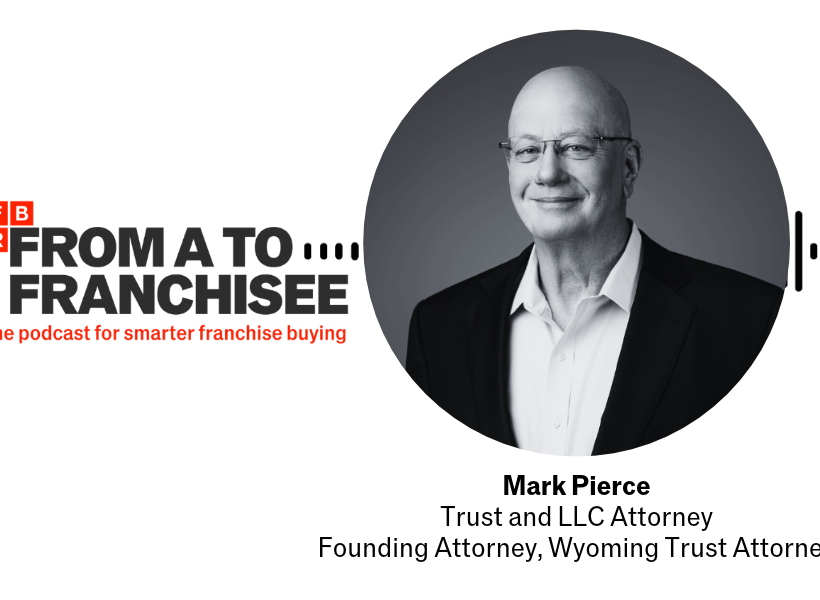
Guest: Mark Pierce, Trust and LLC Attorney of WyomingTrustAttorney.com
Before Mark Pierce became an asset protection attorney, he spent years as a bankruptcy trustee, reviewing more than a thousand petitions and noticing the same mistakes again and again. In this episode of From A to Franchisee, he tells host Allison Dudas why the time to protect yourself is before you sign, not after trouble shows up, since the law protects people who plan and not people who react. He explains what an LLC does and doesn’t shield, how commingling personal and business money can undo that protection, and why a $250 paperwork lapse nearly cost one business owner a $20 million loan. He also covers personal guarantees, how your financing choices affect your risk, and how to structure multiple locations so one weak unit doesn’t take down the rest. If you’re thinking about buying a franchise, Mark lays out what to set up first and who should be on your team. This episode is for informational purposes only and is not legal advice; laws vary by state, so talk with a qualified franchise attorney and accountant about your own situation.
What you’ll learn
- What a bankruptcy trustee sees when business owners’ structures fail
- Why you should structure a franchise as though it could fail, and do it from day one
- What an LLC protects, where it stops, and why commingling funds puts it at risk
- How to think about personal guarantees on franchise agreements, leases, and loans
- Why funding with your home or retirement accounts raises the stakes
- How the state where you form your LLC can change your protection
- How to structure multiple locations with separate LLCs, a holding company, and a management company
- When a family trust makes sense, and what happens to a franchise without an estate plan
Key takeaways
- Set up an LLC before you buy, open a dedicated bank account, and keep business and personal money separate.
- Transfers made after trouble starts can be set aside by a court, so plan ahead.
- Keep your LLC in good standing by filing annual reports and keeping a registered agent. An administratively dissolved LLC can trigger a lender’s default.
- Get an accountant and an attorney who both know franchising before you invest.
- Use a separate LLC for each location, with a holding company above them, so one struggling unit doesn’t sink the others.
- Avoid financing with your house or retirement funds when you can, though first-time owners may not have a choice.
- Build your wealth through LLCs first, then add a trust as your family and assets grow.
- Mark’s advice for anyone about to sign: have an attorney who knows franchising go through the agreement with you, the good and the bad.
Resources
- Red Flags in Your Franchise Agreement
- Do You Need a Franchise Lawyer?
- What Is a Franchise Agreement? Everything You Need to Know
- How to Get Funding for a Franchise
- Understanding the Franchise Disclosure Document (FDD)
- The Most Important Items in an FDD
- How to Prepare for Franchise Financing Before Making the Leap
- The More, The Merrier: Multi-Unit Ownership
- Top Multi-Unit Franchises
- Franchise Financing Resource Center
- Franchise Term Glossary
Transcript
Allison Dudas (00:07)
Welcome to From A to Franchise Z, the podcast for smarter franchise buying. We are Franchise Business Review and we’ve got over 20 years of market research data from the franchise industry. We’re here to spill the tea. FBR is the definitive source for unbiased insight into franchise ownership. We’ll share real metrics, helpful advice, and talk to actual owners. See what great franchises look like and how to spot red flags in others.
This podcast will build your franchise toolbox so you can make the right investment for you. Think of us as your franchise besties with data.
Allison Dudas (00:49)
Welcome to From A to Franchisee.
Buying a franchise is one of the biggest financial decisions you will ever make. And most people spend months researching the brand, but almost no time thinking about how to protect everything else they own once they sign. Today’s guest spent years as a bankruptcy trustee, taking apart the legal structures people thought would protect them. And now he builds ones that hold up. If you’re thinking about buying a franchise, his advice on setting things up the right way before anything goes wrong could save you from a very expensive lesson. m
Mark Pierce, welcome to the podcast.
mark pierce (01:25)
thank you for having me on, Alison.
Allison Dudas (01:28)
So happy to have you here. I I know that your advice is really going to help a lot of people and that’s really what what we’re about. Uh all right, so take us back to the beginning. How did you go from being in business and accounting to becoming an attorney focused on asset protection?
mark pierce (01:44)
Yeah, well I I focused when I was an undergraduate, I had a dual degree in a statistics and uh accounting, and I went to work for a large accountancy firm and made it all of about three hours before uh I quit and went to work for an offshore drilling company as management trainee, and I got injured, so I went to law school. So
Allison Dudas (02:01)
Wow.
mark pierce (02:02)
like they say about law schools, the the uh great American repository for directionalist postgraduates. So that was me in law school.
Allison Dudas (02:12)
I
love that. What did you learn as a bankruptcy trustee about how to structure, how structures fail under pressure?
mark pierce (02:20)
Yeah. Well, I was living and working in uh Denver, Colorado, in nineteen eighty-three to nineteen eighty-five. And I’d worked for a large firm and I did not like working for a large firm. I found it to be really just too constraining. So I went out and I became I signed up and I became a bankruptcy trustee as a way to generate some cash flow. So I was assigned 30 cases per month to review for efficacy. And I did that for about three years, so well over a thousand bankruptcy
petitions that I went through and I looked at those and I said, What was the singular biggest mistake that they made in filing for bankruptcy, ending up in bankruptcy? The first mistake is so many of them d kept their businesses in their personal name.
So that when the business failed, all the business liabilities came out and they had to pay those individually. So since the Hudson’s Bay Company in the 1600s, you are allowed to put businesses together and capitalize them and have passive investors outside of that, so that you, as an LLC owner or a corporation owner, are not liable for the debts within that business unless you personally signed a guarantee for them. So that inside out liability is the first thing that they did wrong. They needed to put that.
business entity that that business into an entity, either an LLC or a corporation. That was the biggest single thing. And then the thing that we found that was the easiest way in which to go after most business owners is they began m commingling, if they did have an LLC or a corporation, they began co-mingling their assets and their liabilities with the business itself. So in other words, if your spouse comes in and has a debt that needs to be paid
on his or her credit card for groceries and running the kids around, that sort thing, you run it out of the business. Well, a judge is gonna look at that and say, Well, you did not respect the efficacy of that business because that was not a business expense. If you’d
Allison Dudas (04:13)
Right.
mark pierce (04:13)
have made a distribution to the individual and then paid it, you’d be fine. So what
Allison Dudas (04:17)
Yeah.
mark pierce (04:18)
You know, this is kind
of a segue is that, you know, you need to get good accounting advice before you get good legal advice, but that accounting advice is paramount because they set up your cash flows and why you do it the way that you do it. You need to learn it and you need to implement it because it will save you at some point in time.
Allison Dudas (04:35)
Yes, that’s such a great point. And we definitely encourage people if they are thinking about franchising, investing in a franchise, that you should be talking to an accountant and even more specifically an accountant that’s very familiar with the world of franchising because it it is different.
what did you find that owners usually wish they had done earlier?
mark pierce (04:56)
Oh yeah, just getting back to what we just talked about. They wish they had set up an LLC or a corporation to house that business beg uh from the beginning. And they also wish that they had there’s a third thing, they also wish that they had uh, you know, honored the advocacy of that LLC and not commingle business and personal assets together. You find you still find that a lot. And that’s what people go at when they try to break through these.
these LLCs. And then, you know, the last thing was is that when you’re looking at doing this and you’re looking at getting a good accountant to maximize your cash flows and minimize your expenditures, you have to, you have to acknowledge that there are ebbs and flows on that business. You have good months, you have bad months. Don’t overspend.
And I know
Allison Dudas (05:40)
Yeah.
mark pierce (05:41)
one of in one of the downturns, there was a psychologist that appeared on CNBC who said the biggest problem that small business owners have is they have some initial successes and they overspend. So they borrow money to buy things that they don’t need to impress people that they could care less about. And I found
Allison Dudas (05:58)
Hm.
mark pierce (05:58)
that going on a lot. And I did a bankruptcy for a gentleman who went from making, and this is probably about 1988, 450,000 a year to a quarter of a million dollars a year. In 1988, that was a lot of money.
Allison Dudas (06:10)
That is
mark pierce (06:10)
And
he’s he’s broke. So you look up you can’t take the kids out of private school because that’s gonna affect the rest of their life. And we can’t come out of the house that we have down at Cherry Hills Village because you know that’s gonna be too much of a damage on my ego. And I can’t drive the Mercedes anymore. And I looked at him and said, Well, there you are. You’re a sinking ship going down, and you don’t believe you have any freight to throw overboard. So don’t take the freight on initially. Live prudently, run your business prudently prudently, put the money in the bank.
Allison Dudas (06:41)
That’s great, great advice. And and celebrate your successes maybe in a little bit of a different way at first, right? Like not by going out and spending, but by being really smart and and securing things. because then maybe later down the line, you’ll really know when you can celebrate. You’ll really have that security. Yeah.
mark pierce (07:00)
Yeah, you know, and you’re
you’re sitting there as a franchisee in these various markets. And I’ve seen this repeatedly. Somebody gets into a new franchise, they operate their business really well, they put cash to the side, and then other franchisees begin having the wrong kinds of troubles. So they can actually end up standing s stepping into those additional locations, and then you go from one location to two to three, and next thing you know, you got twenty. If you
Allison Dudas (07:26)
Right.
mark pierce (07:27)
manage your business prudently.
prudently and learn how to deal with people and learn how to deal with the money.
Allison Dudas (07:33)
Hmm, great advice. Okay, so if someone’s just starting to explore franchising, when should asset protection enter the conversation? Immediately.
mark pierce (07:42)
Immediately. You know, you have
to structure this business as though it’s going to fail. And then you have fo have to focus on it over a long period of time and you have to make sure that it doesn’t fail. But if it does fail, you want to make sure it doesn’t drag you down with it so that you can get to the next business. And as an entrepreneur, as a society, I think a lot of times we have a tendency to believe we don’t believe in failure. Nobody fails. And yet
Allison Dudas (08:06)
Right,
right.
mark pierce (08:07)
Everyone fails, you know. And when I was in the technology business in San Francisco in the nineties, if you didn’t have a bankruptcy behind you, you just weren’t that much of an entrepreneur. Because how do you know what
Allison Dudas (08:17)
Ha ha
mark pierce (08:18)
your limits were if you didn’t fail at the end of
Allison Dudas (08:20)
Yeah.
mark pierce (08:20)
the day? That’s exactly what it was. So it’s like T Boone Pickens said, he was a wildcatter in West Texas in the 70s and 80s. He says the best business lesson you can teach anyone, and and he largely funded Texas Tech, but there’s mi billions of dollars. He says the
The number one lesson is that you take the money off the table when you still have some so that you can get into the next game. And I find so many entrepreneurs will get into something and they get to that point where it’s like, I’ve got a little bit back, but I’m putting it in. I’m not letting it fail. And then they really do fail.
And that
Allison Dudas (08:55)
Yeah.
mark pierce (08:56)
I think is that tendency to believe that we’re always successful. And you know, like a friend of mine used to say, I still know a lot of technologists who are working their parents’ basement out in San Jose, California. Not everybody is Bill Gates or, you know, whomever the real successful people are.
Allison Dudas (09:10)
Nope. Right,
right, whoever the next person is. All right, so let’s talk a little bit about timing because I think timing timing is everything, right? And you’ve seen people kind of at the worst stages in their business. And when you think about timing, like what happens when people wait until trouble shows up to fix things, to come to get get help.
mark pierce (09:31)
Um that’s a very easy answer,
you know. The law protects you if you plan. The law does not protect you if you react. So if you put your franchise interest into a business when you begin, then you’re not doing a fra what what the law calls a avoidable preference or a fraudulent preference. So you can go forward with that.
And if the business fails, they’re not going to s be able to come outside that business against you because you followed all the rules on putting the assets into that business.
If you get to a point where you’re starting to fail and you say, my goodness, I should have put this into a limited liability company, and you make that transfer, then that transfer is not going to be upheld in a court of law. The judge is going to set the transfer aside and come back against your interest. So plan, don’t react. And that shouldn’t be shocking, is it? I mean, when you go
Allison Dudas (10:23)
No.
mark pierce (10:23)
in and to buy a franchise, the more time you sp and you run into this, the more time that one of your clients spends up front.
The easier the transaction is because you’ve learned the nomenclature, you’ve no learned the pitfalls, you’ve learned the positives, and you can really swim quickly with them and find something that works well for them.
Allison Dudas (10:42)
Hmm. Now going back, you mentioned L an LLC. Now most franchisees do form LLCs when they invest in a franchise. Is that is that what you would recommend forming an LLC over an S Corp or something else like that?
mark pierce (10:57)
Yes, I think that the S Corp is an historical uh anachronism. And I think it’s very easy to fall in that because people have gotten used to it over the years. But the LLC really there’s four different ways you can uh tax an LLC depending on how you want to be taxed. You can elect to be taxed as a C Corp, an S Corp, a a f a partnership, or a sole proprietorship as a flow-through entity directly onto your ten forty. You have all that all of that all of those.
variations that you can engage in. With a corporation, it’s only a C corp or an S-corp. And back in the 80s when I initially started practicing, I did a lot of my clients would get, they were young. So they’re in their 20s and they said, look, the the max tax rate on a corporation is 21%. I need that max tax rate. But you would always caution them, that’s fine. You’ll pay 21% when it comes into the corporation, but when you distribute it out to yourself, you’re going to pay whatever your tax rate is at that point in time, which could be 40
Forty five, fifty percent, depending on the state that you live in. And that can be a little overwhelming. And if you keep too much money in your corporation, you’re stop you’re subject to accumulated earnings taxes. And those
Allison Dudas (12:07)
Huh.
mark pierce (12:08)
are I think an additional 10 to 12%, just right off the top. So we we began running into problems in in my 50s and 60s, where people coming to me, my goodness, I’ve been really successful. This is great, but I’ve got all that money trapped in that C Corp. How do I get rid of it?
I said, absent charitable contributions, you’re going to pay a double taxation on that. They said, Well, how do you get out of it? I said, You don’t. And you’re not going to find
Allison Dudas (12:32)
Yeah, you can at that point.
mark pierce (12:34)
you cannot, and you’re not going to find one CPA that’s going to get engaged in any tax dodges that you’ve come up with. And then when they hit you with the accumulated earnings tax, you’re going from a 40 to a 50% tax. Well,
Allison Dudas (12:45)
Yeah.
mark pierce (12:46)
best to pay as you go. And I’ve always
Allison Dudas (12:48)
Yeah.
mark pierce (12:49)
found that to be the case. You know, if you’re running your business on credit cards,
Other than to start sometimes, I think that’s a fool’s errand. And you’re just better off paying as you go, making the money, investing the money as you go.
Allison Dudas (13:03)
Now in terms of LLC, what does it protect?
mark pierce (13:08)
Well, two things. You have what they call an inside out liability. So if you form an LLC and you’re running your business in it and you end up with difficulties with creditors, those creditors cannot sue you personally. So that’s an inside out liability. Now, if you have a bank loan and you’ve guaranteed it, it’s a consensual loan, you’re like, you’re gonna have to pay that. So if you guarantee something, that’s not going to be cut off by the LLC. But that inside out liability is gonna get rid of a lot of your liability. So that’s
Allison Dudas (13:36)
Hm.
mark pierce (13:37)
the one thing that
Does. The other thing that you have to worry about are outside in liabilities. And I had a client, for instance, whose 15-year-old son had been told do not drive any of the cars. And the 15-year-old son came home high on something or other with a couple of his friends. They got into one of his classic cars, roared down the road. He killed one of them, maimed the other one. So they sued him for more than the insurance limit limitations on that. And
You know, that’s your outside in liabilities. So if they get a judgment, let’s say that that in that is we negotiated that out, but in that instance, if they had come after him and gotten that judgment, they would have gone after all of his interest in his corporations and his LLCs. Now the corporations, they could have taken the shares and sold the shares to whomever they wanted, or taken the shares and putting themselves in charge and sold the business and liquidated it. With an LLC, you’re limited to a charging order.
That essentially says your creditor gets a charging order against that LLC interest. They don’t attach, can’t sell it, can’t come into the management of the company. If and when that LLC makes a distribution out to its membership interest holders, that creditor will get those distributions. Now, good luck with that. They can sit and wait by the mailbox. And eventually you can work out something with them to get a discount to that liability, but you probably would not get rid of all of it if it’s a successful business.
Allison Dudas (15:02)
Okay, all right, let’s talk for a moment about franchise agreements. Um so franchise agreements and even leases and loans often require a personal guarantee. How should a buyer think about that and what can they do about it?
mark pierce (15:16)
Well
You know, it depends on your negotiating position when you come in. If you’re a strong franchisee
Allison Dudas (15:20)
Right.
mark pierce (15:21)
and you’ve got a number of franchises, I think the franchise or is going to say, look, we’re gonna run with you because we’ve got a track record with you. And we wanna make sure that we’re able to enforce the the covenants that you have in those agreements against you individually. So that’s what you do, you put it in place. So as you get more of an operating record, then you find that they are going to ask for guarantees and individual guarantees uh from you. So it’s really a function of how long have you been.
business and who have you been in business with. And I I found over the years that if you have one bank that you’re in business with and you maintain your accounts with them and you’ve given them good business, you’ve always paid your loans, that they’ll eventually get away from the guarantee. But that’s not a guarantee. That’s that’s not a guarantee of the guarantee.
Allison Dudas (16:01)
Hmm. Ha ha.
mark pierce (16:05)
Yeah. But in the same thing with franchise oars. With when the franchise oars get with the bigger franchisees, they’re not asking for personal representations for people.
Allison Dudas (16:13)
Hmm, hmm. Okay. Now let’s talk about the financing piece. So when when franchisees decide to invest in a franchise, they they fund them in different ways, right? Whether it’s savings, retirement money, home equity. How does that choice of how they’re funding it affect the risk?
mark pierce (16:33)
How does it affect the what? I’m sorry.
Allison Dudas (16:34)
Their risk.
mark pierce (16:36)
yeah, the risk. You know, I always think when you put your house up on your loan that you’re really you’re you’re risking probably the one thing that matters the most to your family is the place to live. Um and then I also think, you know, if you put up pension funds as guarantees of your obligations and those guarantees come due and they hit those pension funds, you’ve got not only the loss of funds out of the pension, you’ve got the tax aspects that come with it from the liquidation of the p of the pension.
Allison Dudas (17:01)
Mm.
mark pierce (17:01)
So my feeling
is you’re always best to go out and get a bank loan. Um, and if ne if necessary, secure it against your cash accounts, that sort of thing. Uh don’t finance with the pay with the tax free accounts. Don’t finance with your house if you can avoid it. But generally if you’re just starting out and you don’t have a track record, you’re gonna have to put your house up as collateral.
Allison Dudas (17:21)
Yeah, yeah. So it it could be unavoidable for some people. Um, what should now obviously, you know, we’re saying if somebody’s going to buy a franchise, they should engage with an attorney that’s familiar with franchises, they should engage with an accountant. What do you feel like are the big, big things that they should ask their attorney before investing in a franchise?
mark pierce (17:42)
Well,
I think it’s the same thing for an attorney or an accountant, right? Is you want to make sure that you understand where I could go wrong with this and how do I keep from doing that. And so my advice is make sure you get into an LLC, form a bank account with that LLC, and make sure that all of the monies that are generated by your business go into that bank account and only the expenses that are necessary for that LLC come out.
If you’re gonna make a distribution to yourself to pay personal things, that’s fine. That’s a personal distribution, you can do that. But you have to make sure that you leave enough money in the business to pay the business debts. Otherwise, you’re rendering the business to be uh unable to continue, and that’s a liquidation preference, so they can come after you for those l those amounts of money too. So leave the money in there, let the business run, take the salary that you’ve got, live on that. So that’s to me the most significant thing.
What I find to be very interesting is that Wyoming
Which is where I’m from, has what they call a closed LLC that’s available to you. Wyoming is a small business state, and we have families that engage in that small business. And you’ve sat down with your family over the coffee table or over the breakfast table in the morning and you do your business in the morning. And then you go out and you do it, right? You don’t go in and you don’t have annual minutes of a meeting, because you don’t have an annual meeting, you don’t have special meetings. If you go to get a bank loan, you talk about it, you talk to the bankers, you do what you need to do, sign what you need to sign, you get on with it.
So Wyoming
Allison Dudas (19:07)
Right.
mark pierce (19:08)
is not going to allow a creditor to come in and break apart an LLC for personal liabilities of the membership interest holders just because they don’t have paperwork. Because Wyoming says no one gets paperwork. I mean it’s the best recognition I’ve ever come across. Falsifying annual annual minutes for your meetings going back 10 years. I’ve seen people doing it for years because no one keeps the meetings.
So why would it be a legal basis to get into your LLC? Wyoming recognizes the closed LLC. Second thing that Wyoming does, and they did it by statute, they said they recommend they they recognize single member LLCs. Well, you go to Florida as a as a primary example. Florida does not recognize single member LLCs. So if a husband and wife get into an LLC in Florida, they’re one considered to be one person. There’s
Allison Dudas (19:54)
Oh.
mark pierce (19:55)
no liability protection within that LLC. They can break through.
And they can break out. So you have to be careful about where you organize that LLC. And then the last thing is the charging
Allison Dudas (20:05)
That’s really, really interesting.
mark pierce (20:07)
order, yeah, that we just discussed.
Allison Dudas (20:10)
Right, that we just discussed. Okay, so let’s talk a little bit about protecting what you own from from the business, from like inside the business. So tell us about a business owner whose personal wealth was exposed by a problem inside their company. What happened?
mark pierce (20:25)
Yeah, well that’s what he just went over was the guy whose son borrowed his car against his
Allison Dudas (20:29)
Yeah.
mark pierce (20:30)
express instructions and killed one kid and maimed another.
And that’s an
Allison Dudas (20:34)
Yeah.
mark pierce (20:34)
example of a personal liability getting into the business. Now, if you don’t maintain the efficacy of the cash flows and the legitimacy of that LLC, like by filing your annual report, maintaining a registered agent, that sort of thing, and you allow it to break down, then people within that business can come out. And I’ll give you a specific example. I was representing
Allison Dudas (20:53)
Mm-hmm.
mark pierce (20:54)
uh a doctor who had gone in and borrowed $20 million to build a certain type of structure to house some sort of medical, not procedures, but a
Laboratory for blood analysis and that sort of thing, and had it all set up. But like in most things in medicine, you know, it’s dependent on hospitals, and then you have budgets, and then you have input, and it didn’t go together all that well. And he raised some money from friends and he put the 20 million into the ground in a drug-on for about two or three years, and he was making the payments on the note. He did not keep the LLC effective with the Secretary of State where he was. So
The banks go in and they review, they’ll say, Okay, we got a loan with XYZ Corp. Are they current their reports? No. All right, keep an eye on them because if they go to Lincoln and they’re administratively dissolved, we’re gonna go after that loan. Cause that’s the easiest way in the world to go after that loan. So he had he had sat on it for two years. It was a DIY. He did it himself.
Allison Dudas (21:52)
That’s brutal because it’s
such a simple paperwork thing. Ugh.
mark pierce (21:56)
It’s a hundred bucks, right?
You you pay a hundred dollars to the secretary or si it’s Wyoming is sixty dollars to file the form, a hundred dollars to prepare it, and then a hundred dollars to have a registered two hundred fifty dollars. That’s lunch. That’s the cost of lunch. It it dissolved,
Allison Dudas (22:11)
Especially right now. Yeah.
mark pierce (22:13)
especially right now. Yeah. So it dissolved. So the bank sends them a notice of foreclosure, said you’ve got to pay it off right now. And so all of his partners are looking at him. So what have you done?
Yeah, so you know, and I advise doctors, go be a doctor, turn the admin over to somebody that keeps track of that stuff because you guys can do it, but it’s not interesting and you don’t do it well as a result. So that was an example of an outside in, inside out, two of them like that. Can you imagine?
Allison Dudas (22:42)
Yeah. my gosh. Okay. You no, I can’t, especially
over like a clerical a clerical oversight like that. my God. my God. Terrifying. Um, all right. how do you separate what the business owns from what you own personally?
mark pierce (22:58)
Oh, well, you know, the easiest thing is that you have a checking account inside the business that receives and distributes all the money pertaining to that business. If you’ve got real estate and those sorts of assets, make sure they’re in your personal name and get them away from that business and don’t commingle the two. That’s the easiest way to do it. Another way to
Allison Dudas (23:15)
Definitely.
mark pierce (23:16)
do it is that, you know, if you begin to have business troubles um with your LLC and you’ve got some uh consensual loans that you’re gonna have to have to take care of.
And you take a look at what the exemption is on your house. Like in Florida, I think it’s five million dollars, not much to worry about. In Wyoming, it was 40 until recently. But it’s such a small amount. What you do is you put a HELOC in place. So it looks like there isn’t any equity in there. And if you need to, you would draw it and then you use that to live on. So you draw down the equity in your house so that you can live on the equity in your house rather than it going to the bank that’s got a loan on it.
Allison Dudas (23:52)
Right, right. Okay, so where do insurance and LLCs fit and where do they leave gaps?
mark pierce (23:59)
I would say, well, you can’t get insurance for everything, right? So, you know, you can get errors and emissions and that sort of thing. That’s become prohibitively expensive. If you’re in
Allison Dudas (24:09)
Mm.
mark pierce (24:09)
a real estate venture and you’re buying real estate and you’re putting in it LCs and doing all that, I mean an umbrella policy under LLC to cover anything that goes on with uh something in in uh
You know, single family housing or apartment housing, that sort of thing is excellent. I think on the business side of things, keep your cars insured for more than what you might think that you’re going to be liable for, because it’s that excess liability that comes back to haunt people. And and what I tell people is you take all the automobiles that you think are worth so much and stick them in a single LLC and you lease them to your other LLCs. Because w you know, there’s nothing that ever nothing that’s any good that ever comes from automobiles.
They break down,
Allison Dudas (24:50)
Yeah.
mark pierce (24:50)
they crash into things, they run over people. Uh your employees get drunk and run over people, your employees get drunk and run over themselves. You know, all of those sorts of things that every business owner, if you talk to enough business owners, somebody’s run into that sort of thing. So putting the putting the cars over in another LLC and getting away from that liability is always a good idea.
Allison Dudas (25:11)
Hm.
mark pierce (25:11)
So that’s one of the things you can do to minimize your your liability as well. Because in your franchise, depending on the franchise, you may need automobiles, but keep it away from the franchise itself. So if there are excess policy limits on that, it doesn’t come back to affect your your LLC and your franchise business itself.
Allison Dudas (25:28)
Hm, hm. Okay,
when they begin scaling, how should the structure change? Especially if they own multiple locations and one location for whatever reason becomes extremely weak.
mark pierce (25:42)
Right.
You would want to have each one of the locations in a separate LLC. And then and then you would have each one of those LLCs old by a holding company. And then the holding company would also own an LLC that acts as a management company. So what happened?
Allison Dudas (25:57)
wow. Okay.
mark pierce (25:58)
All right, so that management company comes in and collects the monies on behalf of each one of those entities, pays the debts on behalf of each one of those entities, and renders a bill for the services every month.
So that you can take the money out legitimately in exchange for the services are done. That way you only have one checking account because that checking account’s for everyone’s benefit. And then
Allison Dudas (26:17)
Huh.
mark pierce (26:18)
if you begin to have problems with that one LLC and it’s not performing well, then you can take and you can take that management company and you go back up to that holding company and you’ll have money there. And the companies that are doing well can make distributions of excess working capital into that holding company, then the holding company can loan money to that franchise.
And then you put the documents in place. It’s a revolving line promissory note with a UCC one to secure whatever it is that you have uh extended credit on against the assets within that franchise. Now, obviously, that’s not going to subvert what the franchise or has, but at least gives you some background of what you do. And it also gets rid of that uh commingling attitude, because you’re not commingling, you’re making a loan. And that’s what comes down.
Allison Dudas (27:04)
Yeah.
mark pierce (27:05)
And I always tell people.
You always hold on too long in a bad situation. Take a good hard look. Why did you do what you did? How did you do it? How did it work? If it wasn’t right, did you adjust? And how did the adjustments work? And if the adjustments didn’t work, maybe you should just shut that business down and call your k call it a day. And we always
Allison Dudas (27:26)
Yeah.
mark pierce (27:27)
want to go, you know, wanna be a success, wanna be a success. I don’t know that many people who’ve been a hundred percent success their whole life.
I do find people that cut their losses early and and run with the successes and cut the losers.
Allison Dudas (27:39)
Yep.
Well it’s like no when to hold them, no one to fold right? No when to walk away, no one to run.
mark pierce (27:44)
Yeah, exactly right.
Allison Dudas (27:47)
what it’s like when you have to protect your business from family because
So many franchisees enter franchise ownership alongside their parents, their spouses, their children, or even later on bring those people into the business. So some of I know your toughest cases, because we’ve talked about this before, didn’t involve competitors or anything like that. They involved actual family. can you talk about some of the ways that you need to protect businesses from family members and what to do?
mark pierce (28:20)
Yeah. W once you become once you get to a certain level of success, say a million dollars or more in assets that you have, net assets, you have to really think about going into a trust. And you call it a legacy trust, a legacy planning trust that protects each one of those businesses under that trust. And it puts an over
a an an overbearing, an overburden on those trusts that allows you to manage for the benefit of the family. So the two biggest issues that you have in a family besides people not getting along, but you can usually see those coming a long way away, but it’s
Allison Dudas (28:51)
Mm.
mark pierce (28:52)
divorce. And then the second aspect are drugs, you know, because when you mi give money to someone who you know is a drug addict and they go out and they purchase drugs, you’re an enabler and that
Makes you liable for some of that enabling at some point in time in the event that there’s damage done. And people don’t seem to grasp that reality. And they think that they’re trying to help their kids, they’re not. And they’re not helping themselves either. And you can’t save one kid and let all the other kids go under. So I think that’s the biggest issue. But also the divorce end of things. And I’ll give you an example of that. I had a client
Who had a couple different holding companies, a variety of businesses underneath, had been very successful. And he and his family went into a legacy trust, at what they call a qualified spendthrift trust, a domestic asset protection trust. And they put all of those business interests into that trust. And the husband and the wife, and then the three kids, who were all over the age of 21, 22, over the age of majority, were
beneficiaries of that trust. Now in Wyoming, those beneficial interests are not property interests. So as a result, if any of those kids get married and divorced, that’s not part of their divorce estate. If the husband and wife get divorced, it’s not part of the divorce estate. So what ended up happening is that she decided she wanted a divorce. You know, it’s fine. Things don’t work out all the time. And she wanted, she hired a couple divorce attorneys and they wanted half of what was in the trust. And I said, you should go get somebody who understands
what it is that they’re doing here because you have no right to sue for a distribution or anything else out of that trust. If and when distributions are made, and they will be made, you know, it’s not like she’s being cut out and
Allison Dudas (30:34)
Right, it’s just
upon an exit, I would imagine. Is that when
mark pierce (30:36)
Yeah, so she just
she chose to exit the relationship. That’s fine. You get the divorce and you’ll get your distributions out of the trust just like everyone else does. But it doesn’t mean that you own half the trust. So it took us about s on her third set of attorneys, she finally began getting the message that she’s gonna be a part of that family for the rest of her life. As well, she should be. But she’s not gonna be preferred over anyone else in that trust. So it preserved those businesses. And then the
Allison Dudas (31:04)
Yeah.
mark pierce (31:05)
We ended up selling some fairly substantial assets. She got a big distribution out of it. So she got her share at the end of the day. And uh I could I never understood the divorce attorneys want to get into that trust and take half. Really? What makes you think you’re entitled to half when it’s a family business?
Allison Dudas (31:20)
Right.
mark pierce (31:21)
So that saved that particular business and made it much easier
Allison Dudas (31:23)
Hm.
mark pierce (31:23)
for them to work forward as a group. And they and as a family, they healed from it too. So I think it really worked out well.
The other thing that that does is it puts a management structure in place where some of the kids, it’s like a smorgasbord. Kids can come in, work for the business. If they like it, they stay. If they don’t, they leave, they go out and do other things. They’re still supported by the family structure, but the people in it get paid for running it. And then they have the excess distribution goes on after that. So it becomes an umbrella that makes it worthwhile for you as an individual going forth in your life.
So you have to
Allison Dudas (31:55)
Yeah.
mark pierce (31:55)
build that into the trust. You can participate in the trust and the businesses under the trust as much as you’re comfortable with.
And you’ll always be taken care of, but you’ll be taken care of better if you’re actually producing additional monies for the trust. So that’s one of the hard facts of life. But it doesn’t mean you get excluded either. You get all the family events, you get taken care of with excess distributions, that sort of stuff. So that’s what you do. And then they have what they call unitrusts within the trust. Wyoming has most states have unitrusts, but they’re specifically structured by the trust industry banks so that you could put money into a trust for the benefit of a kid who’s a drug addict.
To provide for that kid’s basic needs without being liable for everything that goes on in the event that that kid goes off the rails. Because the average number of times that k go in for drug rehabs or alcohol rehabs is five times. So one, two, three, four aren’t viewed as failures, they’re viewed as stepping stones to getting to that fifth time, and then it begins to take hold. But it doesn’t always take hold, does it? So at the end of the day, you establish these unit trusts.
as a way in which to take care of those people without relic resulting in liability back to the company itself.
Allison Dudas (33:07)
I see. Okay, so you would really recommend like a husband and a wife or a father and son, mother or daughter, creating a trust and then also obviously the LLC when they decide to invest in a franchise. That’s the best and safest way to protect themselves.
mark pierce (33:24)
Yeah, I would start with the LLCs, build your wealth up, and then at some point in time develop the trust. So it’s a step process. Get used to running the LLCs, get used to running the holding companies. And then when your kids get a little bit older, get into that trust because that’s going to allow you as a family to move forward.
Allison Dudas (33:41)
Okay. All right. Thank you for
spelling that out. Yeah. Um, all right, let’s see. this is this is definitely an interesting one. So what happens to a franchise if the owner dies or becomes incapacitated without some kind of a plan?
mark pierce (33:58)
Well, the government has a plan for you. Uh, you know, it’s called intestacy. So
Allison Dudas (34:00)
Yeah.
mark pierce (34:03)
what’ll happen is you’ll have to go and you’ll have to open a probate estate, and then the law dictates who gets what. And typically what happens uh in most states is that the spo if if you’ve got w if it’s a spouse that dies, the other spouse gets half, and then the kids split up a half somehow.
Allison Dudas (34:20)
Mm.
mark pierce (34:21)
And so
At that point, somebody has differing interests. And this is where in Wyoming in particular, this is where you start to see the loss of family farms and ranches. I mean, there are no family ra farms left in Wyoming. It’s just too dry, but the family ranches are split up and sold because there’s nobody who can come in and manage that ranch or wants to. And I had a uh an example of a ranch that had been uh founded in the late 1800s and it was on their fourth generation.
And they’re very responsible landowners and great ranchers, but they all died. And the only people that were left, there were there were two kids out of one guy had no uh one of the kids had no children, another one had two. Um they had left Wyoming to pursue careers because
You know, there’s nothing they could do at the ranch. There are already people on it. So they ended up finding other things to do. They got married. They have kids. They were living in Denver. They didn’t want to come back to a place called Recluse, Wyoming, which is descriptive. And they that their wife said, I I’m I’m not going to go back there. And then uh the third sib the third sibling had uh three kids.
So they came back and they said, well, the best way to get rid of this thing then at the end of the day is we need to minimize our estate taxes, put it into a pile, and just give the kids the money if that’s what they want to do. So when the last of the kids died, that’s what they did. They put it up for sale. It was like 14,000 acres. So it was about 1.14, twenty twenty some million dollars and it went to these
these seven kids. So
Allison Dudas (35:53)
mm.
mark pierce (35:54)
that’s that’s what happens. So that’s why you need the trust and why you need to put those things into place, depending on what you want to accomplish. But
If you rely on testus intestacy to provide for what it is that you would like to have happen you might be surprised by what happens.
Allison Dudas (36:09)
I wanna put you through some rapid fire, Mark. Are you ready?
mark pierce (36:11)
Okay. I’m ready.
Allison Dudas (36:14)
All right, okay, so first question. One thing every franchise buyer should do before signing.
mark pierce (36:21)
Get a good accountant and spend a lot of time familiarizing themselves with the nomenclature and why they want to get into that business.
Allison Dudas (36:29)
All right, biggest myth about LLCs.
mark pierce (36:33)
Although protective with from everything no matter what happens.
Allison Dudas (36:39)
One red flag when vetting an asset protection attorney.
mark pierce (36:45)
Take a look at the the amount of time that they have spent in the asset protection arena and exactly where they spent that time. And look at their litigation experience. I’ve litigated in bankruptcy court, tax court, district court, federal and state, local. And I go back constantly. I run into people who have been there 10 years, and it’s like
What have you been litigating l it uh recently? Let me take a look at your at your at your disclosure list. And they don’t have one. And I just ran into a guy who’s 77 years old, has been a tax registered with a tax coin since 1981. He’s got three cases that he’s tried, lost all three. Now that’s my guy. Yeah.
Allison Dudas (37:23)
Mm.
mark pierce (37:25)
You’re gonna hire him? Good luck.
Allison Dudas (37:28)
All
right. The best time to set up asset protection before buying in year one or later.
mark pierce (37:35)
Um, do it immediately and do it in the form of an LSC or a corporation and just get used to the idea that that’s how you conduct your business. You can build from there.
Allison Dudas (37:44)
One conversation that couples should have before buying a franchise.
mark pierce (37:49)
Yeah, what do you really want?
Allison Dudas (37:54)
The most overlooked risk for new business owners.
mark pierce (37:59)
uh your own mental attitude. And you know, it goes from complete euph euphoria to the end of the world analysis, but it’s never as bad or as good as it ever as it seems to be. And that’s why I say it wouldn’t hurt to have a Dutch uncle who can sit down with you once in a while, every three months, go have lunch with your Dutch uncle, tell him what’s going on, and get some hard advice.
Because if you can find somebody who’s in their sixties, they’ve gone through these things. And a lot of times your problems are not about you. It’s about things around you. But you have to take what you got and run with it.
Allison Dudas (38:33)
Mm, yeah. Have so have somebody who gives you honest advice, even probably when it’s harsh, is critical.
mark pierce (38:39)
Especially when it’s harsh.
Allison Dudas (38:41)
All right, if you could give one sentence of advice to somebody about to sign a franchise agreement, what would it be?
mark pierce (38:49)
Have an attorney look through it and go over the good and the bad and have somebody who’s used to dealing with franchises look in it to
Allison Dudas (38:57)
Yeah.
mark pierce (38:57)
make sure a good franchise attorney is hard to come by. So you may have to find a franchisee who has gone through a couple of these things to go through it with you, explain what it is, what the upside, what the downside is, because there’s nothing like somebody who’s run through one and had them work for a while.
Allison Dudas (39:13)
Yeah, that’s great. That’s those are great points of advice.
Mark, I think you’ve given people so much to think about. I think the reality is that buying your own franchise is a big decision. It can be a very huge financial investment. It can be a very complicated relationship to enter into if you decide to do it with a co-owner or co-owners. And you should be going in with your eyes wide open and you should be going in with almost an advisory counsel. And it sounds like, you know, you need that franchise attorney. You need a an accountant, a franchise accountant.
And then you need you need that that uncle or that person in your life, maybe multiple people who are gonna give you those honest pieces of advice and and tell you to get get your act together when you need to get your act together. Um any last pieces of advice for people.
mark pierce (40:02)
Go enjoy yourself. You know, business is something that you can really have a lot of fun with, but you have to put yourself into a position to do it. And if you can minimize what you would consider to be your weak points and deal with them, because those are what’s gonna hurt you, then you know, go enjoy the process and involve your family with it. Go make some money and have some fun.
Allison Dudas (40:22)
Hmm. I love that. What a great positive note to end on. Mark, thank you so much for your time. We really appreciate you sharing your expertise, your experience, your wisdom.
mark pierce (40:33)
I appreciate it, Alison. I I enjoyed our conversation. Good questions.
Allison Dudas (40:37)
good. Good. I’m glad. Okay.
All right. Well, thanks so much everybody for tuning in. Make sure you check out the show notes. We’ll put some more resources in there as where as well as where you can find Mark Pierce. And I hope you all have a great day. Tune into next week’s episode.