
Listen on Apple Podcasts | Listen on Spotify | Watch on YouTube
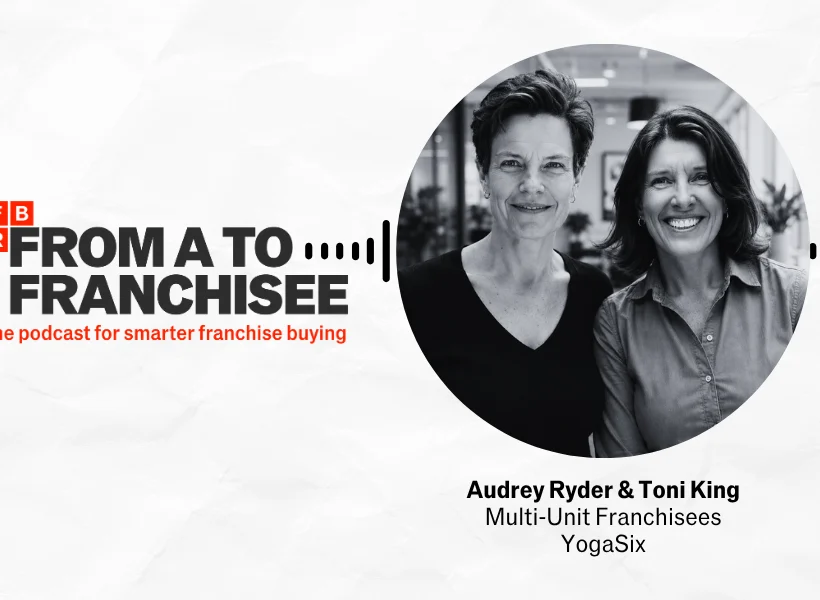
Guests: Audrey Ryder & Toni King, YogaSix Franchisees
Two elite athletes. One shared love of yoga. Seven studios and counting. On this episode of From A to Franchisee, host Michelle Rowan talks with Audrey Ryder and Toni King about trading a rowing career and a black belt in Taekwondo for life as YogaSix franchise owners.
They walk through how they picked YogaSix over other franchise options, the due diligence process that nearly sent them down a different path (including a tip involving Undercover Boss), and how they’ve split roles, scaled to multiple states, and leaned on a tight-knit owner network to grow. Plus: what’s actually trending in boutique fitness right now, and their honest advice for couples thinking about going into business together.
Topics covered:
- From Olympic-level athletics to franchise ownership
- Vetting a franchise: the due diligence questions that matter most
- Splitting the workload as co-owners
- Scaling from one studio to seven across three states
- What franchisor support should look like for multi-unit owners
- Boutique fitness trends: community, flexibility, and consistency
- Real talk on running a business with your spouse
Resources
- Listen: Mathnasium Franchisee on the Podcast (great discussion on employee management and retention)
- Top Franchises for Women
- Women in Franchising: A State of the Industry Report
- Top Fitness Franchises based on Franchisee Satisfaction
- *This is not a sponsored podcast episode, but if you’re interested in learning more about owning a YogaSix, visit their development website: https://www.yogasix.com/franchise
Transcript
Michelle (00:03)
Welcome back from A To Franchisee. I’m your host, Michelle Rowan, president of Franchise Business Review. And today we are going to be talking about the fitness industry. And we have two franchisees from Yoga Six to join us for the conversation. in our 2026 women in franchising trends.
Report which we will tag in our show notes, we see that 52% of franchises are owned by women. Additionally, there’s some other really important representation happening that we’re going to talk about here today. I’m joined by Audrey Ryder and Toni King, a married couple who own multiple yoga six locations in Las Vegas and California.
We are going to talk with them about their history. We have Audrey, who is a former rower for Stanford and Team USA, and then moved into platform diving and long distance swimming. And Toni was a marathon runner with a third degree black belt in Taekwondo. So my goodness, you are both so interesting.
Audrey (01:00)
Ha
ha.
Toni King (01:00)
Yeah.
Michelle (01:01)
So I wanna just talk about if you guys want to talk about what were you doing before you became franchise owners. I think everyone can see the apparent love of fitness, but what were you guys doing in your lives before you became part of a franchise system?
Audrey (01:15)
Do you wanna jump in there, Toni?
Toni King (01:17)
Sure. so for years I was in sales, everything from in-home sales to eventually B2B sales. And thankfully Audrey and I were together and she knew that I although I was good at my job, I hated my job. so thankfully she gave me the space to go get a job for I think twelve dollars an hour at the YMCA working in fitness, obviously not paying any bills whatsoever.
And that led to an opportunity to work at Stanford in fitness. And that’s when I just found my jam of just my I remembered that love of fitness. Because when I did martial arts, I also taught. That was part of the way of moving up the ranks as you had to do so many hours of teaching. And I really enjoyed that. But I’d forgotten that because I went after a paycheck instead of what I actually enjoyed doing.
Michelle (02:08)
Got it. And Audrey how about you? What were you doing before you s I and I’m gonna ask kind of how you came into becoming a franchise owner too, but what were you doing before this?
Audrey (02:17)
Sure,
yeah. Well I had after having kids and kind of staying home raising the kids, I went back to work as a fitness as a swim instructor and got a job at a country club and kind of made my way up the ranks at the at the country club. became the swim coach, then became head of aquatics, then they didn’t have a fitness center at the country club at that time, and so I
proposed
to the board that we build a fitness center and have a whole fitness programming there. And so we we did that. And so I was there at that country club for ten years before we decided to move into franchising.
Michelle (02:56)
Okay, so so that’s what I want to talk about next. So what did that look like for you? first of all, how long have you been franchise owners?
Audrey (03:04)
we signed on in twenty nineteen and we built in twenty twenty, not the best year to do that, but that’s when we started. Yeah.
Michelle (03:13)
Here though. Yeah. That’s great.
Okay. So tell us what that was like with that curiosity or or how you came to find franchising. Did you just want to be business owners or were you did you were you aware of franchising and and then started kind of looking at your options?
Audrey (03:29)
Yeah, I mean we knew it was time for something new in our lives. and s I had quit my job just knowing it had become a bit too much for me. and we didn’t know what was next. I was
in a bit of a depression at that time, I would say. And Toni was right there by my side just saying, We’ll find something and she filled out a little online form that was like, What do you want to be when you grow up? And five minutes later we got a call from Emily, a f a rep of of a franchise consulting firm. And she was like, You guys would be great with franchising and
And w we had a conversation from there. We explored all the different franchising options, everything from senior care to those little like boxes where you can put your old clothes and, you
Michelle (04:23)
Yeah.
Audrey (04:23)
know, vending machines
Toni King (04:24)
Andromats.
Audrey (04:25)
and laundromats and all the things and and then at that time yoga six had just become
been bought by Xponential and there was an opportunity there. So Emily at FranNet, shout out to her. She really helped us through that process.
Michelle (04:42)
That’s great.
Yeah, we we have another episode which we can add in the notes about working with franchise consultants or brokers. So that’s great that they just kind of educate you on what what’s available out there. So so were you once you found fitness, did you look at multiple kinds and and what what attracted you to the yoga six model or why did you pick that particular brand to go with?
Audrey (05:04)
Yeah, well, Emily recommended Row House for us because I was a rower and she thought the brand would benefit from having an like an Olympic rower and thought I would love it, but we didn’t really see as much value there as we did in the yoga brand. And we had just, Toni and I together had just started practicing yoga a couple of years before.
like online for ten minutes a day we would just do yoga together and we absolutely loved it. And then we joined a local studio and yoga was becoming a part of our lives at this very same time that yoga six became available.
Michelle (05:45)
Excellent. Okay, so how about what was that time period if you can remember back to then as far as when you when you filled out that form to when you signed on the dotted line, just to give people a sense of what that timeline looks like as you’re doing your research.
Audrey (05:58)
I think we started late 2018 and we signed 2019. I would you know the signing process can happen pretty quickly. as you know, you you need to get a copy of the franchise disclosure document, the FDD. they make you wait 14 days before you sign anything after you get that.
You do your due diligence and it can happen very quickly. I recommend taking some time to doing to doing your due diligence. The signing part with the franchise is it can be pretty quick though, and then from there the clock starts on your development, which can take six to twelve months, I would say.
Michelle (06:42)
Yeah, and it’s fun.
Toni King (06:42)
Audrey, say
from the time we met Emily to actually signing, wasn’t that like three, four months, something like that, or was it longer?
Audrey (06:47)
I would say yeah,
probably three, four months while we were doing our due diligence. Yeah.
Michelle (06:51)
Yeah. Yeah, that’s great.
Toni King (06:51)
That was sort of my guess. Okay, yeah. So
I think it went relatively quick based on other people we’ve met who have taken longer to find the right fit. I think we were just when we realized yoga was an option, that really resonated with us.
Michelle (07:05)
Yeah, yeah. And how about what did what did that due diligence look like for you? what were you guys doing to just kind of assess the model or make sure it was a fit for you?
Audrey (07:15)
Well, for every franchisor that we were presented with, w we asked them for a list of franchisees and we called them and we talked to them at length. we
Toni King (07:27)
We also
reached out to our own contacts and saw if anybody else knew other people within the brands. And we were able to find some people. in one occasion, I won’t out the brand. This was not yoga, it was not fitness, it was another thing we were looking at. we were in some of the final conversations with them and they happened to mention that, did you know the CEO was on that show? What is it? Something boss, undercover boss.
Michelle (07:55)
Yep.
Toni King (07:57)
And so we said, Okay, we’ll watch that episode. And that was the moment we decided we were not going to move forward with that brand.
Michelle (08:04)
I I mean that is such a great piece of advice. We actually haven’t gotten that before, but there’s so many. There’s undercover boss, there’s a couple other shows that they’ll do. What a great way to to feel like if you’re aligned with the the leader of the company. I’ve never even thought about that. That’s great. It’s a great
Toni King (08:20)
And I we can’t take
credit. If they just happen to say it on this call as sort of an aside and I thought, let’s go watch that. Wow. We w we were not aligned.
Michelle (08:27)
Yeah. my gosh, what a great tip on
that.
Yeah. Okay.
Audrey (08:31)
We also asked
for the business model from each franchisor and studied it pretty carefully and asked other business owners to review it. I think the business model that franchisors put forward might be a little optimistic and so you really wanna make your business model with sort of in mind a worst case scenario as well as a best case scenario and what’s sort of middle of the road to make your decision there.
Michelle (08:59)
Yeah, that’s also a great tip for people. We talk about that when you’re looking at the F D D if there’s any kind of financial representation in that item nineteen, understanding what you’re looking at. And I think sometimes they present the top stores or the average and you really do need to have that mindset of like, I’m gonna try my hardest, but somebody’s at the bottom of the pile and and if that was me, could we survive on that? So I think that’s also a great tip to consider what is the worst case scenario look like if it doesn’t go as planned. Yeah.
Audrey (09:27)
Yeah. Yeah. And then
locations. What what what locations are available? So there were some franchise models where we might have gone in that direction, except that the licenses that were available were not in locations that we felt were viable. So
you know, having a viable location with all the metrics that you need to run whatever that business is, like that’s that I would say picking a location is the top priority when considering a franchise.
Michelle (10:01)
And was the frontador helpful with that? I I mean, are you talking about just like town or you’re talking actual which plaza or or physical space should we be at?
Audrey (10:10)
I think franchisors could are more helpful if they have local representation. So if you have a franchise that has like a headquarters but they don’t have brokers that live locally or work locally, it’s harder to get good advice. So you wanna work with a local broker who’s really
like understands your industry in your area and what’s available. because
Michelle (10:40)
And you’re you’re speaking
about a real estate broker, not not the original person you worked with. Okay.
Audrey (10:43)
Yes. A real estate broker.
And some franchisors will provide a broker and some you can find your own. I just recommend that using one who has a local presence.
Toni King (10:57)
I like the but well the front the franchise or of course is just selling you a territory. So actually we went with yoga six. They wanted us in a different territory. and we said no. From the beginning, this is the territory we wanted to start out in Mountain View, for Mountain View, California for our first one, and they wanted to move us somewhere else. And they said, Well, there’s higher density population. Well, that’s true, but it wasn’t a population that was likely to do yoga for many reasons.
not only the income but also the demographic makeup. And so we just said either we get the territory we want or we’ll go do something else. And I’m not trying to say everyone should do it that way, but because sometimes I think like odd to Audrey’s point, if you don’t have someone local, the numbers might look really good on a piece of paper, but we knew the area.
So we knew that that’s not gonna work.
Michelle (11:48)
Right. Yeah. Yeah. That’s a good point.
So they’re using software, they’re they’re looking at it from a population standpoint, but you you you know your demographic, you know your area if you’re in it. So that that’s also a good point too. And some will be flexible
Audrey (12:02)
Yeah.
Michelle (12:03)
and some won’t be. So I think that’s great too.
Audrey (12:06)
Data has gotten better with AI and the different ways that they can analyze locations has actually in the last year gotten a lot better, but it doesn’t replace somebody local, knowing really your market really intimately and knowing what’s available maybe and what’s maybe available not even on the market yet. So that can really help.
Michelle (12:28)
That’s great. okay, so let’s talk about what a typical week looks for you. you are a married couple, so d do you split up the the roles of the business or how do you guys tackle that and what are each of you handling in the business? What does it look like to actually run your business?
Audrey (12:45)
It’s
Toni King (12:46)
Yeah. Just sprint every day, seven days a week.
We also have another
business too. Just we that we I just want to back that backtrack that a little bit. We had already had a personal training business that was mostly just me until Audrey left her job and then I call her the Rainmaker. Then that business blew up. but that’s not brick and mortar. We do all 90% of our training through Zoom. Thank you, 2020. That that definitely helped that business quite a bit because Audrey and I were capable of understanding how to train on Zoom, how to use Zoom.
How to even infuse music for our people. And so we got just a lot of people coming to us for referral. But we knew then we wanted to expand
Audrey (13:27)
Not just us, but our team.
Toni King (13:29)
into brick and mortar, but we did not want to open up a private training gym because that meant Audrey and I doing all the work. So, which we still are doing a lot of the work, but not all of it. So then we led into that. And so how we divvy up, Audrey, do you want to answer that one of how we divvy up? Is we just pull things out of a hat? I’m just kidding.
But no.
Audrey (13:52)
Sure. No, we
have actually pretty pretty strong lines between like what we do so that the division of labor really helps us like kind of stay in our lane and support each other without getting in each other’s way. So Toni is on the development side, so real estate, leases, construction, maintenance, insurance, all legal documents,
networking, Toni does that, retail, she handles that.
Toni King (14:26)
Grudgingly.
Audrey (14:27)
and for me, I’m on the marketing side, so I’ll do marketing, sales, I’m on the education side, so overseeing the teachers. and and yeah I what else is there?
Toni King (14:45)
I
think the only thing I would add is division and labor also includes our family life.
Audrey (14:52)
Yeah, we have we have three kids in their
Toni King (14:53)
And Yeah.
Audrey (14:55)
twenties, and a dog and a couple cats. So Toni really does take care of Yes, yes, yeah. So
Michelle (15:02)
all the balls in the air. It’s a lot. A lot. All right.
Toni King (15:06)
Yeah. I did a
logistics as well of travel. It’s like I tell Audrey where to be when.
Michelle (15:12)
Yeah, yeah.
I love that. so you touched on two things that I think are
I I don’t wanna say the hardest, but I think maybe the most overlooked or there’s not a clear division of role between franchisor and franchisee on two things. So I’m gonna start with you, Toni, on networking. the importance of being in your community i is cannot be put at the top of the list more than it really needs to be. And I think sometimes people come into a franchise network, become a franchisee thinking the franchise owner is gonna bring me the business.
And I’m just gonna run the business, but we try and just hammer home how important it really is to be part of your community, to build your brand, no matter what the the plan or the strategy is that comes from the franchise or as a fitness owner. What are you doing? What does that networking look like? What is your what is your goal and and how are you doing that to build your business, just to give other fitness owners an idea of what they would be doing?
Toni King (16:15)
Interesting.
I don’t know that our playbook matches what should be the current playbook. So when we opened the first one, it was during COVID, quite literally. but so it was more I mean, we wore yoga six everywhere. like every time we saw anybody or one when we still had kids in school. so it’s sort of a soft networking that way. to be frank, most of the chamber of commerce were not fruitful for us.
we’re in areas where the bigger players get the attention. but what mostly worked for us is just being in the studio all the time and doing endless amounts of conversations with the team, with the people walking in, and modeling for our team of part of making people feel comfortable is making feel like they have somewhere
they can go where they can just chat.
so ours is more like every time someone’s walking in or walking by, talking to them, finding out what their goals are. and then yes, there’s the the networking of every time we’re out. We know a lot of people from having kids in the area in the schools, and just
Chatting
them up. So I wouldn’t say we’re the stereotypical networking, like go to this meeting, that meeting. We tried some of that and it made us contacts, but not contacts that were resulting in people walking through our front door. what works better for us are grassroots events. And the same thing, standing behind that desk and chatting to people for long periods of time, you know, one after the other of anything. And even if you’re
If they come up and you know, look, they don’t live in my area or they may never actually want to do yoga. I think there’s value in having conversations with people that they may tell somebody else. But more importantly, Audrey and I, part of why we went into yoga is we believe that it truly helps everyone. We have a fitness business. So I know there’s some people like me who should no longer run because my knees are gone. and I there’s Audrey loves to swim, but there’s some people who shouldn’t swim.
I truly believe everybody should do yoga. So part of networking, I think, is just truly speaking to people, whether or not they’re a immediate prospect or not. And I think that’s what has helped us. Yeah.
Michelle (18:40)
Yeah, educate. Yeah.
I loved what you talked about, Toni. I think that franchisors have an opportunity to help franchisees be good leaders of people. I don’t think that they stress enough and really loved how you said understanding the goals not just of your customers, but of your team and emulating customer service and what you want to see in the stores. I think that’s a great lesson for any business owner to understand that how you treat your people and how you lead your organization certainly makes things easier because people stay.
But also to this idea of when they when they stop working for you, they’re out there telling a story, either good or bad, that helps your business or helps you hire the next hire. So I think those are great lessons for business owners to really think about too is if I’m not good at leading people or managing people, you need to make sure you hire for that person. Somebody has to to be mindful of that experience of your workers.
Audrey (19:38)
Yeah, I
Toni King (19:38)
You know, that
you just brought up a good point. is the number one thing we do when we hiring or when we’re hiring is the the first thing we look for is are you nice? Do you like people? We
Michelle (19:48)
Yeah. Yeah.
Toni King (19:50)
can teach you almost everything that you have to do if you’re a front desk on the computer. We can teach that. I cannot teach you how to be genuinely nice to other human beings.
Michelle (20:00)
Yeah.
Toni King (20:01)
So after that we can pretty much teach everything else.
Michelle (20:04)
That’s good tip. Audrey, were you gonna add to that as well?
Audrey (20:08)
I just gonna add that as as franchisees who want to grow are you know th that model worked being in the studio a lot on the first studio, but then we had two and three and four and five and six and seven, it doesn’t work. And some of our studios are not local. We have one in Las Vegas and we also have one in Colorado and you know, we can’t be at all our studios all the time. And so we we hire for people who are friendly.
and outgoing so that they can
be that for us when we are not there. So it we we were so involved in our first studio that we couldn’t possibly dream of having another one because like how could we spend twice the amount of time when we’re already working all day every day. And so one of the reasons w we actually grew pretty quickly was so that we would learn how to not do everything and learn how to delegate and learn how to hire people who can have an owner’s mindset when we’re not there. And so
So that’s that’s worked actually pretty well and we’ve now instead of investing our time at, you know, at farmers markets and chamber of commerce events and in studio, we invest in our staff who then do that on our behalf and that that’s allowed us to grow.
Michelle (21:29)
well and that brings up a good point. I’m still gonna go back to one of the other on your roles, so I wanna just remember that. But what is the what is the time commitment or the cadence once you have that manager in place of a location that you’re not physically at? What is the cadence of how you’re managing them or staying in touch with them? Is it is it a heavy lift or you know, what is the time commitment as far as thinking about not the studios that you’re physically near, but the remote ones? What kind of support or time are you giving them?
Audrey (21:58)
Well,
a lot of support needs to come from the franchise itself and that’s why we picked a strong franchise or that could bring in regular trainings for every type of staff member and really detailed best practices and SOPs and role playing and certification process for the teachers, all those things. So
We continue to push for the franchise or to continue to develop their trainings for us. that’s important not only for our
locations but for the the unified feeling of the entire brand. So not every owner is training everybody in a different way. so we rely heavily on the franchisor for training. And then as far as like human connection, we it varies per location depending on the personalities of the people there and kind of their work style. But in general we are on line with them.
probably every day. on Slack with them multiple times a day. all of our studios have a way to connect with each other all day. So one manager can ask another manager instead of us. one teacher can ask another teacher. They share playlists, they share like here’s something
Toni King (23:22)
Jokes.
Audrey (23:23)
I used to try to sell our ten pack today, it really worked. Like it’s constant buzz among our entire network and so
We feel like there’s a tipping point when your organization gets to a certain point where people are starting to help and lead each other versus us needing to be there. So I would say there’s no easy answer, but it it varies per location, per stage of the business, and then it varies as you mature as an organization.
Toni King (23:51)
We also have a regular cadence of a lead teacher meeting. So we have a regular cadence where all the lead teachers will come together in a meeting that’s sometimes curated by Audrey, sometimes not. Same thing with our leaders. And we don’t have just managers, we have so our front desk is called wellness advisor, and then you can get promoted to lead wellness advisor. So they’re proud of our management as well. So we have meetings where we get them all together so they can see share the best practices, but also
just kind of see how one studio is handling a certain issue versus another. And that’s been incredibly helpful. So we try to curate the team relying on the team.
Michelle (24:34)
I I it sounds like the franchiseor ha really had the infrastructure to encourage you to go into multi unit ownership, that that the tools were in place for you to do that.
Audrey (24:46)
Yeah, and those tools have been going through some change at our franchise door and they’re up leveling.
Which is was needed. so I think in any big organization, especially with developments on the technology side, there’s gonna be like always changes being needed and always up leveling. And there’s there’s room to grow there for sure. But that’s one of the reasons we signed on is is because of the of the possibility of having that that support. And it’s it’s been very good. On the teacher side it’s been excellent. We our teachers are known for being incredible.
Skilled. And our sales, our front desk wellness advisor team has similar trainings that help them learn how to how to sell in a way that’s relationship-based. So always customer focused on trying to understand what their goals are and then connect them with the service or product that will best meet their needs in a way that feels supportive versus pushy.
Michelle (25:52)
and I think that’s also a great tip to think about that even if you’re just starting as a new franchise owner in unit one, asking the questions about how they support that multi unit owner so that you can envision that and think about that growth opportunity a as you settle into your business, if if that’s a goal. So I think that was good. okay. So Audrey Yeah.
Toni King (26:13)
I want to throw another tip out on that really
quickly. Is we were fortunate that shortly after we purchased, we had an owner who she had four studios already. She reached out to us and said, Do you need any help? And that has been our experience across Yoga Six. the other owners have been instrumental in the ability to be able to scale, do the day-to-day tasks. Audrey even formalized that a little bit. She created an owner’s Slack group.
So now every day we have owners asking each other, what do you do about this situation? What do you do about that? What vendor do you use for this? That support among owners is huge. Everything from how do I scale this? How do I make this happen? so I want to put a shout out to the other owners. And it’s my understanding, talking to people in other modalities, that’s not all that common, which is a shame. But yoga six, frankly, we kick ass at that of helping each other.
Michelle (27:11)
Yeah. So
I we always encourage people to reach out to other franchisees in their network because that’s a very powerful part of franchising. but that they reached out to you and said, How can I be of help? is is really amazing. I was gonna just share, we do we do franchisee satisfaction surveys. So we talk to people that are existing franchise owners to ask them. And I just pulled up the data when you said that. and we actually see that 81% of franchisees that have taken our survey agree or
strongly agree that their fellow franchisees are supportive of each other. So we are seeing that
Toni King (27:48)
Awesome.
Michelle (27:48)
that’s that we’re seeing that across most networks. And I think that is really the the biggest power or multiplier in franchising is that you have access to all these owners that are running the same business as you. So that you can learn from their mistakes or their best practices. So that’s a great call out. I’ve never heard that they’ve reached out to me to ask how they can help. So that’s phenomenal.
Audrey (28:11)
We
Toni King (28:12)
Yeah.
Audrey (28:12)
we also created an owner’s association. So we have an official association now and we put out best practice videos and so on any topic from how to survive the summer slump to how to do the best grassroots to you know best practices for working with your digital ad vendor.
best retail sales practices, all those things we as an owner association have have developed on a regular cadence. So that’s also been helpful.
Michelle (28:49)
That’s amazing. I love it.
okay, so you guys own an independent business and you own a franchise, which is great. ’cause I want to just ask you a question of what is what is the biggest surprise about running the franchise versus the independent business that you have or a benefit. I I’m not sure if it’s a surprise or a benefit that I’m looking for, but just like what is the biggest difference that you see between running a business that’s part of a franchise system and being an independent business owner?
Audrey (29:20)
I
think th the biggest surprise really is is being a part of something bigger than ourselves, in a good way. It’s really provided us with an entire national, even international network of colleagues that we can talk to every day. and that’s that’s provided a like a a nice
sort of group of friends for us to be honest. and feeling like we’re part of s a mission that’s bigger than just Audrey and Tony’s
corner studio, which has its value too. I’m not saying it doesn’t. Like that’s an amazing thing for a community to have a local studio. but it’s fun for us to be a part of something bigger and to feel the energy of of all the different owners and all the different studios across the the country coming together to in with a common goal. That’s been fun. And our our independent business that we have, I guess
We have more freedom there to do whatever we want. We don’t have to pay royalties and answer to anybody and that that is nice too.
But when we stop doing that, that work will stop. I mean, we do have a team of ten people in that business also. and they’ll do fine carrying on. But it’s it feels a little bit more like being a part of Yoga Six is something that will last. when we sell. the the business will continue on. And we like that idea.
Michelle (30:56)
Toni, any differences or surprises between the two that you would want to share?
Toni King (31:04)
well that they are pretty different because of the brick and mortar versus you know basically working out of our house and our PJs. So interesting. I I think one of the the is definitely the team members and the interaction is our small, our personal training business that is very personal. We know these people very well.
The yoga six, you have a larger volume of people coming in. So you don’t get to know them as well. And s sometimes you gosh, I’m trying to say this nicely.
It’s dealing with that when I f I get upset, like people treating our wellness advisor staff different than our teachers, and then they could teach maybe not treat them so well. And then we walk in, they find out we’re the owner, and all of a sudden this person’s personality just flipped of, you know, and I just I don’t like that. And so on a personal training business, we know each other intimately.
but I’ve never been a fan of someone treating someone different based on their job title. So that was sort of surprise to me of a what are you doing? You know, because everyone on our team is just as valuable. So treat them as such. So anyway. That was a little rambling, but I was trying to get to.
Michelle (32:26)
Yeah, I like
Audrey (32:26)
I think we’ve
learned a lot on the customer service side of how to handle people who are upset or people who are just don’t match our values and that that’s been a a learning curve. But again, being a part of a of of a bigger network has helped with that too, right, Toni? Like if if we are like, how do you deal with this kind of person in your store? Like other people are like, yeah, we’ve been there and here’s
Michelle (32:48)
How did that?
Audrey (32:49)
what we’ve done and that’s been helpful.
Toni King (32:53)
It has led to something that was good. This is a segue here, but something we hear from the team on we’ve heard it repeatedly now with seven different studios, is how they feel safe in our studios. and part of that is because we will not accept someone treating our team poorly. and we will fire members. so if someone makes a mistake, they own it.
They sincerely apologize. Hey, we all have bad days. And frankly, that’s where yoga can help you. But we have some people dig their heels in the sand and feel like they did nothing wrong or they just don’t want to apologize. And that’s when we have to part company. because at the end of the day, yeah, it’d be nice to have that paid membership, but it’s more important to me that we have a team that realizes there are levels of respect.
And they go two ways. So that was actually a surprise to me. I’ve I didn’t realize it. I just thought that’s how you you behave, you know, like a decent human being, day in and day out. And then we had employee, I hope I never forget this interaction, just so teary eyed, thanking Audrey and I, because we had had to fire somebody who was a fire member who was just behaved atrociously, and
They had not experienced that before in a previous job where the employee was protected. So which makes me very sad.
Michelle (34:28)
I mean it’s it’s important that that we do give people that space to feel safe and also the space both employees and customers to mess up and learn from it and grow. So I like that you that you did mention that and that there is room to be human and make an error, but it is kind of more about that that you that you have the back of your staff, that you won’t accept that treatment of them. So I love that. okay. How about we talk about w any trends you’re seeing in fitness? So I was.
Gonna ask, you know, I think that one of the things to do during due diligence is to think about the resilience of the business. You you did this in 2020, so I think you got a firsthand look at how your specific model or fitness in general has changed since COVID, the way that people pivoted. What kind of trends are you seeing, or what things do you think are important for people to think about when they think, heaven forbid, I hope we never have another COVID situation? But what what are things to think about because trends do come and go in fitness, or how you
deliver that teaching what are things that people should think about when they are considering a fitness franchise of what’s hot or what’s actually gonna to stick around and be part of a business model that you grow and sustain?
Audrey (35:42)
Yeah, I think fitness does change very quickly, especially if there’s something big like COVID, but it changes anyway very quickly. Like right now Pilates is hot and next week it’ll be something else, right? It’s so the ability to pivot is is very important. So don’t stay married to any one thing that you have in your head that might not match reality in a given moment. And for example, during COVID we all of a sudden put all of our classes and live streamed them. Within a week we had everything.
Live streaming and kept our staff because we wanted to do the right thing and and so that really helped. Other owners weren’t able to pivot as quickly and ended up struggling a little bit more through COVID. and sorry, as as far as
what’s the trends. So the trends right now in fitness, I think people are
Toni King (36:38)
Okay.
Audrey (36:41)
wanting more variety in their workouts so and more flexibility. So the membership model, if you’re relying a hundred percent on a membership model, it it might you might want to consider the option of diversifying your offerings so that people can have more flexibility. People want to do different modalities.
But you can’t completely sell out in that way because really the the thing that’s the most valuable
Toni King (37:08)
you
Audrey (37:11)
in any kind of fitness journey is consistency. So if you’re doing one one week you’re doing yoga and the next week you’re swimming and then you’re do bike riding and spinning and this and that, like variety’s great, but it’s really important to have like one thing that you do consistently to see progress and
the way to make progress in yoga is a a consistent daily or weekly practice. so you want to have the opportunity for people to to commit and give them value for committing and then have maybe higher priced options that give people more
more variety in how they connect with your studio. So and every location will be different. We have one market where nobody buys packs. Like everybody wants to be a member because it’s a very tight knit community and they want to belong. We have another studio that has it’s very transient. People are coming and going. It’s actually high income and so they’re traveling quite a bit and they’re away for the summer or whatnot. And so they’re always buying packs. So we we have to target our marketing and our and our services.
to what’s needed in that market. And so again, that’s that ability to like pivot and be smart about what you’re doing in a given moment.
Michelle (38:30)
Toni, anything different or you want anything you want to add?
Toni King (38:34)
One thing I would add is, so trends is, think, like Audrey said, people want variety, so you’re seeing big box gyms trying to put everything all in one. And I think where boutique really fits in well, whether it’s fitness or some other modality is, even though you have your brick and mortar, you’re not defined by your brick and mortar. Get out sometimes. People really love, like we have our Las Vegas studio, there’s a
nearby park with a hill and a platform at the top. People love doing the hike and yoga. You hike up this side of this hill, you go up top, you do yoga, you come back out again. And that just is a very bonding moment. People love that. anything from, hey, let’s do a run club or have a book club or anything to engage your community in something just slightly different. But to Audrey’s point, you don’t change your whole vision of now all we are is a hike and yoga.
Michelle (39:32)
Yeah.
Toni King (39:32)
studio,
right? So it’s like, okay, we normally have a price fix menu, but today we have a special. So we still want to know who we are and keep our core of who we are. And in every business, I think if you lose who you are, then you’re just scrambling after everything and you really don’t know which direction you’re going. And it’s also highly disruptive to the team.
Michelle (39:56)
Yeah, that’s great.
Audrey (39:57)
Yeah. That does triggers my like all my juices are flowing now because I think right now people are looking for community. They’re looking for relationships. They’re looking for a place to belong and there is sort of this loneliness epidemic that has surfaced after COVID and people still are seeking ways to connect. And at the same time the big box gym idea is coming forward.
Many many big box gyms are coming forward that have a Pilates studio and a spin studio and a hot yoga studio and a pool and lockers and for a very low price point. What we’ve seen with the big box gyms is they come in hot and strong at a really low price point and people just jump on board. but over time at the big box gyms people have a harder time connecting and feeling like a part of a community.
And so that’s where the boutique fitness comes in is just providing that sort of home away from home feeling, the people that you know every day, people on a similar journey. And I think online yoga also ha is having a moment, but at the same time it’s not providing it doesn’t have the potential to provide that community home base feeling. And so I feel like
Boutique fitness is actually on the cusp of of a big rise because of people really needing that sense of belonging.
Michelle (41:29)
Yeah, yeah. And they go people go hard for the the brand or the community that they love. So they’re they’re they’re wearing your gear, they’re they’re they’re your biggest advocates out there as you’re marketing. talking about the the value they get from that community. Yeah.
Audrey (41:46)
That is that is true. That is true.
Yeah.
Michelle (41:49)
All right, as we wrap up, I want you to, I want, I want to ask you each to offer a piece of advice that you’d give someone considering franchise ownership. You can it can be generic for for anyone, but I think you have a unique perspective to offer as far as people that are thinking about going into business with their partners. my husband and I, we own a business together, but he runs the day-to-day. I cannot imagine working with him day after day. So you can take it from either angle, just for anyone in general.
general, something that you would just offer them with your experience and your hindsight or just something that you think is really important before they choose, or people that are considering doing this with a partner or a spouse, what you would offer them for advice.
Toni King (42:36)
Do you want to start or?
Audrey (42:38)
Sure, I would I would say have a sense of adventure and fun. obviously do your due diligence and all the smart things, but
really when when the rubber meets the road and things get tough, like you need a you need a way to carry on and just having a sense of joy, a sense of lightheartedness. even when you’re signing a ten year lease or a an SBA loan, like, there still needs to be a sense like that we’re doing this because we want to and we’re excited about it and e it’s gonna be hard sometimes, but the the
the fun things about it and the rewards from it are gonna outweigh all that. And so let’s just go for it and have fun. And when we’re angry with each other for whatever silly reason, like just know that the relationship behind it is still there and we’ll survive and thrive and even grow from the challenges that we have on a daily basis. So like just take a longer view and have fun.
Michelle (43:43)
Love it. How about you Toni? What’s your what are your parting words or advice?
Toni King (43:48)
My advice is a little less philosophical, but I remember when we were at Discovery Day for Yoga 6 and the then president came up and asked us, have you two ever worked together? Because clearly they were concerned about that. And I said, absolutely, we’ve done it forever. And she actually made this comment saying, oh my gosh, I can’t imagine like having day in and day out, you know? And I think that’s a good advice if
Don’t let this be the first time you work together, right? Whether it’s you go out and build a deck together or go do something else where you are relying on each other to get something accomplished,
Toni King (44:31)
I think you should make sure that you can work together, that you have experience having worked together. and it doesn’t have to be like in a business, because it can’t be a theory that we’ll be fine, we we will be able to work together because we have seen things implode from people who thought they could automatically. we had the experience of working together. We had already f new on figured out some of those nuances of
All right, look, there has to be a a line of like this is your area. So ultimately, even if I don’t agree, this is your area, so you make the final decision. Because sometimes it comes down to it. And the thing about Audrey and I, even if we don’t necessarily in that moment agree with each other on a particular decision, whoever owns that part, they make the final decision and we absolutely support it. You you won’t hear no one on the team will ever hear that we disagreed on it. Right. We will be.
Michelle (45:22)
That is such a great piece
of advice.
Toni King (45:24)
enthusiastic.
I’m there because at the end of the day, your team always needs that comfort to know we’re good. So it’s like they don’t need to see the squabbles that we have to come up with the ultimate decision. We’re aligned. So that’s I think was important. And then franchising we labored a lot over could we envision this franchise? Because we saw some that had really appealing bottom line numbers.
based on but like I don’t want to do that every day. You know, I’m not excited about this. You know, so that’s how we ended up with yoga because we were excited about
Michelle (46:06)
Yeah. that’s so great. this has been such a pleasure. Thank you so much for sharing your experience with our audience. And as always, FBR is here, franchise business review is here as a resource for anyone that’s looking to buy a franchise. And hopefully this helped you think a little bit more about a fitness franchise that might be right for you.
Audrey (46:25)
Thanks, Michelle.
Toni King (46:25)
Thank you, Michelle.